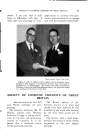
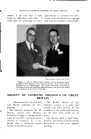
G. ROBERT CLARK, THIRD HONORARY MEMBER By DAN DAHLE, PH.D. Bristol Myers Co., Hillside, N.y. THE ENACTMENT of the Food, Drug& CosmeticAct in 1938 brought up the question of Color Certifica- tion, so I went looking for a man who should know something about colors. Mr. Jablonski, the color expert in the Food & Drug Administration New York Station, told me he could spare a young man who was working as an assistant in his laboratory. That's how I met Bob Clark. As for the statistical data on Bob, he was born in 1910 out where men are men to be more exact, in Colorado. He was exposed to the usual hazards of civilization, such as public school, high school, and finally the University of Colorado. He took them for A.B. and M.A. degrees and they in turn took him for a teaching assistant. Like most college boys, Bob had to make extra money while in school. He worked as a lifeguard and also as a bouncer in a mountain dance hall. In 1937 he joined the F.&D.A. in Denver, and later via Boston came to New York and into coal tar color work. Now, anyone who really works with colors frequently looks like an Indian in war paint. Bob was no exception. In fact his name soon became connected with the biblical story about Joseph. Joseph had a coat of many colors, Bob's work shirt was famous for the same reason. We always said that any time we needed a sample of any certified dye. we could scrape some off Bob's shirt. All in all, it shows that Bob worked hard at it. At the end of the war he was in full charge of the F. & D.A. certified color work and next in line for the job he now holds-- Chief of the Cosmetic Division. He succeeded to that in 1946. In the meantime he had married, built himself a house outside of Washington, and discarded his west- ern boots. But he still had excess energy. So late in 194:5 he went back to school at night. For that the Georgetown University in Wash- ington, D.C., awarded him a Ph.D. degree in 1947. That in a few words is the man we are honoring today. Much more could be said about him but after all, he is well known to all of us. 347

ACCEPTANCE OF HONORARY MEMBERSHIP By G. ROB.RT CI^RK, Ph.D. Chief, Division of Cosme. tics, Food and Drug ztdministration, tf ashington, D.C. MR. PRESIDENT and Mem- bers of the Society, I assure you that I deeply appreciate the privi- lege of accepting this honorary ,membership. As all of you know, the personnel of the Food and Drug Administra- tion are engaged in the enforcement of a law that is intended to pro- tect the consumer. The primary purpose of the enactment of the law was to insure that the pur- chaser of any food, drug, or cos- metic will receive honestly labeled and carefully manufactured prod- ucts, so that he will receive in- jury neither to his person nor to his pocketbook. In those cases in which complete protection is not provided, it is required that the purchaser be warned of the chance he is taking. It would be impossible of course to enforce such a law if it were not the general intent of the food, drug, and cosmetic industries to conduct their operations in such a manner that compliance with the law is assured. As the interested industries and the Food and Drug Administration both. progress toward serving the interest of the consumer, it is the technologists who lead the way. I can think of nothing that can better serve the consumer and the cosmetic industry alike than an organization such as this SOCIETY. This association of scientists, freely exchanging such information as methods of testing cosmetics and reporting results of fundamental investigations carried out in their laboratories, has inspired and will continue to inspire important prog- ress in the application of tech- nology to cosmetic problems. For this reason, I feel especially proud to have been elected as Honorary Member. I have not yet examined this scroll Dr. McDonough has just handed me, so I do not know the exact duties of an Honorary Mem- ber. I assume that a continuing interest in chemistry and other sciences as they pertain to cosmetics is one of the paramount require- 348
Purchased for the exclusive use of nofirst nolast (unknown)
From: SCC Media Library & Resource Center (library.scconline.org)