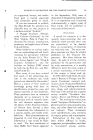
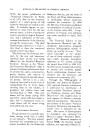
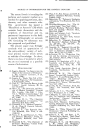
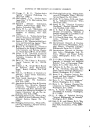
346 (31) JOURNAL OF THE SOCIETY OF COSMETIC CHEMISTS Young, C. B. F., "Surface-Active Agents," Chemical Publishing Co., New York (1946). (32) McCutcheon, J. W., "Surface-Active Agent File," J. W. McCutcheon, New York (1947). (33) Research Advisory Corporation, "Readco Surface-Active Agent File," Readco, Columbus, Ohio (1947). (34) Davis, H. L., ed., "Mechanism and Evaluation of Antiseptics," New York Academy of Sciences, New York (1950). (35) Lawrence, C.A. "Surface-Active Qua- ternary Ammonium Germicides," Aca- demic Press, New York (1950). (36) S. palton, L. M., "Pharmaceutical Emul- sions and Emulsifying Agents," Mor- gan Bros., Ltd., London (1950). (37) Boig, F. S., and Brown, E., "Chemical Periodicals in the Fields of Pharmaceu- tical, Cosmetic, and Perfume Chemis- try, Merck Report, 59 (3), 25-28 (1950). (38) Naves, Y. R., "Chemical Literature Dealing with the Essential Oils," Soap, Perfumery, Cosmetics, 22 (12), 1343- 1344 (1949). (39) Davis, A., "The Library in Research," Special Libraries, 41 (4), 129-132 (1950). (40) Graham, J. H., "Trade Mark Record for Perfumes, Toilet Preparations, Soaps," Beauty Fashions, New York (1947). (41) Vail, G., "A History of Cosmetics in America," Toilet Goods Association, New York (1947). (42) Toilet Goods Association, "Digest of Cosmetic Cases," The Association, New York (1947). (43) Association American Soap & Glycerine Producers, Inc., Glycerine Research Committee, "Translation of Sections on Glycerine and Some Glycerine De- rivatives from Beilstein's Handbook of Organic Chemistry," 4th ed., The As- sociation, New York (1949). (44) Packaging Institute, Inc., "How to Pre- dict Shelf Life from Laboratory Data," Advisory Service Report No. 276 (1949). (45) Packaging Institute Inc., "How to Pre- vent Cap Corrosion," Advisory Service Report No. 271 (1949). (49) ß (50) (46) Packaging Institute Inc., "Filling Toler- ances of Collapsible Tubes," Advisory Service Report No. 295 (1950). (47) Faith, W. L., Keyes, D. B., and Clark, R. L., "Industrial Chemicals," Wiley, New York (1950). (48) Ewell, R. H., "Chemical Economics Handbook," Stanford Research Insti- tute, Stanford, Calif. (1950). U.S. Food & Drug Administration, Division of Cosmetics, "Methods of Analysis Applicable to Certifiable Coal- Tar Colors" (May, 1949). U.S. Food & Drug Adm., Div. of Cos- metics, "Changes and Additions" (April, 1950). (51) Quartermaster Research & Develop- ment Laboratories, Philadelphia, Tech- nical Library, "Container Coatings," Bibliographic Series No. 12 (1950). (52) Quartermaster Research & Develop- ment Labts., Philadelphia Tech. Li- brary, "Pepper and Pepper Substi- tutes," Bibliographic Series No. 11 (1950). (53) U.S. Office of Technical Services, Bib- liography of Scientific and Industrial .Reports," Supt. of Documents, Wash- •ngton, D.C., 1946•date, Vol. 1. (54) Colborne, R. S., Pitt, G., and Sully, B D .... ß ., Synthetic Aromatics, Per- fumes, Isolates and Their. Derivatives," Hobart, Washington, D.C. (1948). (55) Karas, S. A., "German Cosmetic, Per- fumery and Soap Formulae," Hobart, Washington, D.C. (1947). (56) Hoyt, L. F., "Synthetic Detergents," Hobart, Washington, D.C. (1948). (57) Hoyt, L. F., "German Chemical De- velopments in Tylose HBR," Hobart, Washington, D.C. (1945). (58) U. S. Atomic Energy Commission, "Handbook on Aerosols," Washington, D.C. (1950). (59) U.S. Office of Technical Services, "Selected Bibliography on Aerosols," Washington, D.C. (1949). (60) Kirk, R. E., and Othmer, D. F., "En- cyclopedia of Chemical Technology," New York, Interscience, 6 Vols. (1947- 1951).

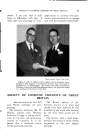
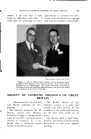
G. ROBERT CLARK, THIRD HONORARY MEMBER By DAN DAHLE, PH.D. Bristol Myers Co., Hillside, N.y. THE ENACTMENT of the Food, Drug& CosmeticAct in 1938 brought up the question of Color Certifica- tion, so I went looking for a man who should know something about colors. Mr. Jablonski, the color expert in the Food & Drug Administration New York Station, told me he could spare a young man who was working as an assistant in his laboratory. That's how I met Bob Clark. As for the statistical data on Bob, he was born in 1910 out where men are men to be more exact, in Colorado. He was exposed to the usual hazards of civilization, such as public school, high school, and finally the University of Colorado. He took them for A.B. and M.A. degrees and they in turn took him for a teaching assistant. Like most college boys, Bob had to make extra money while in school. He worked as a lifeguard and also as a bouncer in a mountain dance hall. In 1937 he joined the F.&D.A. in Denver, and later via Boston came to New York and into coal tar color work. Now, anyone who really works with colors frequently looks like an Indian in war paint. Bob was no exception. In fact his name soon became connected with the biblical story about Joseph. Joseph had a coat of many colors, Bob's work shirt was famous for the same reason. We always said that any time we needed a sample of any certified dye. we could scrape some off Bob's shirt. All in all, it shows that Bob worked hard at it. At the end of the war he was in full charge of the F. & D.A. certified color work and next in line for the job he now holds-- Chief of the Cosmetic Division. He succeeded to that in 1946. In the meantime he had married, built himself a house outside of Washington, and discarded his west- ern boots. But he still had excess energy. So late in 194:5 he went back to school at night. For that the Georgetown University in Wash- ington, D.C., awarded him a Ph.D. degree in 1947. That in a few words is the man we are honoring today. Much more could be said about him but after all, he is well known to all of us. 347
Purchased for the exclusive use of nofirst nolast (unknown)
From: SCC Media Library & Resource Center (library.scconline.org)