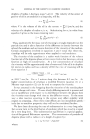
THEORY OF EMULSION STABILITY* By HAROLD L. GREENWALD Rohm & Haas Company, Philadelphia 5, Pa. As EMULSION IS ^ system consisting of one liquid phase dispersed as droplets in another liquid phase. Two types of emulsions are possible with a given pair of incompletely miscible liquids--A dispersed in B and B dispersed in A. Water as one phase and some organic compound, referred to as an oil, as the other phases are by far the most common constituents of emulsions. The present discussion will be confined, principally, to oil-in- water emulsions. I. INTRODUCTION Since most of you are more familiar with the preparation of emulsions than I am only a few comments will be made on this aspect of emulsions. The energy input in the formation of an emulsion is the energy required to form the new interface and is given by: E = ?•zt (l) where q'i is the interfacial tension and At is the area of interface formed. If the spherical droplets formed are all of equal radius, r, and if the dis- continuous phase volume is F this becomes: E - (2) Thus the energy required to form a liter of emulsion containing 10 per cent of the discontinuous phase in droplets 0.1 micron in diameter where the interfacial tension is 1 dyne per centimeter (or erg per square centimeter) is 3 X 10 7 ergs or 0.7 calorie. This value is quite low compared with the energy necessary to heat the emulsion one degree. Our usual concern is with the stability of emulsions. In some applica- tions we wish to have maximum stability and in others, where emulsions are undesirable, minimum stability. A stable emulsion is one which exhibits (1) no sedimentation or creaming of the discontinuous phase, (2) no aggregation or flocculation of the droplets and (3) no coalescence of droplets. Borrowing a term from those studying the structure of liquids * Presented at the September 23, 1954, Seminar, New York City. 164

THEORY OF EMULSION STABILITY 165 this may be rephrased as: A stable emulsion has an unchanging droplet radial distribution function. In emulsions which are not perfectly stable it is quite evident that the rates of creaming, aggregation and coalescence are interdependent. Creaming decreases the average interparticle distance which should then lead to changes in the rates of aggregation and coalescence. Or, coales- cence produces larger particles which will then increase the rate of creaming provided the densities of the two phases are different, etc. In this discussion the factors affecting creaming will be covered first. We will see that the principal determinants in creaming are particle size, the difference in density between the phases and the viscosity of the con- tinuous phase. Then an investigation of the forces between oil droplets will show that there are both forces of attraction and forces of repulsion present and that the interaction between particles depends on the sum of these. The behavior of the emulsion with respect to fiocculation and coalescence will depend on the sum of the corresponding energies. These energies will depend on the charge on the emulsion droplets, the concentra- tion and valence of the ions present, the particle size and what seems like a host of other factors. In a final section specific effects of surface active agents will be discussed and it will be found, alas, that most of the equa- tions and graphs used throughout the discussion cannot be trusted quantita- tively but are in qualitative agreement with observations. II. SEmMENT^T•O•r The sedimentation rate of a single droplet is given by Stokes' Law as: 2gr=(d- d') (3) where: u = rate of fall of droplet g = gravitation constant d = density of oil d' = medium (roughly the emulsion) density . = viscosity of medium (roughly that of the emulsion) r = droplet radius This law is applicable to dilute emulsions although even here there is a small uncertainty in the significance of the term "droplet radius" as will be seen in the subsequent discussion. In the case of concentrated emulsions, including the cream of dilute emulsions, the exact form of the equation will be changed. Nonetheless the qualitative dependence of the sedimentation rate on the variables will probably be maintained. Ordinarily one is interested in the mass rate of creaming or, if you will, the motion of the center of gravity of the oil phase. In the absence of fiocculation and coalescence the system can be described as consisting of n•
Purchased for the exclusive use of nofirst nolast (unknown)
From: SCC Media Library & Resource Center (library.scconline.org)