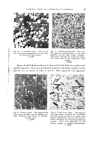
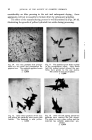
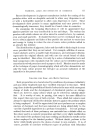
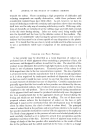
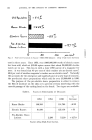
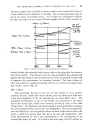
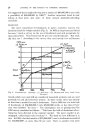
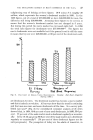
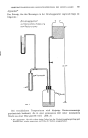
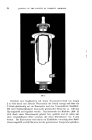
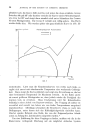
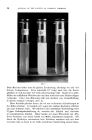
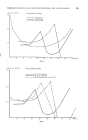
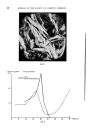
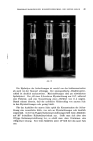
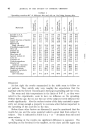
BEHAVIOUR OF COSMETIC CREAMS, LOTIONS AND OILS ON THE SKIN small amounts of chlorophyll were added to the fats and oils. This gave them a pinkish-red fluorescence in the UV-light. The results obtained with the skin microscope and the fluorescent light agreed satisfactohly within the limits of the method. Method: The test-area is washed with toilet soap and thoroughly rinsed with tap water. After the skin is blotted dry, it is not touched for one hour while the subject relaxes in a comfortable chair. For the test on the chest, the upper arm and the forehead, the subject lies motionless on his back on a bed. On the lower arm, the measurements are taken while the subject is sitting in a chair holding the arm horizontal and immobile. The room- and skin temperatures are taken and noted before and during the test. With a blood pipette, 0.003 c.c. of the test material are placed on the skin. The size of the area occupied by the amount of matehal is measured immediately. Then the spreading area is determined in intervals of 5 minutes for the first 15 minutes and then in intervals of 15 minutes up to 90 minutes. Since the spreading is always approximately circular or elliptical, the skin-areas are measured by taking the diameters. From the diameters the areas are calculated. Our definition of "spreading number 90," means the number with which the skin area occupied by the fatty matehal at the start of the test has to be multiplied to find the area which is covered by the same amount of fat after 90 minutes. In other words, the "spreading number 90" tells how many times the fat or oil dot has increased its original size after 90 minutes' contact with the skin. E.g. If the area at the start of the experiment is 0.15 cm. • and after 90 minutes it is 3.00 cm. • then the "spreading number 90" is gO. Table I lists the mean values of all the "spreading numbers 90" of the different fat and oil materials obtained from the different tested subjects that are summarised. The fat and oil matehals are grouped in the table according to decreasing viscosity. In all tests the room temperature was between 2•1 ø C. and 30 ø C., but never fluctuated more than 3 degrees during any one test. The skin temperature ranged between 31 ø C. and 36 ø C. The maximum deviation during any one test was 2.5 ø C. The skin temperature on the forehead, in almost all the cases, was 2-3 ø C. higher than on the other skin areas. The "spreading number 90" does not show the actual size of the area the fat materials covered on the skin surface. Therefore the smallest and the largest areas of all the tests in square centimetres at the start and at the end are given below. The smallest starting area was 0.06 cm. •, the largest starting area 0-82 cm. •. The smallest area at the end of 90 minutes was 0.06 cm. 2 and the largest area at the end of 90 minutes was 1840 cm. 2.

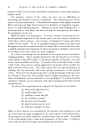
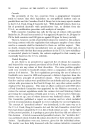
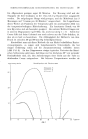
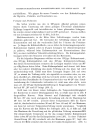
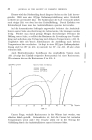
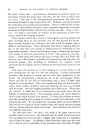
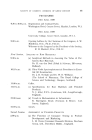
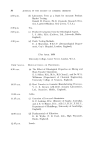
46 JOURNAL OF THE SOCIETY OF COSMETIC CHEMISTS TABLE I "Spreading numbers 90" of different fats and oils on the living human skin. Materials • • m• • m• • • Lanolin U.S.P. 2.9 1.4 5.5 4.0 3.2 0.4 1'8 0.6 Vaseline U.S.P. 1-9 0.3 1.1 1.1 2.1 0.4 3.0 0.5 Lard 4.1 1.9 19.3 3.5 18'6 10.3 2'3 0.2 Liquid fraction of lanolin 2.2 0.4 8-6 6-2 5'2 0.2 6'4 0.1 Castor oil 2-1 1.2 7.1 3.3 12'6 1'9 13'3 0.4 Mineral oil (high viscosity) 4.9 2.2 12.9 8.3 14.8 0-2 45-0 0.6 Polyethyleneglycol 400 3-6 1.5 2.7 0.6 3.0 0.3 8-7 0.4 Olive oil 4.4 2.1 8.6 1.1 10-4 2.1 18.3 0.8 Peanut oil 4'3 2.3 28.3 7.4 9'2 1.0 45.0 0.2 Sesame oil 4'6 3-1 16.9 0.6 18'4 4.1 30.2 0.8 Rice bran oil 2'3 0.9 22.4 3.4 13-8 0.5 25'6 0.8 Apricot kernel oil 2.4 1.2 16.2 2.0 9.2 0.3 21.0 0.9 Corn oil 4.2 3.6 15-4 8.0 16.3 5.3 5.4 0.1 Coconut oil 4.1 2.0 21.0 18.0 8.3 0.3 21'0 0.7 Perhydrosqualene 4.5 1.9 21 '6 11.1 11-7 0.2 27.0 1.0 Mineral oil (medium viscosity) 3.5 1.4 5'3 2.7 9.0 0.9 38'2 2.0 Sperm oil (refined) 6.7 3.7 9.3 0-3 17.1 7.2 48.5 4.0 Butyl myristate 4-2 3.1 39.7 3.7 30.0 0.1 77.0 3.0 Isopropyl myristate 2.1 0.4 27.9 7' 1 35-5 4-5 43.0 2-0 Mineral oil (low viscosity) 2'7 0.4 21.0 0.0 40.3 7.0 35.7 1.0 Discussion At first sight the results summarised in the table seem to follow no set pattern. They satisfy only very roughly the expectation that the material with the lowest viscosity gives the largest spreading and vice versa. The room and skin temperatures in the limits of 5-6 ø C., as they were noted in the experiments, seem to have no influence on the spreading. Neither did the age, the sex nor the race of the subjects tested influence the results significantly. Also the surface tension of the fatty material is appar- ently not strong enough a property to overcome other factors important in the spreading of fats and oils on the skin. Before those other factors are discussed it must be mentioned that the results for one and the same material varied a great deal from subject to subject. This is indicated in Table I as a + or -- deviation from the noted mean values. By looking at the results one significant difference is apparent. The spreading on the forehead is the smallest, on the chest and the upper arm
Purchased for the exclusive use of nofirst nolast (unknown)
From: SCC Media Library & Resource Center (library.scconline.org)