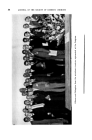
SOCIETY OF COSMETIC CHEMISTS 59 After a short sojourn in Rome, the party, which now included Dr. R. H. Marriott, President of the British Society, who had joined in Rome, went to Milan, where it was greeted by Dr. P. Rovesti, one of the internationally known cosmetic chemists, who had arranged a Symposium which he called the "Italian-American Symposium on Cosmetic Science". Tuesday was spent in seeing some of the sights of Milan and attending a reception given by the Mayor of Milan at the Villa Commale. At this reception the party was joined by the Members of the Italian Society. In the evening a banquet was held. On Wednesday the Conference took place and the following papers were presented. .Yew Derivatives of Hydrogenaled Lanolin, by Dr. S. Rivera. The Use in Cosmetics of a New Amino Acid Synthesised from Furfuryl and GJycine. This work was sponsored by Professor B. Ciocca and Dr. P. Rovesfl. The work was carried out and the paper read by Signor G. Roccheggiani. Experiments on the Use of New Synthetic Hormones in Cosmetics, bv Dr. V. Facchini. The Acfion on the Skin of Phyto-hormoni:ed Fruit Juices, by Dr. A. Massera. The Production of Masculine Type Perfumes, by Dr. Rovesti. 5few Observations on the Action of Anti-Mycotics in Cosmetics, by Dr. A. Cocchini. All these papers were most interesting and it will be seen that the work of the Italian cosmetic chemists is on similar lines to that in America and in England. It is to be noted that the modification of natural materials, as for example lanolin, in order to give properties which will enable them to be used more effectively in cosmetics is appreciated, whilst the modification of amino acids to produce new substances which can be of dermatological value is also being carefully watched. As regards hormones, here again there is evidence that the chemical modification of steroids in order to limit the general systemic action of the natural substances is being experimented with. It is, however, interesting to note that the use of fruit juices in cosmetics, which had a vogue some 30 years ago, is now being resuscitated in Italy. It must be emphasised, however, that the notion is much more modern

{30 JOURNAL OF THE SOCIETY OF COSMETIC CHEMISTS than in the past, inasmuch as the fruit juices are being specially prepared and the vitamin content assdyed so that some form of standardisation is being achieved. In the instance of perfumery, Dr. Rovesti made the very good point that the compounding of perfumes which appealed to the male are significantly different from those which are liked by the other sex. It must also be remembered that the acceptance of perfumes, certainly amongst males, varies from country to country, although there are certain odour notes which seemed to have a more general acceptance amongst the male popula- tion throughout the world than others. Altogether it can well be said that the Symposium, though short, was well worth hearing. The party then moved on to Bonn in order to take part in the Inter- national Congress organised by the recently formed German Society of Cosmetic Chemists. The programme for this meeting was an extensive one and the organisa- tion of the two-day Congress by Dr. Masch and his colleagues is to be commended. Although most of the papers were given in German, they were simul- taneously broadcast in English and vice versa. Altogether 24 papers were read. If one were to criticise the Congress, one would say that, because the lectures were delivered in full, the time taken up prevented subsequent discussion. It must, however, be pointed out that unless the papers are short, the only alternative is to have them preprinted, and to allow the author to talk only for a limited tirae. Before the Congress opened, however, there was a discussion between representatives from America, Great Britain, Germany, France, Italy, Scandinavia, Switzerland and Spain, to try to find a common ground which would lead on to some form of close international association or, perhaps, federation so that the scientists engaged in the industry would be fully recognised in all countries where cosmetics are made. It should be mentioned that a document furnished by the American Society proved to be an excellent setting out of the objects and aims of scientists engaged in the cosmetic industry and this document was agreed by all attending the discussion. It remained, therefore, to try to get a standard of membership which would be agreeable to all countries so that the academic standing of all the societies would be, as far as possible, equal, quite irrespective of the members in the
Purchased for the exclusive use of nofirst nolast (unknown)
From: SCC Media Library & Resource Center (library.scconline.org)