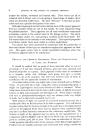
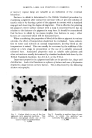
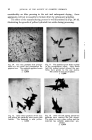
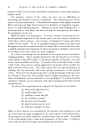
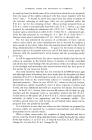
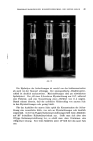
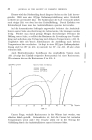
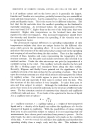
PIGMENTS, LAKES AND DYESTUFFS IN COSMETICS 7 or mercury vapour lamp are valuable as an indication of tile eventual behaviour. Fastness to alkali is determined in the British Standard procedure by examining a pigment after contact for one hour with a 1 per cent solution of caustic soda or by leaving a print of the pigment in contact with a standard soap gel and observing the degree of migration. This is effective for printing ink purposes where surface coiltact with a soap is concerned but it has no relation to the fastness of a pigment in soap base. It should be remembered that fastness to alkali by no means implies true fastness in soap other factors are concerned which will be discussed later. When considering the properties of bleed of the lake or pigment to various solvents, the effect of temperature should not be overlooked. Some colours, fast to water and solvents at normal temperatures, develop bleed as the temperature is raised. This can usually be overcome by the addition of the colour at a late stage in preparation or the use of a suitably processed coloured base. Associated properties such as soluble salts present and ether extracts are usually determined by standard methods laid down by the British Standards Institute, the A.O.A.C. or the F.D.A. Important properties in a pigment and lake are its particle size, shape and distribution. Such vital functions as softness of texture and ease of dispersion depend to a large extent on these factors. This is illustrated by the following electron micrographs. Fig. 1. Carbon black is one of the fe•v pigments -•'ith spherical particles. This electron micrograph shows one of the coarser types of carbon black. X 1 i,000 Fig. 2. Graphite is another form of pure carbon, in •vhich the particles are extremely thin plates or sheets. X 11,ooo

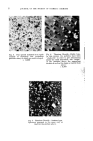
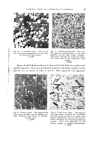
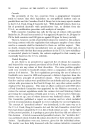
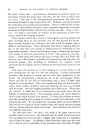
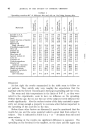
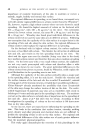
8 JOURNAL OF THE SOCIETY OF COSMETIC CHEMISTS Fig. 3. This special hydrated iron oxide consists of extremely fine crystalline particles many of which are needle-shaped. X 11,000 Fig. 4. Titanium Dioxide--Rutile type. In this picture the particles have been "shadowed" in order to give information about the third dimension--the "height" of the particles above the supporting surface as well as the shape as viewed from ' above. X 5,5130 Fig. 5. Titanium Dioxide--Anatase type. Specimen prepared in the same way as that for the picture above.
Purchased for the exclusive use of nofirst nolast (unknown)
From: SCC Media Library & Resource Center (library.scconline.org)