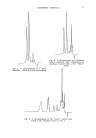
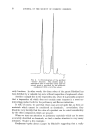
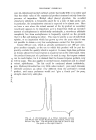
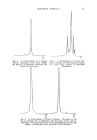
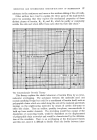
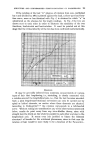
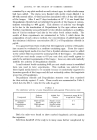
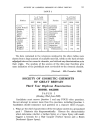
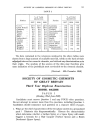
12 JOURNAL OF THE SOCIETY OF COSMETIC CHEMISTS PHENYL PROPANOL Fig. 8 indicates chromatograms of two grades of Phenyl Propanol. The figure on the left shows practically no traces of impurities, but this particular product is soft, flat and rather uninteresting. The figure on the right, where traces of impurities are shown, possesses a strong sweet top note. This then is the problem which has existed for so long between per- fumers and the manufacturers of perfumery chemicals. We have seen how modern equipment has made it possible to appreciate more clearly the make-up of the materials we use. In fact, our problem appears to resolve itself into a distinction between unwanted impurities on the one hand and desirable or at any rate harmless subsidiary constituents on the other. PASSING ON THE CORRECT INFORMATION Now we come to the manner in which the perfumer can best assist his supplier to produce the exact type of material which he, the perfumer, requires. This is very much the perfumer's domain and I shall therefore tread warily. The perfumer's simplest approach will be via the smelling slip. Let us say his immediate problem is to improve the quality of a given perfumery chemical. A simple but careful examination of the slip produce information of great use to the manufacturer. If the unpleasant odour is strong at first and then fades on standing to produce a substance of acceptable odour, this info•xnation means a lot to the distillation expert. If you can indicate whether the unwanted odour lasted for minutes or hours, then the manufacturer is even better armed to deal with the problem. On the other hand, if a product is acceptable at first but loses odour and becomes flat and uninteresting on standing, this information may well be an impor- tant clue to the producer. Finally, what of the residual odour ? Tell your supplier whether this is to your satisfaction. If full details of odour per- formance are not given, you may find your next sample lacks your valuable top notes, but still retains the unpleasant residual odour. The next request from supplier to perfumer is more difficult. Can you describe wanted and unwanted odours ? Even a general description may be of value: sharp, sweet, crude, flat, burnt. For the better equipped perfumer, there are other aids to odour evaluation. Vacuum fractionation, employing modern laboratory column fillings, is an important weapon in the perfumer's armoury. Efficient stills may be constructed and relatively sharp separations of the various components of a perfumery chemical achieved. Examination of the various fractions should tell just which part or parts you require for your particular purpose. One point on the question of these stills: always use a form of reflux control, preferably electronic, as without this even a highly efficient column is almost useless. There is, of course, gas chromatography, which as you have seen is

AMPHOLYTIC SURFACE ACTIVE AGENTS 13 capable of giving an enormous amount of information even when the exact natures of the components are unknown. Chromatograms of the type of product which you like and those you do not like may indicate a trend which will enable you to obtain your ideal material. CONCLUSION The perfumer naturally wants the raw material which will give him maximum results and he wants the material to be identical with each delivery. He, the perfumer, can do a lot to help the supplier to bring about this highly desirable state of affairs. Finally, can I just say that the number of times when you find you really need a pure compound will be relatively small. That master perfumer--nature--never offers a pure chemical to us, she always shades it off with blending agents. [Received: 25th August 19591 REFERENCES Krajkeman, A. J. J. Soc. Cosmetic Chem., 7 (1956) 38. Mitchell, W. Perfumery oessent. Oil Record, 21 (1950) 41. AMPHOLYTIC SURFACE ACTIVE AGENTS C. D. MOORE, F.R.I.C.* Based on a lecture delivered before the Society on 16th March 1959. The general characteristics of surtace active ampholytes are discussed with particuhr reference to their similarities and dissimilarities to the better- known types ot the surface active agents. A re-classification ot the long chain betaines is proposed, and the reasons tot this suggested change are given. AMPHOLYTIC SURFACE active agents have been known for a considerable time, but they have remained little more than chemical curiosities until very recently, owing to the difficulty of procuring suitable intermediates for their manufacture. The situation has changed radically over the last few years, due principally to the pioneering work on Fat and Petroleum Chemicals, carried out mostly in the U.S.A. At the time of writing, however, it would be fair to say that owing to the still comparative novelty of the Ampholytics, little is yet known regarding their practical application. * Glovers (Chemicals) Ltd., Leeds, Yorks.
Purchased for the exclusive use of nofirst nolast (unknown)
From: SCC Media Library & Resource Center (library.scconline.org)