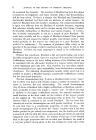
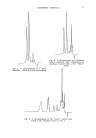
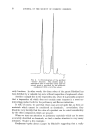
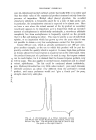
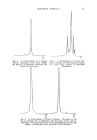
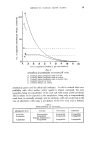
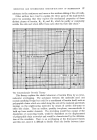
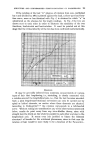
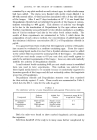
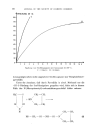
STRUCTURE AND SYNCHRONIZED STRETCH-ROTATION OF HAIRKERATIN 29 • If the rotation of the hair "n" (degrees of rotation from zero, multiplied by •r and divided by I8(}) is plotted against the load, a three-part load-rota• tion curve, more or less identical with Fig. 1, is obtained in which "n" is substituted on the abscissa for the length readings. In Fig. $ the two are drawn next to each other in order to illustrate the similarity of the twc• functions, load-stretch and load-rotation. It must be pointed out at this stage that the virtual identity of the two has been confirmed mathematically.. RESULTS It may be generally inferred from numerous measurements of various types of hair that lengthening, i.e., stretching, is closely connected with a rotation around the longitudinal axis, i.e., that the hair becomes uncoiled. Such a joint lengthways-rotational movement can only be carried out by spiral or helical elements, no matter where these elements are situated. According to Heiling6tter n,• the rotation corresponds to a left-handed screw. Without taking into consideration any of the observations mentioned below, results do point away from any inter-fibrillar theory, since with straight hair the fibrils on the whole lie parallel to each other and also to the longitudinal axis. It seems even less justified to blame the bilateral structure •a of keratin for the rotational phenomena, since in that case the rotation of hair would be more likely to be a function of the Paracortex-

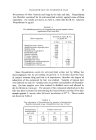
30 JOURNAL OF THE SOCIETY OF COSMETIC CHEMISTS Orthocortex turning, which causes curling of hair, than a function of stretch- ing. In reahty the rotation was observed even in completely uncurled, sleek hair. It was always a function of the stretching, which has presumably very little connection with natural hair torsion. If the cellular structure of hair may be assumed as being orientated in a semi-parallel manner and if the desired spiral element is not to be found in histological structure visible under the microscope, then the unwinding of these spirals must cause a coiling of the superimposed parallel cords structure. In fact, one can see with the naked eye that hair will curl in a corkscrew manner if it is allowed sufficient freedom of movement during stretching. This is the case in the experi- ment described above, where the silk thread offered almost no resistance to the rotation of the hair. The small rotation of the silk thread due to the twist of its strands can easily be determined in the same way and deducted from, or added to, the result. Many results obtained from load-stretch measurements can also be used as approximate measurements of rotation. Are there any cases in which there is a discrepancy between the two processes? One .immediately thinks that the a-/•-keratin transition is not primarily connected with the triple stage load-stretch curve, as has been proved by X-ray examinations of horse hair. For this reason it would be useful to treat hair with reagents which have a specific action upon it and then to subject the hair to load-stretch rotation measurements. It has already been stated elsewhere TM that in order to make the two measurements differ from each other, even after the hair has been dried, it is necessary to treat the hair for a quarter of an hour with ammoniacal thioglycollate solution. The separation of cystine- and salt-bonds appears on the load-stretch graph as an increase of the middle section, but the load-rotation curve does not follow this pattern. In that graph, the rotation throughout the entire process is constant at about 2•r/5 g weight increase and there is no increase in the rotation anywhere to indicate a middle section. An equivalent treat- ment with ammonia, without an added reducing agent, causes no substantial change in the curves and therefore one is justified in concluding that the breaking-up of the cystine bridges removes the synchronization of longi- tudinal and rotational movements. The unwinding of the spiral units must therefore be related to cystine, at least in the non-elastic region of stretching. If this supposition is correct, then other reactions must also influence the relation of stretch to rotation, if cystine is involved in any way. To test this, the influence of hot sodium bisulphite was examined. Unfortunately, the fully contracted hair was weakened to such an extent that it was unsuit- able for further experiments. For this reason, the time of treatment with 5 per cent sodium bisulphite solution was reduced to 10 minutes at a temper- ature just below boiling point. This caused a reduction of stretchability from 54 per cent to 13 per cent (measured after drying). Only one strand of
Purchased for the exclusive use of nofirst nolast (unknown)
From: SCC Media Library & Resource Center (library.scconline.org)