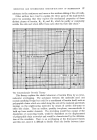
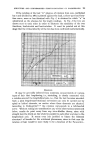
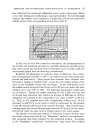
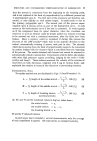
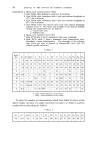
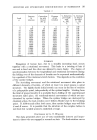
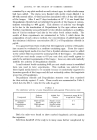
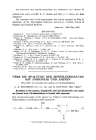
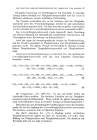
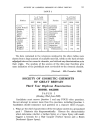
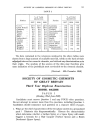
STRUCTURE AND SYNCHRONIZED STRETCH-ROTATION OF HAIRKERATIN 35 TABLE 2 Degrees Correction Degrees % Rotation % Increase Load of for silk of net per length in length g rotation thread rotation unit per unit (0.1 g) n. lOO 1.10o lo lo 0 0 0 0 0 100 5 350 35 315 11 102 10 1130 265 865 30 103 15 1760 285 1475 52 104 20 2190 295 1895 66 105 25 2820 305 2515 88 106 30 3610 315 3295 115 108 35 4630 325 4305 141 109 40 6070 335 5735 201 113 45 7510 345 7165 251 117.5 50 8590 355 8235 291 126 55 9660 365 9295 325 134.5 60 10380 375 10005 350 140 65 11080 385 10695 374 144.5 70 11530 395 11135 389 148 75 (11860) (405) (11455) (401) (lSl) (exp.) SUMMARY Elongation of human hair, due to a steadily increasing load, occurs together with a rotational movement. This leads to a twisting of hair if one end is fixed and the other one allowed to move freely. The degree of synchronization between the longitudinal and rotational movements during the folding over of the elements of keratin can be expressed mathematically by a quotient of the rotational stretch factors. This depends on the condition of the cystine bridges. The stretching movement and the rotational movement take place in different elements of keratin, of which at least two must possess a spiral structure. The highly elastic initial stretch can occur in the line of rotation of a polypeptide spiral, independently of the cystine lengths. Starting from the limit of proportionality it is probable that a folding of the superimposed structures takes place, the rotational-stretch movements of which are syn- chronized by cystine bridges. When the cystine bridges are destroyed by chemical action, the load-rotation curve follows Hooke's law to the breaking point. If AB6-strands affect both cases, then cystine bridges may well ]ink A and B screws. It is possible that the structure of the complex helixes is not fixed but variable around a statistical average. DISCUSSION BY G. T. WALKER The data presented above are of very considerable interest and impor- tance to those who are engaged in research on hair. The load-rotation curves

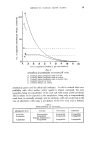
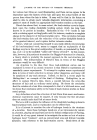
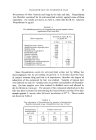
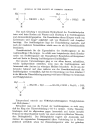
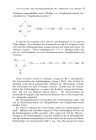
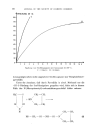
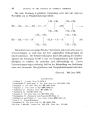
JOURNAL OF THE SOCIETY OF COSMETIC CHEMISTS for various hair fibres are most illuminating, and these curves appear to be ,dependent upon the history of the hair and upon the actual health of the person from whom the hair is taken. It may well be that in the future we ,shall be able to obtain much valuable diagnostic information concerning a patient's state of health by appropriate load-rotation studies on the hair. Hirsch has shown that, to some extent, the load-rotation curve is depen- dent upon the cystine disulphide bonding system which has long been known to be present in keratins. Reduction of the -S-S- bonds in hair with a reducing agent as thioglycollic acid, for instance, results in a complete change in the character of the load-rotation curve. This correlation between the load-rotation data and the reduction of the cystine disulphide bonds is of the greatest interest, and requires further intensive studies. Hirsch, while not committing himself to any really definite interpretation .of his load-rotational work, seems to suggest that an explanation of his findings may lie in the spiral configuration of keratin, as postulated by Paul- ing, et al. 7, or in the modified "coiled coil" theory of Crick •'. In this connec- tion, however, it is pertinent to mention the Huggins •a structure for a-keratin, a theory which is probably the nearest approach to the real structure yet proposed. The interpretation of Hirsch's data in terms of the Huggins structure would be very difficult. An objection to the idea that these load-rotational curves can be explained in terms of an atomic structure is that Hirsch's experiments are essentially macro experiments. To attempt to explain macro experimental data in terms of micro structure is always rather dangerous, and many will be suspicious of any such attempt. Indeed, we find in a recent paper by Heiling6tter n an example of this kind of thinking. Heiling6tter, in an .effort to explain Hirsch's data, draws a parallel between the screw-like structure of hair and an ordinary metal spring. He draws the conclusion that the rotation of a hair fibre corresponds to that of a left-hand screw, and he draws that conclusion solely on the basis o[ load-rotation studies on these metal springs. Any deductions about fine structure of hair fibres from macro mechanico- chemical experiments must be suspect, if only because the fine strr, cture does not usually make itself felt at macro levels. We have still to explain the influence of the disulphide bonding system in load-rotational work, and no explanation can be offered here. It is of interest to mention the role of hydrogen bonds in the ,•tructure .of a-keratins. Since these hydrogen bonds are o[ an intramolecu!ar nature in a-keratin, playing an important part in the helical configuration of Pauling, it would be of very great interest to investigate the action on hair of active hydrogen bond "breakers", such as concentrated urea and lithium bromide solutions, with reference to the load-rotation curves. Break-down of the
Purchased for the exclusive use of nofirst nolast (unknown)
From: SCC Media Library & Resource Center (library.scconline.org)