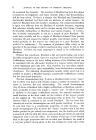
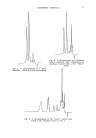
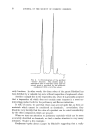
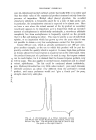
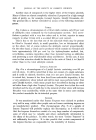
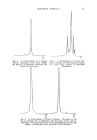
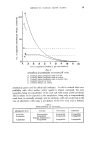
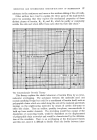
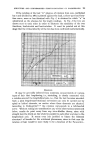
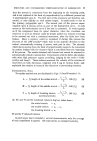
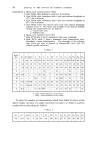
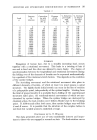
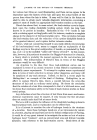
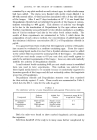
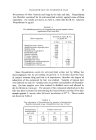
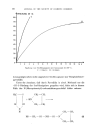
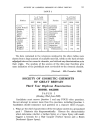
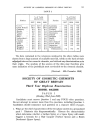
AMPHOLYTIC SURFACE ACTlYE AGENTS 19 pH of ampholyte solution (1 pe.r cent solution) Adsorption of ampholytes at various pH value. A. Dodecyl amino propionic acid on wool. B. Dodecyl amino propionic acid on cotton. C. Dodecyl amino propionic acid on human hair. D. Dodecyl betaine on wool. E. Dodecyl betaine on cotton. (isoelectric point) and the alkali salt (sodium). It will be noticed that com- patibility with other surface active agents is almost universal, the only exception being incompatibility of the acid salt with anion active products. This is rather to be expected as the ampholyte, being only a comparatively weak base, is naturally strongly acid in solutions, with the result that in the case of admixture with soap, a precipitate of the free soap acid is formed. Table 1 COMPATIBILITY IN SOLUTION Alkylamino Acid Anionics Non-Ionics Cationics Acid Salt Incompatible Compatible Compatible Zwitterion Compatible Compatible Compatible (Except Sulphonates) Alkali Salt Compatible Compatible Compatible

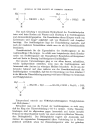
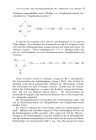
2{} JOURNAL OF THE SOCIETY OF COSMETIC CHEMISTS In the case of admixture with alkyl aryl sulphonates, the free sulphonic acid is formed and the sulphonic acid salt of the alkyl amino acid is not sufficiently ionized to be soluble. The results shown in Table 1 were derived from trials carried out with stoichiometric quantities to obviate errors due to resolubilization, which is observed when either reagent is in excess, an error from which most solubility charts suffer. The reasons for compatibility of the alkaline or zwitterionic forms with cationics is simply due to the fact that the aminopropionic acids do not form insoluble salts with the quaternary cation, and are, therefore, not removed from the sphere of action. They do not modify or inactivate cationics in the process of admixture with them, except by micellular incorporation. This point is most important, and proof was obtained by preparation of hexadecyl trimethylammonium /g N dodecylaminopropionate. This product, not- withstanding its very high molecular weight, was found to be soluble in water, but had quite different surface properties from a mixture of hexadecyl trimethylammonium bromide and dodecyl amino propionate, and unlike the mixture it was bacteriologically inactive, which suggested that its adsorption properties were entirely different. Tests on textile materials actually showed considerable adsorption of quaternary ammonium com- pounds in the presence of the ampholyte in its anionic form. This in itself is a proof that the cationic properties of the quaternary ammonium com- pounds are not being altered or modified, although it should be recognized that in the presence of a very large amount of an alkyl amino acid adsorption can be suppressed, but this is due to the commonly occurring phenomenon of micellular incorporation. Compatibility with the various commonly occurring ions such as calcium, magnesium, copper, barium, aluminium, zinc and chromium is dependent on the pH of the solution. The alkali salts of the amino acids show naturally high pH's and consequently heavy metals come down as hydroxides in their presence, while at the neutral point or in acid solution few metals form precipitates. Indeed, it is difficult to find a salt which is precipitated any- thing like quantitatively, a matter of great value in practice, but a consider- able nuisance in analysis. The tendency to precipitate with salts increases with increasing chain length in the ampholytes, as with any other series of surface active agent. THE LoNG CHAIN BETAINES This type of surface active agent appears to have been almost universally accepted as a typical ampholyte. We have recently felt that the betaine-like surface active agents must be reclassified, as they are increasingly unacceptable either in theory or on
Purchased for the exclusive use of nofirst nolast (unknown)
From: SCC Media Library & Resource Center (library.scconline.org)