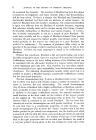
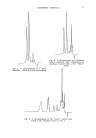
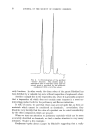
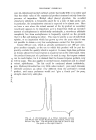
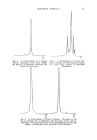
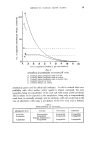
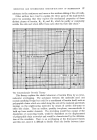
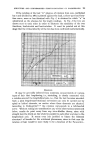
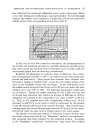
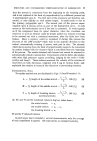
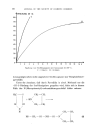
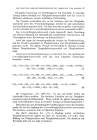
STRUCTURE AND SYNCHRONIZED STRETCH-ROTATION OF HAIRKERATIN 31 hair withstood the treatment sufficiently well to yield a three-part stretch curve, after drying and conditioning to constant humidity. Even in this single instance the rotation curve remained a straight line and did not possess the middle section of the corresponding stretch curve (Fig. 4). In this case, as with hair reduced by mercaptan, the synchronization of the stretch and rotational movement is partially destroyed, and this proves that with treated hair the load-stretch behaviour can be normal, while the load-rotation graph loses its three-step consideration. Reduction of boiling time to 5 minutes made no difference, but a reduc- tion of temperature from 97 ø C to 67 ø C was sufficient to give the normal load- stretch and load-curves. These graphs thus resemble those obtained after 10 minutes' boiling in distilled water, except that the middle section of the curve of the bisulphite-treated hair was longer. In the load-stretch curve the middle section increased from 18 per cent to 22 per cent, and in the load- rotation curve from 720 ø to 780 ø . The following quantitative results may be of interest: During the initial stretching of hair EH34, the free end of 50 mm long untreated hair rotated an average of 568ø/mm or 72.5ø/g. Altogether the rotation to the extrapolated tear point is 6,410 ø at 87-5 g, i.e., 72ø/g, or 17} complete turns with a lengthening of 60 per cent. It was necessary to add 5.5ø/g to the result, in order to compensate for the rotation of the silk thread which turned in the opposite direction. Hair treated with a reducing agent also turned through approximately 70ø/g up to its tear point, but did not reach the same total of rotation since it tore much sooner. The identity of stretch and rotation or behaviour becomes obvious when the stretch values arrived at by the "Bonitation" method • are mathematic- ally compared with those obtained by the rotational method. According to the "Bonitation" method the "stretch-factor" (hair index) Hi is defined

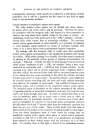
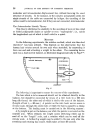
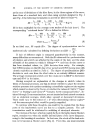
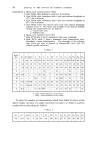
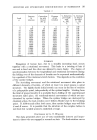
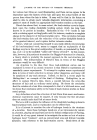
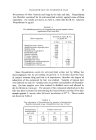
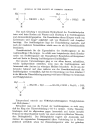
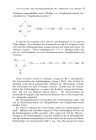
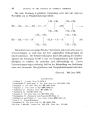
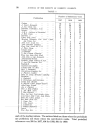
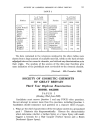
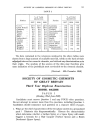
32 JOURNAL OF THE SOCIETY OF COSMETIC CHEMISTS as the sum of deviations of the fibre flaws, in the three regions of the curve, from those of a standard hair, and when using s•vmbols designed in Fig. 1 and Fig $ the following formulation is arrived at (derived from', •*): 1,. 100 Is. 122 la. 184 Hi-- lo. P---•- + lo. P•' + lo. Pa 6 (g-•) (1) Hi is then multiplied by the average cross section of the hair (mm2). The corresponding "rotational factor" Hir is defined as follows n•. 100 n2. 122 n•. 184 Hir -- + + 6 (2) lo. P, lo. P• lo. P• (1'1, 2, 3 ß '•T where n •,•,a -- 180 (3) In an ideal case, Hi equals Hir. The degree of synchronization can be Hir mathematically calculated by defining deviations as QHir -- Hi If hair of different origin is compared quantitatively in this manner, many difficulties are encountered. Both the Hi values and the ,'ynchronization of rotation and stretch are affected by the origin of the hair, and the state of health of the person to which it belongs '6 17 •, and they deviate more or less from standard values, i.e., QHir deviates from unity. For example, hair EH34 (woman on the fifth day of her period) and EF18 (young man with chronic nephritis) as cited in Table 1. The degree of synchronization QHir deviates in each case from the ideal value in an entirely different manner. The average rotation/mm stretch over the whole curve is 304.5 ø in the former case and 87.4 ø in the latter. • Having accepted an explanation of the changes in stretch values in terms of chemical processes, one has to decide whether to place the stretch- rotation processes into cystine-containing extracellular regions or into regions which cannot be observed by X-ray, or whether the values of Crick's •9 "Super Screw" or Pauling's and Corey's TM "Complex Screw (compound helix)", ob- tained through X-ray examinations, are not treated as fixed natural constants but as statistical averages, which allow upward or downward deviations. These could vary to the extent of i 2 ø when determining valency angles • and the macroscopical effect would be greatly magnified. To continue with these thoughts, one could try to explain that the three parts of the load-stretch curve are due to a complex process. The (,-/9- isomerization could be attributed to unfolding of structural elements. The rotation of the hair, which is roughly 2rr/5 g in the highly elastic Hooke's region, remains even when the middle and end parts of the curve disappear, owing to the breaking of crosslinks. In that case, the whole of the load-rota- tion curve becomes a Hooke's curve (Fig. $). From this, one must conclude
Purchased for the exclusive use of nofirst nolast (unknown)
From: SCC Media Library & Resource Center (library.scconline.org)