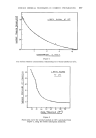
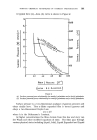
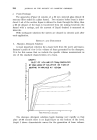
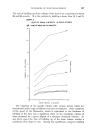
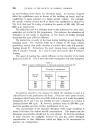
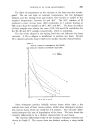
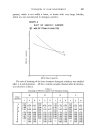
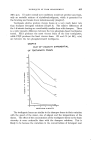
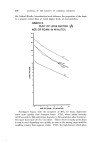
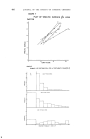
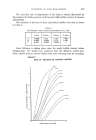
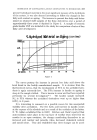
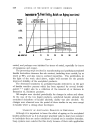
382 JOURNAL OF THE SOCIETY OF COSMETIC CHEMISTS Condensed. Well-defined melting points and phase transitions from one form to another can readily be detected from the force-area curves (Figure 4). Very often surface pressure measurements are made in conjunction with surface potential measurements described above. What use has this type of measurement for the cosmetic chemist ? Many emulsion systems depend on the structure of the primary emulsifying layer it should thus be possible to learn something about the physico- chemical properties and structures of emulsifying agents by spreading them at the Air/Water interface. The results at this interface are easier to interpret than those derived from adsorption measurements at the Oil/Water interface or Air/Water interface. The author has used this technique for simplified detergency studies where the soil is spread at the interface and the detergent injected under the surface. The detergency is studied by examining the changes in surface pressure and potential with time. Where this type of work is carried out, it is necessary to remove con- stantly the material diffusing into the surface behind the barrier by sweeping it clean. Unless this is done, low surface pressure readings will be obtained. Matalon and Schulman TM overcame this difficulty by hanging a Wilhelmy plate behind the barrier. The plate was of such dimension that the pull on the plate was equal to the push on the free side of the barrier. The effect of molecules diffusing into the surface behind the barrier was therefore compensated by the pull on the plate. INSOLUBLE AND ADSORBED FILMS Surface Viscosities The mechanical properties of a surface film often parallel the stability of a foam or emulsion. If the film is too rigid, the system will be unable to resist mechanical or thermal shock. If it is too fluid, rapid drainage of a foam or coalescence of an emulsion will take place. Surface viscosities may be measured by timing the damping of a needle or disc placed in the surface. The effect of an adsorbed or insoluble film on the damping may thus be measured. Alexander and Cumper • studied the surface viscosity of proteins which had been spread or adsorbed at the Air/Water and Oil/Water interface using an oscillating needle technique. The results indicated that the adsorption took place in two stages, (1) unrolling of the peptide chain and (2) coagulation. Blakey and Lawrence •a examined the surface viscosities of soaps and demonstrated the influence of surface viscosity on emulsion stability.

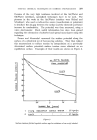
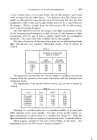
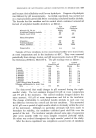
SURFACE CHEMICAL TECHNIQUES IN COSMETIC PREPARATIONS 383 More recently Davies et al have introduced two new (viscous-traction) surface viscometers. One •a is suitable for the Air/Water interface and the other •* for the Oil/Water interface. The method involves measurement of the speed of rotation of talc particles placed in a narrow circular channel placed at the interface. Any viscosity developing at the surface retards the motion of the talc particles. Davies and Mayers •* showed that the mixed film of adsorbed sodium lauryl sulphate and cetyl alcohol, which is well known as an efficient oil in water emulsifying system, becomes extremely viscous in the concentration regions where its emulsifying power is evident. All the different rheological types known in three-dimensional systems can be shown in two dimensions. Surface Rigidities When the surface film condenses, it becomes solid and it is impossible to measure surface viscosities. Monquin and Rideal •ø and more recently Cumper and Alexander" measured the rigidity of a film by rotating a disc just beneath the interface. The displacement of a talc particle was then measured for a given speed of rotation and distance of the disc beneath the surface. It is thus possible to obtain some idea of the rigidity and elasticity of the film. The method can be used for both Oil/Water and Air/Water interfaces. Contact Angles and Spreading Useful information can often be obtained by measuring the rate of spreading, area of spreading and the contact angle of a liquid on a solid or a liquid on a liquid. Obviously, where good contact is wanted, the angle should be low and spreading easy. It should be pointed out that contact angles are not the easiest of things to measure. THE OIL/WATER INTERFACE Many of the methods described above for the Air/Water interface may be adapted to the Oil/Water interface. The Langmuir trough is difficult to use for this interface but the "hanging plate" or "pull on the ring" may be used. The properties of insoluble protein films have been studied in this way •8. Davies •9 has measured interfacial potentials using a vibrating disc. This method is easier to use at the Oil/Water interface than the one involving a radio-active electrode. It has been used to study protein/detergent interactions.
Purchased for the exclusive use of nofirst nolast (unknown)
From: SCC Media Library & Resource Center (library.scconline.org)