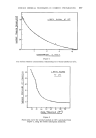
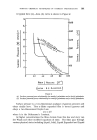
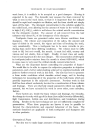
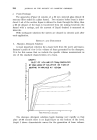
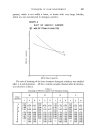
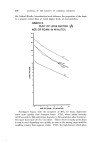
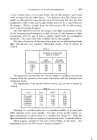
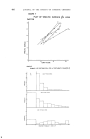
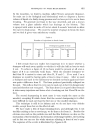
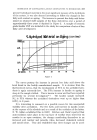
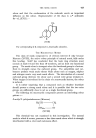
TECHNIQUES OF FOAM MEASUREMENT 399 The effect of temperature on the viscosity of the foam was also investi- gated. The air was kept at constant temperature, but the detergent solution and the mixing bowl and beaters were heated or cooled to the required temperature, between 10 and 40øC. The 10øC solution of M produced a more viscous foam (19-2 centistokes at 1 minute beating at 720 r.p.m.) than the samples at 20øC, 30øC and 40øC. The foam viscosities of these samples were almost the same (13.0, 12.6 and 12-4 centistokes for the 20, 30 and 40øC samples respectively), which is surprising. The size of the aliquot in the mixing bowl does not influence the foam viscosity. A 25 cc aliquot is insufficient to produce any foam. 50 and 75 cc aliquots generate foams which have similar viscosity characteristics. G•APH 3 PLOT OF VISCOSITY DIFFERENTIAL FOR SOILED AND UNSOILED SHAMPOO DETERGENT SOLUTIONS SOILED UNSOILED AGE. OF FOAM IN MiNUT[$ Some detergents produce initially viscous foams which after a few minutes lose most of their viscous nature, whilst other detergents produce less viscous foams which are stable for 3-5 minutes. The viscosity differ- ential measures this rate of degradation of the foam. We have found the viscosity differential to be a distinct characteristic of each foam. The viscosity differential results of the shampoo detergent solutions are shown in Graph 3. The curves show two distinct sections, a steep initial 6

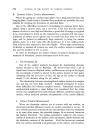
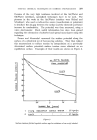
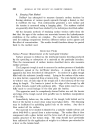
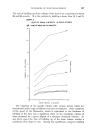
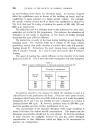
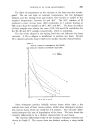
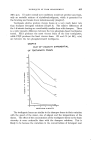
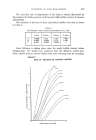
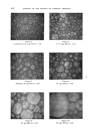
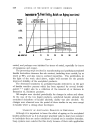
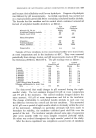
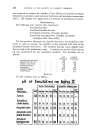
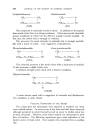
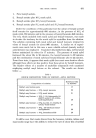
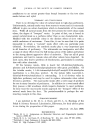
400 JOURNAL OF THE SOCIETY OF COSMETIC CHEMISTS .line, followed by a second, less steep, section. We decided to call the steep .section of the curve the "super foam state". This super foam state is an •'over energised" form of the foam. The length and slope of the super foam curve of a detergent depends upon the amount of work put into the foam. It follows that if equal amounts of work are put into various deter- gent solutions, the longer the life of the super foam and the steeper the gradient of its slope, the easier it is to generate that particular foam. The super foam does not contribute to the cleansing or other useful properties of the foam, but the ability to produce a super foam may be essential to achieve the desired rapid collapse and easy rinsing out characteristics, which are expected from shampoo and toothpaste foams. The duration of the super foam state will be discussed further in our light transmission results. The change in loss factor with time of the four shampoo detergent solutions investigated are similar in character. The slopes of the light transmission curves vary in the same way as those of the viscosity differential and show the super foam state. The significance of these results is dis- cussed in connection with the toothpaste results. The highest loss factor for a foam is obtained after 4 minutes' beating, the 2 and 6 minute foams having about the same loss factor. Temperature of detergent solution has only a slight influence on the loss factor of the foam, the 40øC sample is the only one with a significantly lower loss factor. The loss factor results are used to obtain the specific surface of the foam in question by adapting Clark and Blackman's methods. We also measured the specific surface of the foam using photomicrography. The plot of specific surface with loss factor at a given time yielded straight lines (Graph 7) so for a shampoo foam the loss factor expresses the specific surface. Although the character of the four shampoo detergent foams vary considerably, the specific surfaces are similar. M has the highest specific surface, N a poor foamer, also has a surprisingly high specific surface. The variation of specific surface with the age of the foam is shown on Graph 4. The curve is similar to the loss factor curves and is relatively the same for all the four shampoo detergent foams. D and H have similar specific surfaces and C has the lowest, but the rate of the breakdown of the foam is slow. The growth and collapse of the individual bubbles have also been followed. The larger bubbles increase in size and the smaller ones decrease until they disappear altogether. Examples of these are given in the toothpaste section. The variation in the loss factor and in the specific surface of the foams is surprisingly small, but these differences are very significant. To achieve more diverse results, we would require either liquid with very little air
Purchased for the exclusive use of nofirst nolast (unknown)
From: SCC Media Library & Resource Center (library.scconline.org)