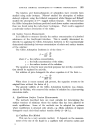
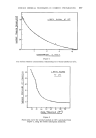
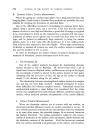
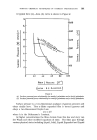
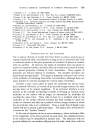
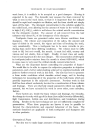
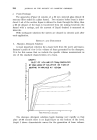
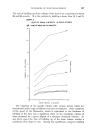
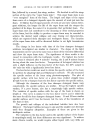
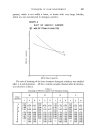
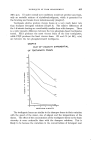
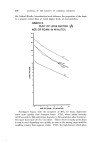
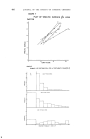
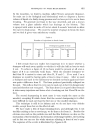
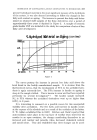
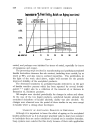
TECHNIQUES OF FOAM MEASUREMENT 397 The rate of building up of the volume of the foam is at a maximum between 30 and 90 seconds. M is the quickest to build up a foam, then H, C and N. GRAPH 2 PLOT OF FOAM VISCOSITY IN CENTI-STOKES VIS TIME OF BEATING IN MINUTES 200 CS • c• -- H C N TIME OF BEATING IN MINUTES The variation of the specific volume with various factors which are encountered under usage conditions were also investigated. Only variations of the speed of the Mixmaster, which is equivalent to the briskness of rubbing of the hair, has a significant effect on the maximum volume of foam produced by a given aliquot of a shampoo detergent solution. At any given speed the rate of building up of the foam volume reaches a maximum, then drops to zero. During this equilibrium, statej the building

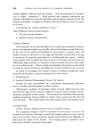
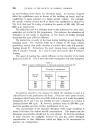
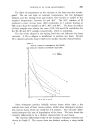
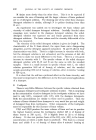
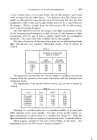
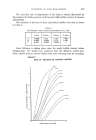
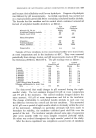
398 JOURNAL OF THE SOCIETY OF COSMETIC CHEMISTS up and breaking down forces are obviously equal. An increase of speed shifts the equilibrium state in favour of the building up forces, until an equilibrium is again attained at a higher specific volume. For example, the specific volume of foam for M at which this equilibrium is attained is 7.9, 11.5, 16.6 and 21.4 ml/g of solution for speeds of 520, 620, 720 and 820 r.p.m. respectively. The subjective feel of a shampoo foam is also influenced by other char- acteristics not studied in this programme. For instance, the adsorption of detergent on the hands is important, so two foams of similar physical characteristics may still feel different. We studied the viscosity of the foam during building up and during its breaking down. The viscosity build up is similar to the foam volume generation, except that peak viscosity is reached after only 4-6 minutes' beating (Graph 2). M produces the most viscous foam, reaching a peak after 4 minutes' beating. H, C and N reach their peaks after 6 minutes' beating. The speed of beating has a great influence on the viscosity of the foam produced (Table 1). This is true with both toothpastes and with shampoos. Table 1 Effect of speed of Mixmaster on the foam viscosity of M and CD Viscosity in centistokes Speed in Shampoo r.p.m. detergent Toothpaste M CD 520 16.8 66.6 620 30.6 88.0 720 48.6 148.4 820 57.0 195.0 In practice, therefore, the manner in which the shampoo is used is a critical factor in the production of a foam. From the user's point of view, a shampoo which foams when very little work is done on it would be popular. Detergents H, N and C are not suitable for such a shampoo as no foam is produced below 400 r.p.m. M, however, produces foam at 250-300 r.p.m. and this possibly provides further justification of its use. The concentration of the shampoo detergent under usage conditions is about 5-10 times the critical micelle concentration. This means that the detergent concentration should not be very critical. In fact, the variations in foam viscosity are negligible between 1% and 2% active detergent concentration so that differences which are likely to be encountered in practice are unimportant.
Purchased for the exclusive use of nofirst nolast (unknown)
From: SCC Media Library & Resource Center (library.scconline.org)