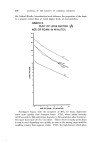
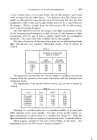
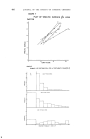
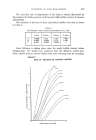
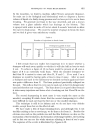
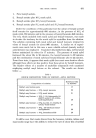
THE MUSK ODOUR 435 DR. H. W. HIBBOTT: By analogy is there not some connection between retention time on a chromatographic column and the retention times you mention ? MR. I). E. BUTTERFIELD: Possibly, though the separation of the con- stituents of a mixture on a column depends on the column itself and not on the other constituents which are present. DR. B. L. R^o: What is the effect of reducing the carbonyl group to the alcohol in these compounds and does it lead to any loss of odour ? MR. I). F.. BUTTERFIELD: From the evidence, for example in the Indane series, it is pretty certain that you need an acyl group present for pro- nounced musk odour. That is, you need the carbonyl group itself. Although I do not recall any particular compounds of this type containing the alcohol group, I think that reduction would certainly remove the musk odour. Whether you get a different odour or just attenuation of the musk character, I do not know. Something comparable, I think, is known about the con- stituents of Civet. The alcohol Civetol, which occurs in natural civet has, I believe, a definite but weak musk odour, but can be oxidised to the odorous civetone. I think there is another comparable case among the amber compounds. DR. A. W. MIDDLETO•: The author gives values for odour retention for methyl amyl ketone of 17 minutes which is increased to 27-28 minutes after replacement of 10 per cent methyl amyl ketone by macromolecules. The 10 per cent is a bulk concentration whereas the relevant concentration is that in the evaporating surface. A surface concentration of about 40 per cent macromolecule (moles per cent) would explain the odour retention times. Has the author any data regarding the surface concentration ? MR. I). F.. BUTTERFIELD: This is an interesting possibility and could explain the different retention times found, other than on the basis of physical interaction in the bulk of the liquid. Unfortunately, we have no data on surface concentration. DR. A. W. MIDDI. ETON: You would expect that the surface concentration would differ with the different types of chemicals you put in. MR. I). E. BUTTERFIELD: Yes that is true. It would certainly be inter- esting to extend this work to further types of compounds, particularly as the compounds yielding high retention times differ significantly in structure from those having little "fixative" effect. Comparison of the macrocyclic ester, ethylene brassylate with benzyl benzoate could be of interest. MR. F. ATKINS: I would like to draw attention to the last line in Table 1.

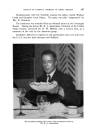
436 JOURNAL OF THE SOCIETY OF COSMETIC CHEMISTS This surely throws some light on the old controversies "Is natural musk a true fixative"? I have always believed it to be a superb blender but not a true fixative capable of evening out the varying rates of evaporation of the more and the less volatile components of a perfume blend. The opposite view has been defended by references to the Van der Waals effect of the macrocyclic bodies present in natural musk. If 10 per cent of pentadecanolide prolongs the evaporation time of methyl amyl ketone by about 50 per cent, how much natural musk would be needed to produce even this modest increase in "lasting power" in a perfume ? MR. I). •E. BUTTERFIELD : Naturally, one must agree that natural musk in the concentrations normally used can have very little fixative effect. The author's results do show however that the newer musks have this unusual effect of decreasing the rate of evaporation of methyl amyl ketone compared with more orthodox materials. The figures quoted in Table 1 certainly don't prove that any musks exert an important fixative effect in practice, but do suggest that there is anomalous behaviour which is worthy of further investigation. SOCIETY OF COSMETIC CHEMISTS OF GREAT BRITAIN 1960 Summer Conference THE 1960-61 Summer Conference of the Society was held on the 24th and 25th of August at the Royal Society of Arts. The Conference opened with a Cocktail Party on the evening of the 24th, when all participants and their guests were received by the President and Mrs. Hibbott. The Scientific Sessions took place on the 25th of August, and the Society's President, Dr. H. W. Hibbott, took the chair for the morning session. In opening the Conference, the President welcomed those attend- ing and extended a special welcome to the members of the American Society, which included their President, Mr. H. J. Amsterdam, and to other overseas visitors. For the afternoon session, Dr. R. H. Marriott, Immediate Past-President, was in the chair. The eight papers having been circularized in full to all participants prior to the Conference, the authors in the main restricted themselves to introductory remarks which allowed for a full discussion after each paper. Four of the papers are reprinted in this issue of the Journal, and the remainder will appear in subsequent issues.
Purchased for the exclusive use of nofirst nolast (unknown)
From: SCC Media Library & Resource Center (library.scconline.org)