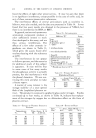
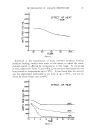
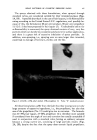
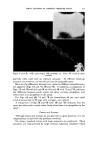
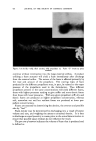
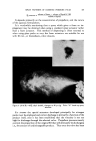
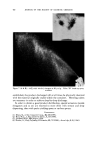
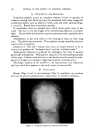
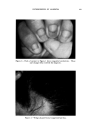
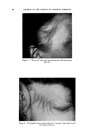
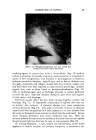
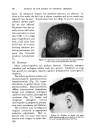
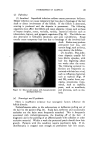
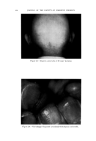
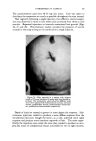
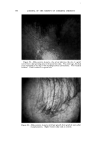
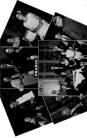
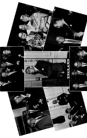
498 JOURNAL OF THE SOCIETY OF COSMETIC CHEMISTS Figure 29.--Male-pattern alopecia--the arrow indicates the site of a graft taken from a hair growing area in the posterior scalp. Two years ago, this had been implanted at the edge of the receding hairline (dotted line). Note receded hairline. Graft continues to grow hair. .. .. Figure 30.•Male-pattern alopecia with hair growth from grafts 4 years after transplantation. Right frontal scalp used as control.

PATHOGENESIS OF ALOPECIA 499 ½icatricial alopecias, other than those already mentioned, include a number of cutaneous diseases with atrophy. They are pseudopelade, lupus erythematosus, lichen planus and scleroderma. Treatment with the chloroquins may stop progression and occasionally produces hair re- growth. In male-pattern alopecia there is evidence to indicate that each individual hair tbllicle is genetically predisposed to respond or not to respond to androgenic and/or other influences that inhibit its growth. The affected site may support hair growth, as evidenced by the ability of full-thickness hair-growing autografts to take in these recipient sites and then produce hair at the same rate and of the same texture and color as the hair of the donor site (Figs. 29 and 30). In general, the various alopecias can be differentiated from one another by expert appraisal of clinical and microscopic findings, together with history. BIBLIOGRAPHY I1) Behrman, H. T., "The Scalp in Health and Disease," St. I,ouis, The C. V. MGsby Co. (1952). (2) Cipollaro, A. C., "Electrolysis. Handbook of Physical Rehabilitation Council on Physical Medicine and Rehabilitation," American Medical Assoc., Philadelphia, The Blakiston Co. (1950). (3) Dillaha, C. J., and Rothman, S., 7. Invesl. Derrnatol., 19, 5 (1952). (4) Dillaha, C. J., and Rothman, S., 7. Am. Med. Assoc., 150, 546 (1952). (5) Dougherty, T. F., and Schneebeli, G. L., Ann. N.Y. Acad. Sci., 61,328 (1955). (6) Flesch, P., "Hair Growth. Physiology and Biochemistry of the Skin," Chicago, The University of Chicago Press (1954). (7) "The Growth, Replacement and Types of Hair," Ann. N.Y. Acad. Sci., 53, 461 (1951). (8) "Hair Growth and Hair Regeneration," Ibid., 83, 359 (1959). (9) Harry, R. G., "Modern Cosmeticology," Vol. 1, London, Leonard Hill (Books) Ltd., (1955). (10) Kopf, A. W., and Orentreich, N., A.M. A. Arch. Dermalol., 76, 288 (1957). (11) McCarthy, L., "Diseases of the Hair," St. Louis, The C. V. Mosby Co. (1960). (12) Montagna, W., "The Structure and Function of Skin," New York, The Academic Press, Inc. (1958). (13) Montagna, W., and Ellis, R. A., "The Biology of Hair Growth," New York, The Aca- demic Press, Inc. (1958). (14) Orentreich, N., Ann. N.Y. Acad. Sci., 83, 463 (1959). (15) Orentreich, N., Sturm, H. M., Weidman, A. I., and Pelzig, A., "Local Injection of Steroids and Hair Growth in Alopecias," to be published. (16) Pillsbury, D. M., Shelley, W. B., and Kligman, A.M., "Disease of the Hair," in "Derma- tology," Philadelphia, W. B. Saunders Co., 984-1010 (1956). (17) Rony, J. R., and Cohen, D. M., 7. Ynvest. Dermatol., 25, 285 (1955). (18) Schwartz, L., Tulipan, L., and Birmingham, D. J., "Occupational Diseases of the Skin," Philadelphia, Lea and Febiger (1957). (19) Sulzberger, M. B., Witten, V. H., and Smith, C. C., 7. Am. Med. Assoc., 151,468 (1953).
Purchased for the exclusive use of nofirst nolast (unknown)
From: SCC Media Library & Resource Center (library.scconline.org)