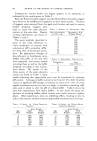
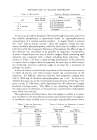
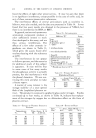
448 JOURNAL OF THE SOCIETY OF COSMETIC CHEMISTS wide range of concentrations of the active principle being sought. Many experiments have been carried out in which concentrated placenta extracts were diluted successively, and the assays on these diluted extracts were entirely consistent. Such tests covered the range of concentration from 1 unit per 100 ml. to 2600 units per 100 mi.---smaller numbers of tests in- dicate the method to be consistent and reproducible down to at least one- half unit per 100 mi. Table 9 lists the results of a typical group of tests, in which a sample solution containing 10 units per 10 mi. was diluted to make a series of solutions rangingin strength down to 0.1 unit per 10 mi. The results of the assays, multiplied by the dilution factor, showed very satisfactory consistency. In the course of the assay a deter- mination is made of any contribu- tion to the final optical density read- ing which may result from inter- fering substances in the unknown sample. This is done by preparing a mixture of the sample with the substrate, the buffer, and the dilute Folin-Ciocalteu reagent, and noting the color developed without incuba- tion. The optical density found for this nonincubated sample is de- ducted from that of the incubated sample. Suspecting that the lack of agreement between different lab- oratories could be due simply to dif- ferent room temperatures, which would cause different results for TABLE 9--CONCENTRATION OF PLACENTA EXTRACT Dilution Assay Found* Sample solu- 10.03 tion 1:2 9.88 1:5 10.08 1:10 9.93 1:20 10.12 1:50 9.72 1:100 10.01 * Calculated to basis sample solution. TABLE 10--EFFECT OF TEMPERATURE OF NONINCUBATED SAMPLE Temperature, Phosphatase, K & A øC. Units/100 mi. 20 91.1 2c •'6.7 30 103 2 35 96.8 TABLE l 1--EFFECT Or ORDER OF ADDITION (NONINCUBATED SAMPLE) Tempera- Procedure I, Procedure I1, ture, K & A per K & A per øC. 100 mi. 100 ml. 20 91.1 202 25 86.7 243 30 103.2 27• 35 96.7 343 the nonincubated sample, an experiment was run to determine the quan- titative effect of this variable. The results are shown in 'Fable 10. It is surprising to note that temperature variations had no significant effect on the nonincubated sample readings, even if the reaction temperature was as high as 35øC. The explanation for this unexpected result was found in the order of addi- tion of the reagents. It turned out that the Folin-Ciocalteu reagent inhibits the phosphate ester hydrolysis, so that the color developed is independent

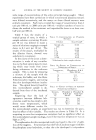
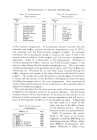
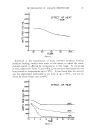
DETERMINATION OV ALKALINE PHOSPHATASE 449 T^•ns 12 INTERFERENCES (Preservatives) TABLE 13--][NTEP, F E P, ENC ES (Preservatives) Additive, Additive, % Assay % Assay None 2600 0.1 methylparaben 2630 None 2180 0.2 rnethylparaben 2575 0.1 phenol 2110 0.1 propylparaben 2580 0.1 sorbic acid 1975 0.1 benzoic acid 2540 0.1 borax 2015 0.1 hexachlorophene 2640 0.1 boric acid 2045 0.1 Actarner 2635 0.1 Dowicide H 2227 0.1 chlorbutanol 2565 0.1 Dowicide 1 2140 0.1 PCMX 2525 0.1 Santophen 1 2095 0.1 dichlorophene 2560 0.1 Vancide 2180 of the reaction temperature. If the placenta extract is mixed with the substrate and buffer, reaction commences immediately, even at 20øC., and continues until the Folin-Ciocalteu reagent is added. An increased reading for the nonincubated sample is found as the result of even a few seconds delay in addition of this reagent, and this increase is temperature dependent. Table 11 is illustrative of this phenomenon. Procedure I involved placing the buffer, substrate and Folin-Ciocalteu reagent in the reaction tube, followed by the sample undergoing assay. This is the order of addition prescribed in the procedure given above, and is that of King and Armstrong (2). Procedure II, on the other hand, involved placing the buffer, substrate and sample in the tube, followed by the Folin-Ciocalteu reagent. The results show that this permits a certain degree of hydrolysis to occur, and the amount of this hydrolysis will depend on both the speed of adding the reagent and on the room temperature. Such experimental results emphasize the necessity of strict adherence to the prescribed order of addition of sample and reagents. The work described thus far deals with our study of the assay procedure as applied to the placenta extract or its aqueous dilutions. The practicing cosmetic chemist will be interested also in the assay of such extracts in the presence of certain commonly used cosmetic ingredients, and will want to know of their possible interference in the phosphatase assay. A beginning has been made on a study of this TABI.E 14--I NTEP, F E P, ENC ES (Antioxidants) Additive, % Assay None (control) 1880 0.1 BHA 1820 0.1 BHT 1905 0.1 NGDA 1480 0.1 BHA, 0.1 Actarner 1835 0.1 BHT, 0.1 Actamer 1890 0.1 NDGA, 0.1 Actarrer 1280 type, and also on the effect of heat on the placenta extract. The pre- liminary results are reported below. Table 12 presents the results found in the assay of an extract originally containing 2600 King and Armstrong units per 100 ml., where nine different preservatives were added. Similarly, in Table 13 are
Purchased for the exclusive use of nofirst nolast (unknown)
From: SCC Media Library & Resource Center (library.scconline.org)