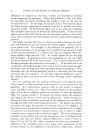
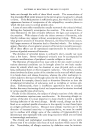
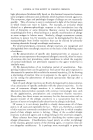
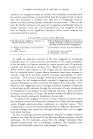
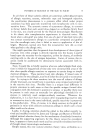
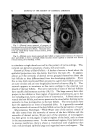
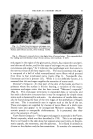
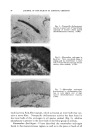
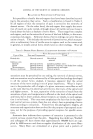
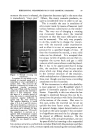
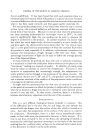
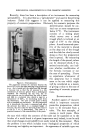
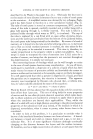
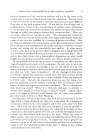
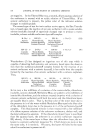
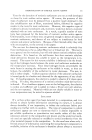
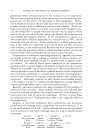
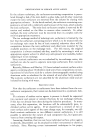
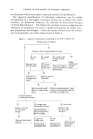
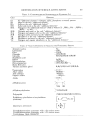
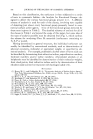
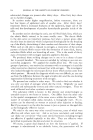
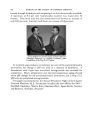
84 jOURNAL OF THE SOCIETY OF COSMETIC CHEMISTS Fig. 5.--Nonspecific cholinesterase reaction in inner bulb of Vater-Pacini corpuscle of rooster's cheek (acetyl thiocholinesterase reaction X200). Fig. 6.- Mammalian end-organ in lipof cat. Note convoluted shape of ending and its resemblance to inner bulb of Vater-Pacini corpuscle (frozen section, silver method X530). •.. :. . f . • '•, . .". .... :... .• _ ::: .:•.%::: . ..- ,. -. ....... Fig. 7.--Mammalian end-organs demonstrated by cholinesterase reac- tion in w)lar digital skin of tiger (acetyl thiocholinesterase reaction X 100). multi-layered, fluid-filled capsule, which surrounds an inner bulb that con- tains a nerve fiber. Nonspecific cholinesterase activity has been found in the inner bulb of this end-organ in all species studied (Fig. 5) alkaline phosphatase is present in the inner bulb in the feline group of animals. 3Iammalian lind-Oroean.--I have described the mammalian end-organ found in the mucocutaneous regions as well as in the paws or hoofs of all

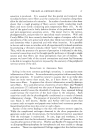
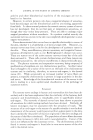
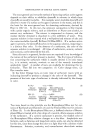
THE SKIN AS A SENSORY ORGAN 85 nonprimate mammals studied (14). It resembles the inner bulb of the Vater-Pacini corpuscle (Fig. 6) and is histochemically similar to it in various species. This end-organ apparently serves the purpose of a mucocutaneous end-organ and a Meissner corpuscle in lower mammals. It contains nonspecific cholinesterase (Fig. 7) and in some species, alkaline phosphatase. Its function has not been studied. SIMILARITY OF NERVE ENDINGS The most impressive feature of the end-organs is their similarity (13). The mammalian end-organ and the Vater-Pacini corpuscle are similar in their basic histologic details as well as in histochemical features. When the histochemical properties vary in the end-organ in one species, the other end-organ also varies. A similar anatomic relationship is apparent in primates between the mucocutaneous end-organ and the Meissner cor- puscle, and it is reinforced by the fact that the mammalian end-organ may be found in both glabrous and haired skin in lower mammals. It should be pointed out that there is a simple anatomic similarity between the network of nerves of the hair follicle, specialized end-organs and the network of derreal nerves. The anatomic variability seems to depend more on the structure of the skin to which a relationship is developed. Thus, the specialized end-organs are supplied by multiple sensory neurons in ex- actly the same way as in the network of cutaneous nerves or the net- work about the hair follicle, so that a spatial distribution of nerve fi- bers is achieved. In all organized endings, nonspecific cholinesterase is present, and this histochemical fact unites all organized receptors, in theory if not in function. In bovine and feline end-organs, alkaline phos- phatase is present, forming another histochemical link. All types of nerve endings in the skin, therefore, may be related in some structural or histochemical way. This is further reason to believe that the chief function of specialized nerve endings is to provide for acute perception and that individual morphologic variations are of little significance. It is generally conceded that the hair follicle is the principal end-organ of the general surface of most animals. The hair follicles are closely packed and are well supplied with baskets of nerves. In almost all mammals the general body surface has no other nerve endings in any significant number. In man, the network of derreal nerves is developed to a position of prom- inence, and while hair-follicle endings remain of great importance, man's existence as a sensitive homeothermic creature is made possible by this change in cutaneous nervous tissue. Touch, pain and temperature, over almost all of the body surface in man, are perceived only by these endings-- the strongest argument for the fact that simple endings are as useful as complex structures.
Purchased for the exclusive use of nofirst nolast (unknown)
From: SCC Media Library & Resource Center (library.scconline.org)