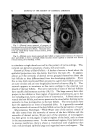
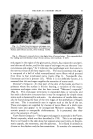
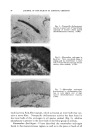
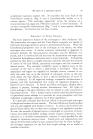
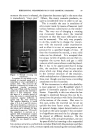
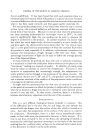
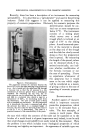
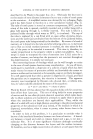
116 JOURNAL OF THE SOCIETY OF COSMETIC CHEMISTS substantial changes are present after thirty days. After forty days there are no further changes. In sections under higher magnification, before treatment, there are but few layers of epidermal cells of smaller size. After thirty days' treatment there is increased thickness of the epidermis, larger size of the cells and the development of peculiar keratohyalin granules inside of the cells. In another section showing the cutis, one will find black lines, which are the elastic fibrils stained to be more readily seen. The elastic fibrils in the skin serve an important purpose, but when a person grows older the skin loses its elasticity which is expressed histologically by the breaking up of the fibrils, diminishing of their number and distortion of their shape. When such an old skin is exposed to estrogen, a restoration of the normal pattern of elastic fibrils occurs with the formation of some thick, heavy, unbroken fibrils which are branching all over. This is the result of thirty days of treatment with estrogen topically applied to the skin. We produced these striking changes not in one or in a dozen of cases but in several hundred. We were not satisfied by relying on our own un- controlled judgment. We applied the double-blind test. We took two groups of patients one received an ointment with no estrogen in it and the other received an identical ointment but with estrogen. The investigator who looked through the microscope did not know which section came from which patient. He made his diagnosis which was not difficult, as you can see from the difference between the aged atrophic skin and the one showing regeneration following treatment with estrogen. We pursued our studies in other ways. We tried to find out whether it was only one kind of estrogen which did the trick. Originally we used estradiol and subsequently estrone and other natural estrogens. Then we used stilbestrol and other synthetic estrogens. The substance which is known to the chemist and endocrinologist as estradiol occurs in two forms or isomers. One differs from the other only in the spatial arrangement of the same atoms within the molecule. The isomer of estradiol called alpha estradiol, is biologically inert. No re- actions can be observed on women or animals after injection or feeding. But if you smear it on the skin the isomer is just as potent on the aged skin as the biologically effective isomer. We tried in the same way other steroid hormones, some of which were effective and others were not. And so we have concluded--and nothing can shake our conviction--that some steroid hormones including estrogen are effective if applied topically to the skin. They are effective when permitted to permeate the skin and enter its structure. Of course, a great deal depends on how the hormone ismapplied. If estrogen is administered in an alcoholic lotion, the penetration will be

ESTROGENS 117 extremely rapid, so rapid that the hormone will get into the lymph or blood circulation in no time and will have effects in distant parts of the body, for instance the womb or the breast of the woman. The effect on the skin is minor since it goes in too quickly. If you take a watery emulsion and put it on the skin, nothing is going to happen either to the skin or to any other part. A watery hormone emulsion does not penetrate. The hormone has to be carried by certain fats, of which in our experience lanolin seems to be the most suitable ve- hicle, although other fats also carry estrogens quite well. Once the hormone has penetrated the question arises: To what extent does it penetrate, all of it or only part of it? Well, we gauged that very carefully, and we found that not more than one-seventh, and occasionally only one-tenth of the amount applied to the skin enters and becomes available for effective performance within the skin. If estrogen is applied properly, the amount which goes beyond the skin and enters the blood circulation is very small. This, of course, is of supreme importance for if a large amount would enter, estrogen could not be used as a cosmetic because it is a powerful drug, and could cause a great deal of trouble. If you take a young woman, or even a woman past child-bearing age, and give her too much estrogen in one form or another, she will get menstrual troubles, or swelling and soreness of the breasts. You cannot use a cosmetic which exposes the user to danger. There- fore, the use of estrogen as a cosmetic is limited to such quantities which cannot cause systemic effects. In our many trials, the results of which convinced the Food and Drug Administration, it was found that if only one milligram of estrone or its equivalent of any other estrogen were used in one ounce of ointment and the individual user would be allowed no more than three ounces of ointment over a month's time, the amount of estrogen thus entering the circulation was absolutely negligible and incapable of producing systemic effects. Some estrogen did enter the circulation, but the amounts were within the range of the physiological fluctuations of normal estrogen secretion, and the finest tests we used were unable to show any systemic effect of estrogen administration. Of all the available methods, the most practical is the vaginal smear method. If a woman who has no ovaries, or whose ovaries have ceased to function, is subjected to the vaginal smear test, certain changes of the vaginal cells are demonstrable which clearly show a lack of estrogen. If the woman is given estrogen in a therapeutically effective amount-- changes take place in the vaginal epithelium whereby it reverts to the type seen in the woman of child-bearing age. In our tests on a large number of women to whom we gave estrogen in ointment form observing the criteria mentioned above, no changes in the vaginal smear were demonstrable at any time.
Purchased for the exclusive use of nofirst nolast (unknown)
From: SCC Media Library & Resource Center (library.scconline.org)