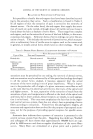
108 JOURNAL OF THE SOCIETY OF COSMETIC CHEMISTS thermoregulatory system by acquiring eccrine glands over his entire body surface. Thereby man has lost a great deal of protection, but also gained considerable freedom to thrive in hot climates. He invaded the tropical regions and was able to settle the entire globe. The price paid, the loss of a certain amount of protection, was amply regained by this greatly enhanced freedom. Since the surface immediately exposed to the outer world was not the hair anymore but the horny layer of the epidermis, man's pro- tective devices had to be modified. Protection was needed against a number of environmental factors and was achieved in a multiplicity of ways (Table 1). Although protec- tion would be needed, we have none against ionizing radiations. 1. Protection against mechanical injuries imposes heavy demands on the skin. The requirements are for a tough, yet resilient and pliable tissue, to be able to withstand trau- mata, yet follow the movements of the body. The specifications called for are somewhat similar to those of a rubber tire. The demands on human skin were multiplied when man lost his fur and was deprived of a great deal of mechanical pro- tection. The solution arrived at was essentially the development of a two- TABLE 1 Stimulus Protective Device 1. Mechanical Physical Physiological 2. Cold Vasomotor 3. Heat Vasodilation Evaporation 4. Ultraviolet light Erythema Pigmentation Thickened horny layer 5. Chemical agents Physical Chemical Vascular 6. Infections Physical Chemical TABLE 2 Fibers Matrix Corium Collagenous Ground sub- (2) stance (3 Elastic (4) Epidermis Tonofilaments Matrix Horny layer Keratinous Nonkeratin material phase system. Tough, yet resilient fibrous networks were formed to make them even more adaptable, they were embedded in a viscous or pliable matrix which permitted movement between individual fiber bun- dies. This dual pattern of fibers, in an amorphous matrix, is repeated throughout all layers of the skin (Table 2). At the surface the fibers are hardest and most consolidated yet, even here, the interfibrillary substances comprise almost half of the horny layer and perform most of the essential functions of the skin surface (5). These are the built-in physical properties of the skin which give immedi- ate mechanical protection. There is also a physiological mechanism which imparts delayed protection to the skin against chronic stimuli. This pro- tective device is the thickening of the horny layer. Upon repeated or chronic mechanical stimulation the horny layer becomes thicker, as in callus or after experimental irritation (6). This thickening is a nonspecific

FUNCTIONS OF THE SKIN 109 response of the skin surface, brought about by a variety of stimuli, as we will see later on. Closely related to the thickening of the horny layer is the problem of epidermal replacement. The skin surface wears off continuously, being shed normally in the form of invisible flakes. The matrix which normally cements the horny cells together, disintegrates and the cells desquamate. Our recent work brings strong evidence that this cementing substance con- tains mucopolysaccharides (7). Disturbances in the disintegration of this cement occur in certain common scaling skin diseases. The replacement of the cells lost from the surface is a continuous process which replaces about one cell layer daily or every two days. Its rate is adapted to make up for increased losses when there is excessive wear and tear on the horny layer (1, 8). 2. Protection against cold had to be bolstered in man after he lost his hairy coat. The protective devices are twofold: First and foremost are vasoconstrictor mechanisms. Release of vaso- constrictor substances by sympathetic nerve endings decreases the volume of blood circulating through the superficial vessels and arteriovenous anasto- moses (9) and cuts down the heat loss. In addition to this immediate effect there are delayed responses. One of them is the possibly larger numbers of arteriovenous anastomoses in people much exposed to cold, to shunt the blood away from the surface and yet allow the proper oxygena- tion of the tissues (1) the other is a possible thickening of the horny layer which has been definitely observed in animals (10). The horny layer is a strong insulator against therma] influences since man in cold weather is unable to grow a thicker fur coat as animals do (11), it would be of interest to see whether he took the next best protection in the form of a thicker stratum comeurn. 3. Protection against heat is twofold: by vasodilatation and by sweat- ing. Both are brought about by a central mechanism, triggered by the heated blood reaching the thermoregulatory center in the central nervous system. Reflex nervous pathways to control heat loss are brought into action at a later stage (12). The vasodilatation is actually a release from vasoconstriction, by inhibition of sympathetic discharges. The existence of active vasodilator fibers is still questioned (1, 13). When vasodilatation fails to keep the body temperature down to normal, sweat glands begin to function. The stimulus is again the heated blood and later nervous reflexes causing release of acetylcholine at the endings of the sympathetic sweat fibers. As mentioned earlier, the spread of the sweat glands over the entire body is a human attribute no other species has eccrine sweat glands over its entire skin surface. It is believed that origi- nally the human sweat glands may have been restricted to the palms and soles, their exclusive localization in a number of species. Extension of
Purchased for the exclusive use of nofirst nolast (unknown)
From: SCC Media Library & Resource Center (library.scconline.org)