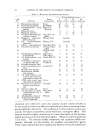
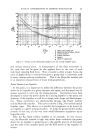
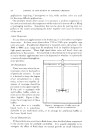
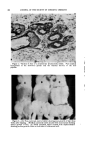
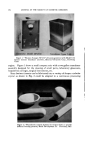
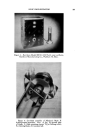
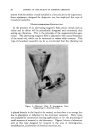
268 JOURNAL OF THE SOCIETY OF COSMETIC CHEMISTS applications requiring 3 horsepower or less, while turbine units are used for the more difficult applications. One problem which often occurs is to produce a uniform suspension in the tank and maintain this suspension while material is drawn off to a filling or packaging machine. Sometimes this can be done by putting dual ira- pellets in the system and placing the lower impeller very near the bottom of the tank. Solids Dispersion In case there are agglomerates to be broken up, it is desirable to use higher shear rates. In these cases, direct drive 1750 or 1150 r.p.m. propeller type units are used. If additional dispersion is required, units operating in the 3000 to 4000 r.p.m. range may be employed with an impeller designed for high speed operation. These high speed shear rates will break down ag- glomerates in the system. It is essential in describing the mixing operation to state whether agglomerates are to be dispersed or whether it is primarily a matter of suspending agglom- erate particles. Alir Enlrainment There are times when the en- trainment of air in the batch is of particular concern. In case it is desired to keep the degree of air entrainment to a mini- mum, at least one impeller di- ameter of coverage should be provided on the upper impeller. If the •ank is equipped with wall baffles, baffles which ex- tend across the surGce are also often helpful. Figure 6 illus- trates the arrangement of these baffles. In case there is a variable liquid level, it is sometimes Figure 6.--Arrangement of baffles across the surface to prevent air entrainment. desirable to use multispeed units, or to arrange for additional bail]es at the lower liquid level. Cry slal Characteristics If the particles are sensitive to fluid shear, then the fluid shear component in the system must be carefully controlled. It is usually desirable to in- vestigate the effect of fluid shear on crystal growth on small laboratory

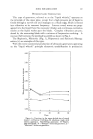
SCALE-UP CONSIDERATIONS IN COSMETIC MANUFACTURE 269 equipment. High speed direct drive mixers should be avoided if fluid shear is detrimental. The use of the slow speed gear drive propeller mixers and the still slower speed tu•'bine type mixers is required if fluid shear rates must be kept to a minimum. In crystallization processes, the over-all circulating capacity must be carefully related to fluid shear to provide the proper particle size. L•QUID-LIQu•D CONTACTING There are two types of liquid-liquid contacting applications. One is the case of extraction, in which it is desired to mix two liquid phases ini- tially to effect the extraction of one component from one phase to the other, but not to produce a permanent emulsion that will not settle. The mixer produces a certain mass transfer rate which is given by the equation Rate c• K,,a (c•-c2) This indicates that the mixer provides a certain interfacial area which is the "a" term above (square feet per cubic foot of volume) and K•, film coefficient, (lb. tools. per hour per foot squared) which is related to the thickness of the stagnant film surround the droplets. The driving force causing mass transfer to take place is the difference in concentration c, of the component in phases 1 and 2. The approach of an extraction to equilibrium is defined as stage efficiency. Scale-up in these systems can be determined by knowledge of the effect of mixer and tank variables on extraction coefficient K•a, and the knowl- edge of residence time and concentration driving force on the stage effi- ciency produced. There are many different ways of carrying out liquid-liquid extraction including single batch extraction, multiple batch extraction with fresh solvent, continuous multistage extraction with fresh solvent in each stage, continuous countercurrent multistage extraction in a series of separate tanks, or continuous countercurrent multistage extraction in a mixing column. Present-day techniques allow accurate prediction of extraction processes. The other class of liquid-liquid contacting is to produce a permanent emulsion. The term permanent or stable emulsion is a relative one, since most emulsions will settle eventually. The formulation of the liquid is of major importance in these operations. If the mixer is producing a particle size which gives a greater interfacial area than the formulation will support permanently, then the emulsion will revert to its more or less stable condition. Changes in mixer design will have little effect on the ultimate product since the formulation controls. If the formulation is capable of maintaining a smaller dispersion size than
Purchased for the exclusive use of nofirst nolast (unknown)
From: SCC Media Library & Resource Center (library.scconline.org)