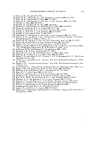
262 JOURNAL OF THE SOCIETY OF COSMETIC CHEMISTS REFERENCES (1) Guha, P. C., and Lankaran, D. K., "Organic Synthesis," Coil. Vol. lII, New York, John Wiley & Sons (1955), p. 623. (2) Fredga, A., Ber. deut. chem. Ges., 7lB, 289 (1938). (3) Whitman, R., and Eckstrom, H. G., Proc. Sci. Sect. Toilet Goods •lssoc. No. 22, 23 (1954). (4) Brunner, M. J., and Smiljanic, A., •lrch. Dermatol. and SyphiloL, 66, 703 (1952). (5) Voss, J. G., 7. Invest. Dermatol., 31, 273 (1958). (6) DeMytt, Louis E., and Hsiung, Du Yung, Canadian Patent No. 615,944 (1961). (7) Heilbron, I., and Bunburg, H. M., editors, "Dictionary of Organic Compounds," Vol. II, New York, Oxford University Press (1953), p. 67.

MODIFICATION OF THE WATER HOLDING CAPACITY OF CALLUS BY PRETREATMENT WITH ADDITIVES By C•^RLEs Fox, B.A., J^•4Es A. T^ssoFF, B.S., M^Rn'•½ M. R•G•, P•.D., and Do•q^LD E. D•E•4, B.S.* Presented May 8, 1962, New York City I. Introduction Du}usc THE PAST DECADE, increasingly more cosmetic preparations have been marketed for which skin "moisturizing" claims have been made. The rationale for such claims is found in the work of Jacobi (1) and of Blank (2, 3). Jacobi described a very hygroscopic water-soluble fraction which could be extracted from hair, wool and skin and demonstrated that fibers and tissues became hydrophobic as a result of such extraction. Blank in his classic studies showed that water, not oil, was primarily responsible for skin softness and flexibility and that cornified epithelium must contain 10 to 20 per cent of water to remain soft and flexible. Blank also showed that the moisture uptake of the stratum corneum is reduced if its water-soluble components are removed. Subsequent studies by Spier and Pascher (4-9), Flesch and Esoda (10, 11), and Szakall and his co- workers (12-14) have confirmed the presence of many water-soluble com- ponents in the stratum corneum and their importance in enhancing the water-holding capacity of this tissue. Yet, despite the presence of this natural hygroscopic material, "dry skin" still remains a problem, and its relief requires external application of lotions, creams, bath oils, etc. (15). The cosmetic chemist has relied primarily on the use of fatty materials and humectants to increase the retention of skin moisture. Fatty ma- terials may act as partial barriers to water evaporation from the skin (16, 17), and, presumably, this occlusivity increases the skin's water content (18, 19). Other fatty materials, especially those found on the skin, are believed to promote skin hydration by forming emulsions with water, which then become reservoirs of water for the skin (20, 21). By com- parison, the mechanism by which humectants moisturize the skin has re- ceived less attention. Powers and Fox (16) reported that humectants, such as propylene glycol and glycerol, accelerate the rate at which water is * Warner Lambert Research Institute, Morris Plains, N.J. 263
Purchased for the exclusive use of nofirst nolast (unknown)
From: SCC Media Library & Resource Center (library.scconline.org)