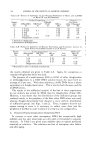
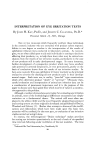
270 JOURNAL OF THE SOCIETY OF COSMETIC CHEMISTS fore, the water sorption of a mixture of powdered callus and 70 per cent sorbitol solution was studied. However, in both series, the sorbitol solu- tions and the callus q- sorbitol mixtures immediately lost weight and con- tinued to lose weight daily, and these studies were discontinued. These results are not surprising since a 70 per cent sorbitol solution is in hygro- scopic equilibrium with air having a relative humidity of approximately 76 per cent and thus should lose water at lower relative humidities (27). TABLE 5--MoIsTUP. E SOKPTION OF WASHED CALLUS,* GLYCEP. OL AND THree. M•XTUV. ES AT 45% R.H. AT 23 ø 4- 2øC. •-----Composition, gm. Callus Glycerol Moisture Absorbed at --- Equilibrium, %- , Found Calculated 0.1349 ... 7.9 ... 0.1702 8.2 ... ... 0.¾i62 18.5 ... 0.6962 18.5 0.'1'1'82 0.4768 15.5 1¾.• 0.1103 0.4607 15.4 16.5 * Lot #2 ww. In Table 5, moisture sorption data for washed callus (Lot #2 ww) and its mixtures with glycerol is shown. This data demonstrates the complete absence of any potentiation of moisture pickup by washed callus in the presence of glycerol and thus is in agreement with the more extensive data on unwashed callus given above. C. The Removal of I4/ater-Soluble Components from Callus and lhe I4/ater Sorption of I4/ashed Callus It was mentioned above that the water-soluble components of callus affect its water-holding capacity (3, 10). It appeared important to deter- mine how different methods of grinding and washing alter the water sorp- tion of callus. Two methods of washing callus for complete removal of water-soluble components were investigated. One of these involved washing with a polar solvent and water, while the second utilized only water. About 10 g. of 60 mesh or finer (Wiley milled callus, Lot #3) was dried to constant weight in a vacuum desiccator over P205. The callus was accurately weighed and shaken intermittently with 100 ml. of a 1:1 mixture of ethyl alcohol and ethyl ether in a glass-stoppered flask for twenty-four hours. The solvent was removed by filtration, and the callus was air dried for three hours. The powdered callus was then washed with consecutive 100 ml. portions of distilled water until the wash water no longer reacted to the ninhydrin and biuret tests. Four such washings were required. The solvent extract was evaporated to dryness on a steam bath. The aqueous extracts were combined and reduced in volume by vacuum distillation at room temperature and retained for the

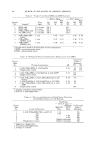
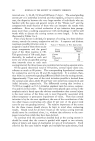
WATER HOLDING CAPACITY OF CALLUS 271 test described under D below. A known aliquot of this liquid was then dried to constant weight in a vacuum desiccator over P205 to determine the total solids. The solvent and water-washed callus (Lot #3 sw) was used in later experiments. A second portion (approximately 35 g.) of the milled callus (Lot #3) was extracted by shaking with consecutive 250 mi. portions of distilled water at room temperature until the washings no longer yielded positive biuret and ninhydrin tests. Eight such washings were required. These washings were concentrated and dried as discussed above, and the callus (Lot #3 ww) was reserved for additional experiments. This washing pro- cedure was also repeated on a different lot of Wiley milled callus (Lot//4). Finally, samples of 50 g. of callus (Lots #2 and 5), which were pulver- ized to 40 to 60 mesh by the freezing and pounding technique discussed previously, were each washed with eight consecutive 250 mi. portions of water. The washings were combined and a dry residue obtained as discussed above. (The calluses washed by this method are identified as Lots #2 ww and 5 ww.) Approximately 150 rag. duplicate samples of these various calluses were accurately weighed into weighing bottles and stored in constant humidity chambers at 45, 60 and 90 per cent R.H. at room temperature. The samples were weighed daily until they reached constant weight. The water soluble callus extracts isolated by the techniques described above were placed in weighing bottles and dried to constant weight in a vacuum desiccator at room temperature over P205. The samples were then stored in constant relative humidity chambers at 60 per cent R.H. at room temperature and weighed daily until they attained constant weight. The weight of extractives obtained and the value of total nitrogen and lactates found are shown in Table 6. The Wiley milled callus (Lot #3) yielded approximately the same amount of water-soluble extract, whether pretreated with solvent or not. The difference of about 1.3 per cent may be attributed to small amounts of lipids that were carried into the water TAm.•. 6--WA.EI• SO•UBLES (Ex•:1•C.F•r• v•o• C•L•tTs) Pounded (40-60 Mesh) Extracted with Distilled Water Lots 2 and 5 combined ,-Wiley Mill (60 Mesh and Finer)-- Extracted with Solvent*/ Extracted with Water •-Distilled Water--, Lot 3 Lot 3 Lot 4 Total water solublest (%) 18.10õ 14.14 15.4 16.35 Total solvent solubles (%) 3.48 [I Total N2 (Kjeldahl) in water 1•i•} 17.0 1'7'.'5 1• i i soluble fraction (rag./100 rag.)+ + Lactic acid (%) :[: 0.73 1.7 0.8 2.17 * Solvent was a 1:1 mixture of ethyl alcohol and ethyl ether. t Based on dry weight of callus. :[: Based on dry weight of extractives. õ Combined extracts of Lots 2 and 5. I[ The solvent soluble fraction contained 10.8% total N•, based on total solids of this frac- tion.
Purchased for the exclusive use of nofirst nolast (unknown)
From: SCC Media Library & Resource Center (library.scconline.org)