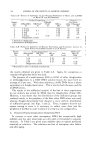
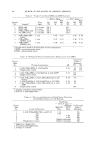
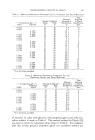
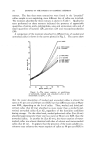
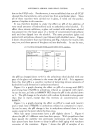
268 JOURNAL OF THE SOCIETY OF COSMETIC CHEMISTS TABLE 3--MoisTURE 5ORPTION OF UNWASHED CALLUS•* CRYSTALLINE SORBITOL AND THEIR MIXTURES •--Storage Conditions• •--Composition, gm. . Temp., R.H., Callus Sorbitol øC. Time Moisture Required Absorbed at to Reach Equilibrium, Equilibrium, % days 0 1851 0 2175 ß ß 0 1'•36 0 1425 0 1690 0 1738 ß ß 0 1'1'67 0 1066 ... 23 45 6.7 4 23 45 6.9 4 0.'•77 23 45 0.5 1 0.5243 23 45 0.5 1 0.3344 23 45 2.9 4 0.3250 23 45 2.4 4 ... 23 60 11.2 6 23 60 11.7 6 0.'1•'02 23 60 1.2 1 0.1493 23 60 1.1 1 0.1394 23 60 5.9 4 0.1793 23 60 5.2 6 * Lot #2, frozen, pounded. tentiates moisture pickup of unwashed callus but that the amount of water vapor absorbed is strictly an additive function. In other words, the observed water pickup of mixtures of callus and humectant is precisely that which would result by adding the moisture pickup of equivalent amounts of the two components exposed separately. In measuring the water uptake of propylene glycol and of mixtures of propylene glycol and callus, it was noted that these substances attained a peak water pickup after two days exposure. The weight then decreased and continued to decrease below the weight of the original anhydrous mixtures. Since the vapor pressure of propylene glycol is 0.15 ram. at TABLE 4--A COMPAKISON OF CALCULATED AND EXPERIMENTALLY DETERMINED MOISTURE SORPTION OF UNWASHED CALLUS -q- HUMECTANT MIXTURES -•Storage Conditions• Moisture Absorbed at •----Composition, gm..----, Temp., R.H., •-- Equilibrium, %----, Callus Humectant* øC. % Found Calculated• 0.1357 0.2852 G 23 45 13.5 14.9 0.1097 0.3077 G 23 45 14.6 15.7 0.0825 0.3193 G 37 40 14.2 14.6 0.1084 0.3134 G 37 40 13.2 13.9 0.0997 0.2335 G 23 60 29.6 30.2 0.0988 0.1924 G 23 60 28.2 29.2 0.1130 0.2486 G 23 90 129.0 132.5 0.1513 0.3397 G 23 90 129.0 133.0 0.1245 0.2952 PG 23 45 15.0 15.3 0.1417 0.2945 PG 23 45 14.3 15.0 0.1426 0.2149 PG 23 60 24.4 23.6 0.0952 0.1944 PG 23 60 25.4 25.2 0.1936 0.3344 S 23 45 2.8 2.9 0.1425 0.3250 S 23 45 2.4 2.5 0.1167 0.1394 S 23 60 5.9 5.8 0.1066 0.1793 S 23 60 5.2 5.1 * G = Glycerol, PG = Propylene glycol, S = Sorbitol. t Based on data shown in Tables 1, 2 and 3.

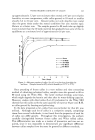
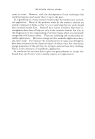
WATER HOLDING CAPACITY OF CALLUS 269 25 ø C., while the vapor pressure of glycerol, under the same conditions, is 0.0 mm. (25, 26), it appears reasonable that propylene glycol vapor was absorbed by the glycerol-water mixture in the base of the humidity chamber, and that propylene glycol from the sample continued to vaporize. When the experiments with propylene glycol and with callus -3- propylene glycol were repeated in a constant humidity chamber maintained with a known propylene glycol-water mixture (25), the phenomenon of weight loss after c =Glycerol x-----xPropylene Glycerol i • .... c•Callus zt ........... • Sorb•tol Crystals I 2 :5 4 5 6 7 Time Days Figure 2.--Comparative rates of moisture sorption by glycerol propylene glycol, crystalline sorbitol and unwashed callus (Lot #2) at45% R.H. at 23øC. 4- 2øC. reaching peak value was also observed but to a much lesser extent. The results for propylene glycol and mixtures of this material with callus in Table 2 are the maximum weights observed in the propylene glycol-water chamber when measured daily and may be in error by + 2 per cent. Anhydrous sorbitol picks up only trace quantities of water vapor and has little if any effect on the water pickup of callus, even when stored at 60 per cent R.H. at room temperature for a two-week period. It is well known that a 70 per cent sorbitol solution is a commonly used humectant. There-
Purchased for the exclusive use of nofirst nolast (unknown)
From: SCC Media Library & Resource Center (library.scconline.org)