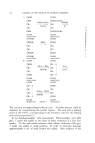
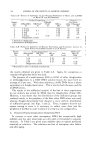
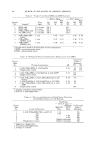
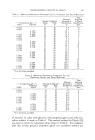
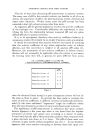
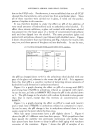
274 JOURNAL OF THE SOCIETY OF COSMETIC CHEMISTS In order to study the effect of these additives on the water sorption of callus, 40 mesh pounded callus (Lot #6 ww) was thoroughly washed with distilled water at room temperature, as previously described, until the washings gave negative ninhydrin and biuret tests. The callus was dried to constant weight in a vacuum desiccator over P205 and subdivided into aliquots. Duplicates of each aliquot were treated with 10 per cent by weight of one of the following additives: glycerol, amino acids, poly- peptides, gastric mucin, sodium lactate, urea and sodium chloride. E.no. ugh distilled water was added to the callus to facilitate wetting and m•xmg. A control sample was also prepared, using callus and water alone. One set of samples was lyophilized at -34 ø C., and the other set was dried to constant weight in a vacuum desiccator at room temperature over P205. Each mixture was then screened through a 40 mesh screen, and the samples of each mixture and of each drying method were further dried to constant weight at 60 ø C. under vacuum. These samples were then placed in a constant relative humidity cham- ber at 60 per cent R.H. at room temperature until they reached constant weight. The amounts of water absorbed by each of the "synthetic" substitutes of naturally occurring skin components and the water sorption of glycerol and propylene glycol under the same conditions are shown in Table 8. It is noted that sodium lactate absorbs far greater quantities of water than any of the other major water-soluble components of the stratum comeurn. This material also absorbs more water than glycerol or propylene glycol under the same conditions. The results of water sorption studies at equilibrium of mixtures of washed callus and the indicated additives are presented in Table 9. The calculated values were obtained as above, following the method of Flesch (22). Since each sample contained 91 per cent of callus and 9 per cent of anhydrous additive, the moisture sorption of the mixtures can be compared with each other. The last two columns of Table 9 were calculated from the following formula to facilitate this comparison: 100 X [% absorbed by mixture - % absorbed by callus] % absorbed by callus -- % increase in water absorbed Sodium lactate, even when present at only 10 per cent of callus weight, greatly increases the water sorption of callus. However, the water sorption found for the callus-lactate mixture was much lower than the theoretical value. Glycerol, at this low concentration, interferes with and reduces the moisture sorption of callus. Although glycerol was found to be volatile,* this conclusion is still true because the samples studied at 60 per cent R.H. still contained 94 per cent callus and 6 per cent glycerol. Sodium chloride, amino acids, urea, polypeptides and a mucopolysaccharide increase the * It was observed that a portion of the glycerol is lost in the vacuum drying techniques used in preparing the callus + glycerol mixtures. The correction for this loss, which yields callus + glycerol mixtures containing 94 per cent of callus and 6 per cent of glycerol, has been made in the calculated moisture absorption value in Table 9.

WATER HOLDING CAPACITY OF CALLUS 275 TABLE 9--MoisTURE SORPTION OF DRIED MIXTURES OF CALLUS WITH SELECTED ADDITIVES AT 60% R.H. AT ROOM TEMPERATURE Additive ---Moisture Absorbed at Equilibrium, %• Increase in Lyophilized Vacuum Dried Water Absorbed -•--at --34øC. ...... at R.T. ß ,•over Control, %• Calcu- Calcu- Lyophil- Vacuum Found lated Found lated ized Dried None (control callus) 10.10 10.50 Glycerol 9.40 lii•0f 9.95 Amino acids* 10.00 11.07 10.45 11 Sodium lactate 12.65 15.72 12.55 16 Urea 10.50 9.12 Sodium chloride 10.45 9.12 li160 Polypeptidest 10.60 10.95 11.37 11 Mucopolysaccharide:[: 10.60 10.24 10.85 10 40 nil nil O5 25.3 19.5 3.9 3.5 '518 28 5.0 8.3 57 5.0 3.3 * Hy-Case, casein hydrolysate (Sheffield Chemical Co.). •' Polypeptide 37, partial leather hydrolysate (Maywood Division, Stepan Chemical Co.). :[: Gastric Mucin. •f Based on mixtures containing 94% callus and 6% glycerol (cf. footnote page 274). water uptake of callus only slightly over that of the control sample. How- ever, it is of interest to note that sodium chloride and urea show approx- imately a 15 per cent increase in moisture uptake over calculated values. At the present, it is not known if these materials are actually potentiating moisture sorption of callus or whether these crystalline materials, on drying, rupture or alter callus and thereby change its water-holding capacity. This series of experiments also disclosed that drying of lyophilized callus in vacuo at 60øC. did not remove any water from the tissue. On the other hand, drying in vacuo at 60øC. of callus that had been stored over P•O• until constant weight was achieved removed about 2.5 per cent additional water. III. Discussion Rigorous interpretation of all the data presented above requires con- sideration of two limitations: As would be expected, the results from dif- ferent lots of plantar callus cannot be compared with each other. Instead, each group of experimental results presented in the tables or graphs above must be considered separately. Secondly, most samples of callus were dried to constant weight at room temperature over P20•. Most other investigators used less efficient desiccants, sulfuric acid (2, 3) or calcium chloride (11) being the commonest. Belatedly, it was realized that con- stancy of weight is not evidence for the anhydrous nature of callus. In- stead, callus dried in vacuo at room temperature over P205 contains about 2.5 per cent of water. This water is removed from wet callus during lyophilization or drying in vacuo at 60øC. Fortunately, the suspected presence of this water in "dry" callus is not important since, in accordance with the first limitation, comparison is made only between samples having the same moisture content at the beginning of each experiment.
Purchased for the exclusive use of nofirst nolast (unknown)
From: SCC Media Library & Resource Center (library.scconline.org)