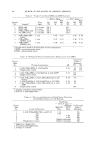
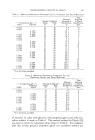
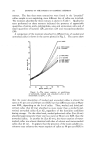
276 JOURNAL OF THE SOCIETY OF COSMETIC CHEMISTS The unexpected presence of water in "dry" callus is probably related to the findings of Watt and Kennett (37), Feughelman and Watt (38), and Algie and Watt (39) with wool fibers. These investigators found that the equilibrium dry weight of wool fibers dried in vacuo is a function of their prior water sorption history. The lowest "dry" weight is obtained by in vacuo drying of fibers which have been saturated with water. Maximum "dry" weight values are obtained by drying fibers that have been stored at relative humidity between 5 per cent and 80 per cent R.H. Presumably, the rate of drying, i.e., the time during which keratin is exposed to inter- mediate humidities, affects its final water content. Apparently, the water in keratin samples stored at intermediate relative humidities is strongly bound and cannot be removed completely, even by heating in vacuo at 140 ø C. (39). Our data demonstrates that the rate of moisture sorption is a function of the surface area and of the quantity of humectant and/,or callus exposed. Therefore, in our studies, all samples were allowed to reach equilibrium, which is independent of both surface and quantity, permitting precise calculations of the "theoretical" sorption of mixtures of callus and humectant. Our results show that the moisture absorbed by mixtures of large quantities of glycerol with callus is strictly an additive function of the water sorption properties of glycerol and callus. This finding is not in accordance with the data of Flesch (22), who reported that glycerol po- tentiated water absorption by callus. This difference may arise from the fact that Flesch determined the water uptake of sample which had not reached equilibrium. Flesch's calculations are based on a sample of glycerol that had absorbed approximately 130 per cent of water at 100 per cent R.H. Our data shows that glycerol exposed to a relative humidity of only 90 per cent absorbs 177 per cent of water at equilibrium, in close agreement with published data (24). Furthermore, glycerol exposed to an atmosphere of 100 per cent relative humidity will absorb more than nine times its weight of water (24). In our work, it required thirty-six days for a 175 rag. sample of glycerol stored in a container with a cross sectional area of 314.2 min. 2 to reach equilibrium at 90 per cent R.H. On the other hand, Flesch terminated his observations after eight days exposure at 100 per cent R.H., before equilibrium had been reached. Flesch noted the absence of potentiation at low R.H.'s, attributing it to the low moisture-holding capacity of callus. It is possible, however, that Flesch's samples, exposed at low humidities, reached equilibrium. His results under these conditions, therefore, confirm our findings. Admittedly, a glycerol q- callus mixture in the ratio of 2: 1 or 3: 1 will absorb a considerable quantity of water at high R.H.'s, literally bathing the callus in a mixture of glycerol and water. However, at low R.H's this mechanism is inoperative. Instead, glycerol will probably absorb moisture

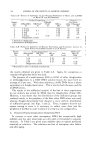
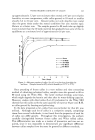
WATER HOLDING CAPACITY OF CALLUS 277 from the epidermal or subepidermal tissue, only to lose it to the dry atmos- phere. Furthermore, if the ratio of glycerol to callus is lowered to more practical ratios, the hygroscopic qualities of glycerol are no longer dem- onstrable (cf. Table 9). In our work, we extracted from 15 to 18 per cent of solids from pulverized callus, depending on the method of extraction and the lot of callus. This value is in good agreement with the amount of water-soluble components extracted by Matoltsy and Balsamo (35), who showed that the amount of water extractables can vary from 12 to 21 per cent within the pH range of 5.9 to 8.2 and that the amount extracted depends on the time of agitation. Blank (3) has reported that the water absorption at 90 per cent R.H of washed whole callus--after removing 3.6 per cent and 7.2 per cent water- solubles--is approximately equal to the amount of water absorbed by un- washed whole callus. Our results with one of the lots of pulverized callus are in agreement with Blank's data, and, furthermore, we show (Fig. 3) about the same amount of water pickup after removal of 18 per cent water- solubles from callus. However, with a different lot of callus water washing decreased its water-holding capacity at 90 per cent R.H. by 13 per cent. Blank (3) also reported that pretreatment of callus with pyridine followed by extraction with water reduces its water-holding capacity from about 38 per cent to 2 a, per cent at 90 per cent R.H. and from about 63 per cent to 35 per cent at 97 per cent R.H., and pretreatment with petroleum ether followed by water washing reduces the water-holding capacity from ap- proximately 35 per cent to 30 l•er cent at 90 per cent R.H. Flesch and Esoda (11) reported that extraction of pulverized callus with ether followed by water reduces its water-holding capacity from 28 per cent to 18 per cent at 100 per cent R.H. Our findings show that washing with polar solvents (ether and ethyl alcohol) has little effect over washing with water alone on the water-holding capacity of the callus. Furthermore, a saml•le of water- washed pulverized callus (Lot #5 ww), from which approximately 18 per cent water solubles had been extracted, gave only an additional 2 per cent of water solubles after washing with pyridine, and the callus, so treated, again absorbed the same quantity of water as untreated pulverized callus (Lot #5 ww). Spier and Pascher (5) have found as much as 16 per cent oflactates in the water extractable solids of stratum corneum. The callus samples used in our work contained very little lactate. In view of the high hygroscopicity of sodium lactate, it is probable that the past history of the callus sample or stratum corneum used may account for some of the observed discrepancies. Callus derived from a subject who bathes or showers daily probably con- tains less of the water-soluble components than that obtained from less frequent bathers. Similarly, plantar callus is older and has been washed more frequently than scales obtained by scraping or stripping. These
Purchased for the exclusive use of nofirst nolast (unknown)
From: SCC Media Library & Resource Center (library.scconline.org)