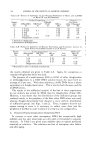
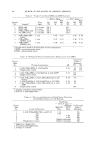
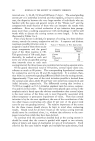
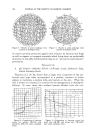
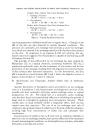
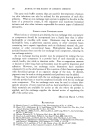
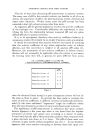
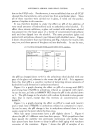
308 JOURNAL OF THE SOCIETY OF COSMETIC CHEMISTS The hydrochloric acid concentrations varied from 0.01N to 0.1N in ethanol-water mixtures. The e.m.f. values were compared with ones obtained on aqueous solutions with the same cell: the deviations from these for corresponding solutions were found to be extremely small, and much less than those predicted by the Dole theory. Now that the apparatus manufacturers can supply instruments with which the smallest direct currents can be amplified with sufficient accuracy and to an adequate extent, the glass electrode has been applied very widely as an indicator, in spite of the fact that it requires calibration and exhibits, in addition to all the basic errors involved in pH measurement, further errors peculiar to itself. Even though in organic media pH values may lie above as well as below the corresponding values in aqueous solution, there is now available a wealth of experimental and practical material concerning electrometric titrations with the glass electrode (13). This is in spite of the fact that its use (pH) in anhydrous media has been warned against from time to time and even deprecated as fundamentally unsound (14). A practical application of the measurement of pH of carbon sludges in nonaqueous systems was the finding that these values correlated with sulfur cure effects in rubber-carbon black systems. Figure 11 shows that •M in lVollowin S Liquid: Mothyl Ethyl Isopropyl Carbon W&tor Alcohol Alcohol Alcohol Micronon W-6 4. Z 3. 9 3. 7 3. 0 Furnoz 8. ß 7. S 6. 9 S. 8 Stitoz B 9. Z 10. 3 9. S 8. Z St&toz 93 ß. ß 7. 7 7. 2 &. & Giston ß. ß 8. I 7. 3 &. S Figure 11.--pH of carbon sludges in water and alcohols. the nonaqueous (alcoholic) sludge gave pronounced pH effects. Alcohols of higher molecular weights gave lower pH readings (15). Many other practical applications suggest themselves, for example alcoholic solutions of some detergents showing a pH lower than a figure set by experience or tests have corrosion properties which may be con- veniently indexed by the pH value. Stability of organic compounds could be measured in anhydrous media from pH change much more readily than in aqueous systems. Relationships between topical irritation and pH values in anhydrous systems have not been reported, although extensive work has been done in aqueous systems.

ANHYDROUS AEROSOL HAIR SPRAY SYSTEMS 309 In conclusion, it has been found that pH measurement in anhydrous ethyl alcohol has revealed valuable information regarding propellent stability and corrosive characteristics of hair sprays. The nonaqueous field seems to be a very fruitful one for the investigation ofpH behavior with the glass electrode. (Received May 8, 1962) BIBLIOGRAPHY (1) Sorensen, S. P. L., Biochem. Z., 21, 131 (1909). (2) Mattock, G., "pH Measurement and Titration," New York, The Macmillan Company (1961), pp. 20, 30. (3) Gutbezahl, B., and Grunwald, E., )t./lm. Chem. Soc., 75, 565(1953). (4) Sanders, P. A., "Mechanism of the Reaction Between Trichloromonofluoromethane and Ethyl Alcohol." Presented at the 46th Mid-Year Meeting of Chemical Specialties Manu- facturers Association, 1960. (5) Bates, Roger G., and Schwarzenbach, G., Helv. Chim./lcta, 38, 699 (1955). (6) Yui, Norio, Bull. Inst. Physical Chem. Research (Tokyo), 19, 1353 (1940). (7) LeBas, Carlyle L., and Day, M. C., )t. Phys. Chem., 64, 465 (1960). (8) Cruse, Kurt, ztrchiv. f•'r technisches Messen, 245, 125 (1956). (9) McInnes, D. A., "The Principles of Electrochemistry," New York, Reinhold Publishing Corp. (1939). (10) Dole, M., "The Glass Electrode," London, Chapman and Hall (1941). (11) Izmailov, N. A., and Belgova, M. A., )t. Gert. Chem. U.S.S.R., 8, 1873 (English summary) (1938). (12) Beck, W. H., and Wynne-Jones, W. F. K., y. Chim. Phys., 49, C 97 (1952). (13) Cruse, Kurt, ztrchiv.filrtechnisches Messen, 245, 217 (1956). (14) Reilley, J., and Rae, W. N., "Physio-Chemical Methods," 5th edition, London, Methuen & Co. (1954). (15) Brooke, M., Ind. & E,oe. Chem., 39, 846 (1947).
Purchased for the exclusive use of nofirst nolast (unknown)
From: SCC Media Library & Resource Center (library.scconline.org)