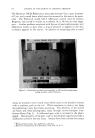
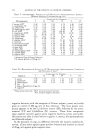
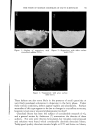
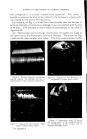
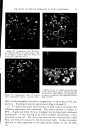
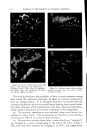
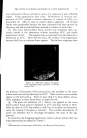
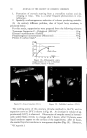
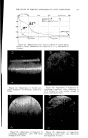
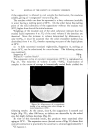
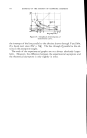
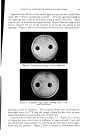
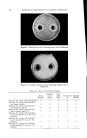
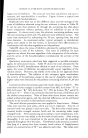
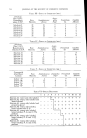
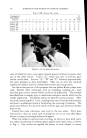
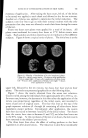
THE STUDY OF SURFACE ANOMALIES OF FATTY SUBSTANCES 741 times faster. The samples are then taken out of the thermostat and kept in the laboratory at room temperature. After four months (Fig. 24) they appear slightly bleached and velvety. Fine white spheroid excrescences are formed, but on a white suppository they would be scarcely visible to the naked eye. (j) If to the same glyceride is added 10% of a mixed mono- and di- glyceride derived from pure C•0- acid, the defects observed after seven months storage at laboratory temperature are more noticeable (Fig. 25). (k) A suppository comprising $uppocire L* and Printex U carbon* black exhibits small excrescences after seven months' storage at room temperature. These are similar to those of Fig. 24 but touch each other. With a mixture of Suppocire BS2X* and 10 to 12% essential oils (melt- ing point 33.5øC) typical excrescences (Fig. 26) were obtained. In this case, the melting point of the mixture studied is evidently too low, and it contains too great a proportion of liquid phase, even at room temperature. CONCLUSIONS According to the observations presented here surface defects can be classified as follows: 1. Excrescences due to crystals: These are unrelated to the fatty base. Instead, the foreign substance diffuses toward the surface and crystallizes. This difficulty can be avoided by wrapping the suppository in a hermeti- cally sealed film (e.g., aluminum foil) touching its surface. 2. Molds: They can be avoided by introduction of an antifungal agent. 3. Excrescences of solid fatty substances: They may be circinate or have wart forms. Crystallization starts from crystalline nuclei. A partial correction may be achieved as follows: The mixture is kept for several days in a pasty form in order to "temper" it and convert the fatty sub- stance into the stable crystalline 3-form then the mass is liquefied slightly at the lowest possible temperature, while keeping the walls of the container below the melting temperature the mass is then poured. This treatment is obviously very time-consuming. 4. Formation of wrinkles: These are due to spontaneous polymorphic changes. Unstable a- and •'-forms are transformed into denser stable 3- form. A possible correction consists of bringing the fatty substance into the 3-form and then injecting the mass, at low temperature, into a mold by means of an injection press. The suppositories obtained are softer than those prepared according to the standard process. 5. Exudates of Liquid Substances: These are due to the presence of too much of the liquid phase and to shrinkage of the crystalline solid skeleton. It seems difficult to correct this anomaly a priori at best one can recom- mend aga. inst storage of the "tempered" fatty substance at too high a temperature. *Cf. Appendix I,

742 JOURNAL OF THE SOCIETY OF COSMETIC CHEMISTS It can be added, finally, that these five standard defects are not formed independently of each other but can appear simultaneously, thus further complicating the problem. The remedies suggested where surface defects are traceable to the fatty base itself (cases 3, 4, and 5) are not commercially feasible because they require major changes in installations. The problem can, however, be solved more easily during the study of new formulations. It would, therefore, be useful to ascertain rapidly whether surface defects are formed readily by the chosen fatty base. For that purpose, it is sufficient to place the suppository in a thermostat at a temperature at which the suppository is slightly softened. Under these conditions, surface defects almost always appear after a few days. If these are fine, homogeneous and visible only under the microscope, they are not serious, and the suppositories can be manufactured according to the chosen formula. On the other hand, if surface defects are formed which are visible to the naked eye, it would be better to seek another suppository base. (Received June 24, 1964) REFERENCES (1) Whymper, R., in W. Andersson, Rev. Intern. Chocotat., 18, 2 (1963). (2) Reinders, W., Doppler, C. L., and Oberg, E. L., Rec. Tray. Chim. LI, 917 (1932). (3) Becker, K., Fette, Seifen, Alnxtrichmitte[, 59, 636 (1957). (4) Kleinert, J., Rev. Intern. Chocolat., 16, 345 (1961). (5) Vaeck, S. V., Ibid., 16, 490 (1961). (6) Giddey and Clerc, Ibid., 16, 530 (1961). (7) Andersson, W., Ibid., 18, 49 (1963). (8) Lutton, E. S., •7. zfm. Oil Chemists' Soc., 27, 277 (1950). (9) Sambuc, E., and Naudet, M., Rev. Franc. Corps Gras, 1, 10, 17 (1959). (10) Mahler, E., Bull. Tech. Gattefoss•, 56, 49 (1958). (11) Mahler, E., Ibid., 55, 58 (1957). APPENDIX I. Raw Materials Codex cocoa butter is cocoa butter meeting the specifications of the Codex Pharmaceutique Frangais. Printex U carbon black is obtained from Degussa, Frankfurt, Germany. Suppocire .4 is an interesterified hydrogenated palm oil having a melting point of 35ø-36øC. It is marketed by Gattefoss&sfpa, 15 rue Constant, Lyon (35) France. Suppocire C is similar to Suppocire A but contains more of the higher molecular weight fatty acids. It melts at 38øC-40øC. It is marketed by Gattefoss&sfpa. Suppocire L is hydrogenareal oil interesterified in the presence of poly- oxyethylene glycol. It melts at 38øC--39øC. It is marketed by Gatte- foss?c-s fpa.
Purchased for the exclusive use of nofirst nolast (unknown)
From: SCC Media Library & Resource Center (library.scconline.org)