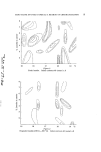
14 JOURNAL OF THE SOCIETY OF COSMETIC CHEMISTS MR. E. W. CLARet: Have you any comments to make on the small peak for peroxides in Fig. • ? T• L•CTUR•R: The fact that the peak is right at the top of the diagram indicates that the concentration of peroxide is rather low. If one has a high concentration of peroxide, the peak will appear at the bottom of the diagram, but as the con- centration fails the peaks move up the concentration axis. Even though this lanolin has been stored for ten years it suggests that there is no high concentration of peroxide. MR. E.W. C•-ARK: Was the sample taken from the surface layer, or deep down ? T• L•CTUR•R: If the surface layer had been taken there would probably have been a much higher concentration of peroxide. MR. J. D. C•w. SHIR•: Do you think that your method for group classification has any advantages for a laboratory already equipped with I.R. spectrophometers? Tn• L•CTUR•R: Yes, for a preliminary examination. If one is faced with a new sample, or a sample of a mixture which is suspect in any way, the method would be very useful when taken in conjunction with I.R. examination. I am not putting up this method as better in any way than established procedures where the analysis is straightforward. It does involve rather a lot of work as I have mentioned towards the end of the paper, and therefore would not be justified except in a particularly difficult case.

J. Soc. Cosmetic Chemists 16 15-30 (1965) ¸ Io6• Society o! ½osmai• ½•mists o! G,eat Britain The Activity of Antibacterials Two-Phase Systems H. S. BEAN, S. M. HEMAN-ACKAH and J. THOMAS* Presented at the Symposium on "Preservatives and Antioxidants", organised by the Pharmaceutical Society of Great Britain and the Society of Cosmetic Chemists of Great Britain, in London on I7th November 1964. l•lynop$1$--Bactericides in oil/water systems are partitioned between the two phases, the concentration in the aqueous phase being controlled by the overall concentration and the oil:water ratio. The antibacterial activity of the systems is determined both by these factors and by the enhanced concentration of bactericide at the oil/water interface. A chaaxge in temperature of the dispersions changes their antibacterial activity by virtue of the normal effect of temperature on bactericides, and by a change in the partition coefficient which may, in some cases, be appreciable. During the past decade or so an increasing number of failures of so-called "preservatives" to protect creams from microbial spoilage has been reported. This period coincides with that during which, in general, there has been a change from the use of anionic emulsifiers to nonionic emulsifiers, and this reformulation unwittingly modified the resistance of the products to microbial attack. Many factors influence the effectiveness of a preservative in any formulation and there are some notable reviews on the subject (1,2,3,4). Emulsions and creams contain many substances which collectively form excellent substrates for the growth of micro-organisms (5,6). Under some conditions the oil phase may be metabolised. Fungi have been reported to grow on fixed oils (7,8,9), and some oxidative and lipolytic bacteria can break down fixed oils and fats (10,11,12), while hydrocarbon oils can be *School of Pharmacy, Chelsea College of Science and Technology, London, S.W.3. 15
Purchased for the exclusive use of nofirst nolast (unknown)
From: SCC Media Library & Resource Center (library.scconline.org)