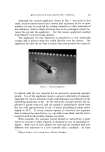
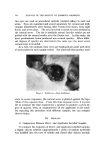
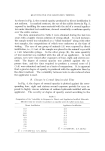
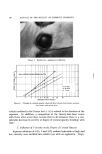
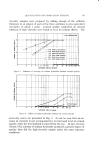
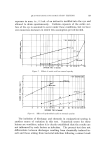
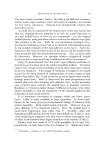
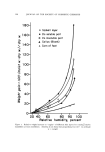
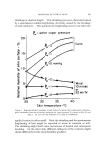
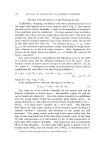
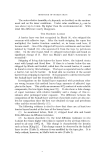
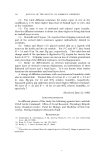
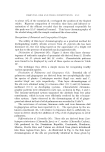
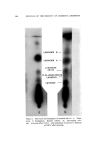
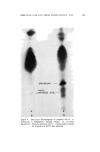
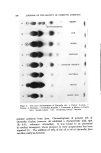
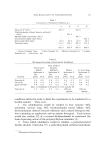
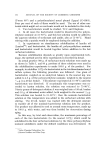
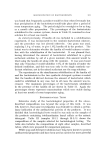
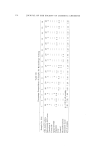
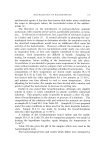
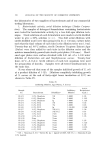
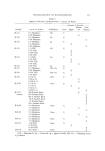
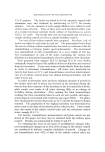
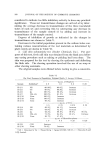
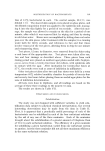
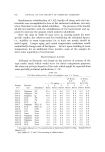
QUANTITATIVE EVE IRRITATION TESTING 129 exposure in man, i.e., 0.1 mi. of an irritant is instilled into the eye and allowed to drain spontaneously. Uniform exposure of the entire sur- face of the eye is assumed to occur under these conditions, but we have seen numerous instances in which this assumption proved invalid. 4 8 1 7 DAY OBSERVATIONS / ! / • '&"21% w/w / / 10.5 % w/w// --." m "''•"' ,"'"5.25 % w/w ............ . ....... .... L-. '( 2 3 4 5 6 7 8 9 I0 15 20 •0 40 50 60 70 IP8 EXPOSURE TIME (In Seconds) Figure 7. Effect of acetic acid on eorneal opacity -- 4 8 • 2 m I :5 4 5 6 7 8 9 I0 15 20 :50 40 50 607080i28 EXPOSURE TIME (In Seconds) •¾gure 8. Effect of hydrochloric acid on corneal opacity The inclusion of discharge and chemosis in conjunctival scoring is another source of variation in this test. Numerical scores for these lesions are worthless, unless it is clearly established that the results are not influenced by such factors as infection. The present test does not differentiate between discharges resulting from chemically induced in- sult and those arising from bacterial infection following a minor break

130 JOURNAL OF THE SOCIETY OF COSMETIC CHEMISTS in the continuity of conjunctiva, contamination of the animal's eye by the experiments, or contamination by the animal himself. The area involved should not be considered in any scoring system of corneal opacity since, in all probability, most of the variations en- countered are due to nonuniform exposure. For this reason applicators have been used for the instillation of test materials. Similarly, we ques- tion the validity of any method in which the lesions are scored, weighted according to the structure involved, and then totaled. Two eyes with equivalent scores may differ considerably in the extent of injury, es- pecially when the total score is low. The rabbit eye has been used to test irritants for many years, but this practice has also been questioned (8). Although anatomical differences between the eyes of humans and rabbits have been reported (4), it would be surprising to find that the greater thickness of the human corneal epithelium has as much of a protective influence on severity of ocular irritation as does the greater output of lacrimal fluid in humans. In either case, in the absence of sufficient comparative data, the eye of the rabbit would be expected to be somewhat more sensitive than that of man. Much thought has been given to the need for a material which could be used as a criterion for irritation. The response produced by this material would serve as a basis for comparing other test materials those that produced less irritation would be acceptable, and those that pro- duced more irritation would be rejected. Until such a substance is selected, it would be extremely helpful to the cosmetic industry for the F.D.A. to provide a standard irritant. This material would enable each laboratory to test the same sample and then compare their results with those obtained by others. In this connection it is noted that Buehler and Newmann (8) recently reported the development of a "cup aspirator" that is designed to insult a defined area of the cornea and to standardize the insult period. Obviously, any test procedures must ultimately meet with the ac- ceptance by the F.D.A. It is also evident that the method described, in principle, is quite different than that of the Draize test however, as additional data become available, it should be possible to determine whether this method is a valid approach to the problem of testing eye irritants. Unfortunately, this difference in procedure precludes a direct comparison between methods at this time.
Purchased for the exclusive use of nofirst nolast (unknown)
From: SCC Media Library & Resource Center (library.scconline.org)