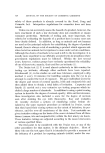
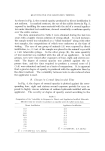
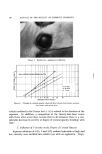
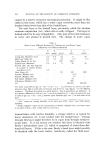
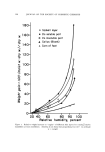
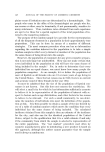
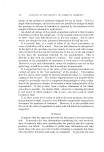
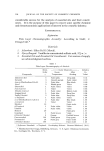
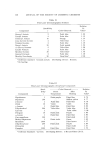
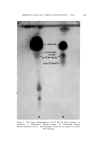
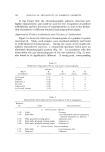
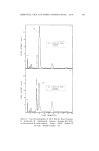
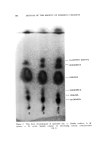
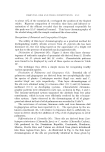
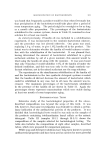
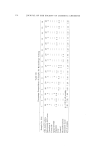
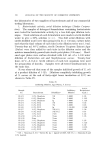
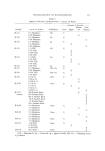
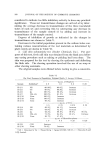
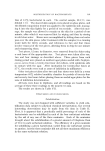
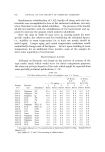
MOISTURE OF HUMAN SKIN 135 The lower barrier contains (Table I) the bulk of the diffusion resistance, and its water vapor resistance varies with relative humidity, as it should for true horny substances. Planned tests should decide whether this description is true. It could also be argued that the Szakall layer is the only barrier but that the stripping process damages it to such an extent that data in vivo and Szakall layer in vitro are not comparable. For the original Szakall process, using petroleum ether to remove the adhesive tape glue, this certainly is the case. With the new mechanical technique of re- moving the Szakall layer there can be no chemical contamination except by the possible remnants of the tape adhesive on the layer. Such rem- nants have not been detected on any of the pieces used for transfer tests when examined with the polarization microscope. Also, no holes could be discovered. However, the question whether stripped-off Szakall layer is usable to represent living conditions has still to be answered. King (2) demonstrated that the water vapor diffusion resistance of horn increases ten times when the relative humidity declines. The latter value is the average of the humidities on both sides of the piece of horn in the test chambers. This change of resistance is thought to be caused in part by the steep increase of hygroscopicity or water regain at high relative humidities (Fig. 1) and in part by an easier liquid water transfer through moist horn. Mali (4) discovered the same phenomenon with excised skin even after stripping with adhesive tape in this particular case a barrier layer without the Szakall layer is probably involved. Buettner (5-7) found a similar change of diffusion resistance with either relative humidity or with the osmolarity* of the solution applied on the living skin of arm, hand and foot. It is sometimes convenient to compare callus and lower horny layer. Callus is easily available in large quantities. It shows simi- larities to the horny layer in its mechanical change of behavior with relative humidity. Both consist mainly of keratin. However, they are quite different in two important aspects. First, the Szakall layer is much more hygroscopic than callus (Fig. 1). Secondly, callus and Szakall layer differ grossly in their water vapor diffusivity (Table I) that of the Szakall layer compares well with that of rubber and plastics, that of callus is one hundred times higher than that of the barriers (Table I). Blank's tests were made at 23øC with humidities of 100 and 18%, respectively, on both sides of the test chamber (8). Blank and Mali's * Osmolarity = molarity X van't Hoff's dissociation constant.

136 JOURNAL OF THE SOCIETY OF COSMETIC CHEMISTS 180- 160- 140- , 120- [] Szakall layer ß Its soluble part ,D Its insoluble part A Callus (Blank) ,, Corn of foot I I i ! 2:0 40 60 80 90 100 Relative humidity, percent Figure 1. Relative weight increase or "regain" of different skin layers for varying'relative humidities at room conditions. Abscissa is not linear but proportional to (rh) 2. In ordinate w = weight
Purchased for the exclusive use of nofirst nolast (unknown)
From: SCC Media Library & Resource Center (library.scconline.org)