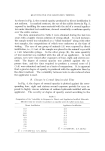
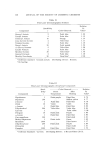
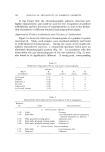
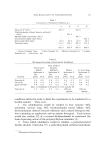
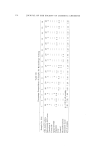
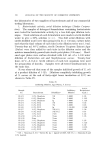
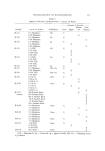
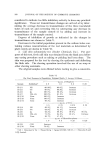
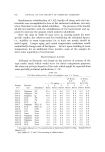
SOLUBILIZATION OF BACTERIOSTATS 173 was found that frequently a product would be clear when first made but that precipitation of the bacteriostat would take place after a period of room temperature aging. The period might be overnight or for as long as a month after preparation. The percentages of the bacteriostats solubilized in the various systems, shown in Table II, remained in clear solution for at least one month. As stated previously, if lanolin oil was included in a solubilization experiment, it was incorporated in the nonionic-bacteriostat mixture, and the procedure was not altered otherwise. One gram was used, replacing 1.0 g. of water, to give 1.0% lanolin oil in the product. The intent was to determine whether the lanolin oil would enhance or inter- fere with the solubilization of the bacteriostat. It was planned that, having determined the amount of bacteriostat solubilized in a given surfactant solution by aid of a given nonionic, this amount would be tried using the lanolin oil along with the nonionic. It was soon found that only Nimcolan S would solubilize 1.0% of the lanolin oil under the defined conditions, and this was true only in the single synthetic sur- factant solutions, not in the mixed surfactant nor the soap solutions. The experiments on the simultaneous solubilization of the lanolin oil and the bacteriostats in the two synthetic detergent systems revealed that the lanolin oil did not decrease the amount of bacteriostat which could be solubilized in any case, but in all cases the amount was in- creased. The maximum percentages of the bacteriostats solubilized in the presence of the lanolin oil are shown in Table II. Again the percentages shown represent concentrations which were stable during at least one month of room temperature aging. BACTERIOLOGICAL TESTS Extensive study of the bacteriological properties of the above- described compositions was beyond the scope of this work. It was felt, however, that some investigation was desirable to obtain a prelim- inary indication of the antibacterial activity of the products. It was decided that bacteriological tests would be run only on the samples of the products containing triethanolamine lauryl sulfate as the anionic detergent. Table III (samples H-3/1 through H-3/8) shows the compositions of the samples selected for bacteriological testing. The table also includes the compositions of eight other samples, described below, which were prepared for comparison purposes. While soap and detergent solutions have long been known to possess antibacterial properties and have been used as carriers for more powerful

174 JOURNAL OF THE SOCIETY OF COSMETIC CHEMISTS
Purchased for the exclusive use of nofirst nolast (unknown)
From: SCC Media Library & Resource Center (library.scconline.org)