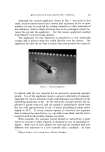
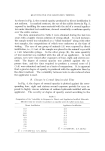
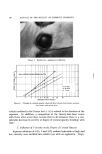
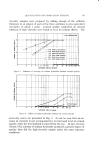
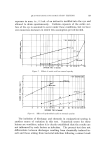
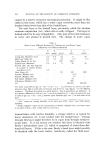
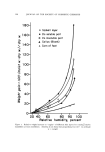
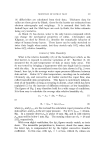
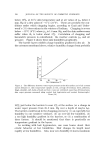
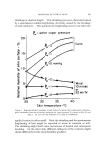
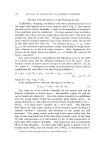
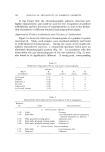
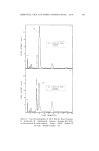
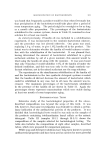
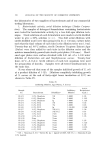
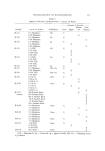
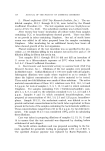
MOISTURE OF HUMAN SKIN 137 (4) diffusivities are calculated from their data. Thickness data for callus are those given by Blank those for the barrier are estimates from electron micrographs and weighings. It is assumed that both the Szakall layer and the Mali layer are each 3/• thick, the latter estimate being very tentative. As Blank (8) has shown, water is the only known compound which can change the mechanical properties of callus. Christopher and Kligman, as cited by Flesch (1), describe the remarkable behavior of strips of human horny layers. These layers can be easily stretched to twice their length when moist, but they stretch only 10% when held below 65% relative humidity. Control of Skin Humidity What is the relative humidity (rh) of the Szakall layer which, as the first barrier, is exposed to extreme variations of rh? Buettner (9, 10) measured the rh and temperature of skin at many body areas. The rh was tested by bringing a hygrometer with one single hair in contact with the skin. In an unventilated room the data shown in Fig. 2 were found here zXpw is the average water vapor pressure difference between skin and air. Below 35øC skin temperature, sweating can be excluded. Obviously zXp•, and convective air tranfer control the vapor flow, also called insensible skin perspiration. This figure is notoriously indepen- dent of air humidity as long as sweating is absent, a fact which has been explained (5) by the increase of diffusion resistance at low humidities. The figures of Fig. 2 may therefore hold for a wide range of conditions. It is then easy to calculate the average skin relative humidity rhs. or P•s = P•,a + /xp• = rh•.p•.•.at where Pwa and pw• are the real and the saturation vapor pressures at the skin surface, and p• is the air vapor pressure. For $5 øC p•, = 42 mm. Hg. In a summer desert p• is about 10 mm. Hg, and in cold winters p•,a may well be below 1 mm. Hg. The ensuing values are rhs = 38 and 25%, respectively. With even slight ventilation, the zXp• figures nearly vanish, as tests show. The insensible perspiration is, however, about the same, since the lower zXpw is compensated for by the higher convective transfer coefficient. In this case, with zXp• = 1 or less, critical rhs values are rhs = (p•,c• d- /xp•,)/p•,•.c, (2)

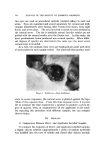
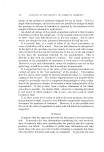
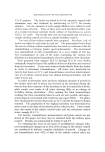
138 JOURNAL OF THE SOCIETY OF COSMETIC CHEMISTS below 10%, at 35øC skin temperature and at air values of P•a below 3 mm. Hg or a dew point of -6øC (21øF). These are precisely the con- ditions under which chapping begins, according to Gaul and Under- wood's (11) observations in the winters of Indiana. Chapping is severe below -13øC (8øF) where Pwa is 1.6 mm. Hg, and the skin surfaces may suffer when rhs is below about 5%. Correlation of chapping and barometric pressure is coincidental the weather controls pw• and air pressure. Figure 3 shows these skin humidities graphically. The barrier layers exhibit a large humidity gradient in dry air. In the extremes mentioned above, relative humidity changes from probably 3'0 3'5 4• Skin temperature-øC Figure 2. The difference between water vapor pressure at the skin surface and of air at some meters distance vs. skin temperature (people at rest, average of forehead, chest, abdomen, thigh, shoulder, calf, backs of hand and foot room not ventilated more than 50 test persons skin vapor pressure measured using contact hair hygrometer and contact thermocouple). From (10) 90% just below the barriers to near 5% at the surface (or a change in water vapor pressure from 38-2 min. Hg over a depth of maybe 6/•). The barriers could break in the chapping process by (1) an especially low humidity in one sensitive sublayer, (2) an over-all low humidity, (3) a too high humidity gradient in the barriers, or (4) a combination of these factors. It should be mentioned that there is practically no temperature gradient in the layers. In working with hair hygrometers, one soon learns about their erratic behavior at low humidities. Hair changes its length most rapidly at low humidities. Also, near zero humidity it shows maximum
Purchased for the exclusive use of nofirst nolast (unknown)
From: SCC Media Library & Resource Center (library.scconline.org)