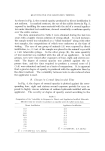
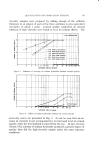
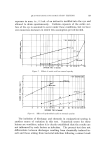
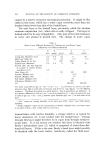
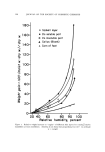
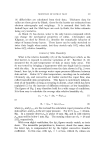
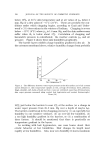
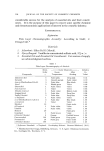
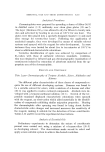
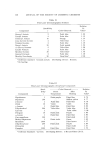
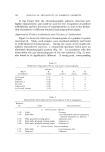
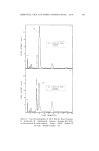
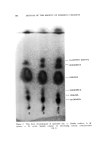
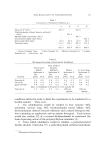
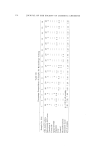
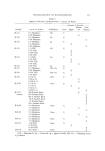
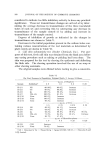
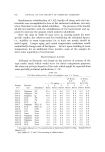
MOISTURE OF HUMAN SKIN 141 The outer relative humidity rha depends, as decribed, on the environ- ment and on the inner conditions. Under calm conditions Pwa can be (see above) up to 6 mm. Hg higher than the environmental air. With wind this difference nearly disappears. THE BARRIER LAYERS A barrier layer was first recognized by Blank ($), who stripped the corneum with adhesive tape. After the tenth stripping the vapor loss multiplied, the barrier function vanished, or, in terms used here, R became small. One of the stripped-off layers is continuous and was later isolated by Szakall (14) who separated it from the tat e by petroleum ether. On the other hand, Mali (1) stripped excised skin and found on significant change of R. How can Blank's and Mali's statements be reconciled ? Stripping of living skin iniures the layers below the injured strata react with lymph and blood flow. If there is a barrier below the one stripped by Blank and Szakall, called here the second barrier, it cannot be found in viva by this technique. The layer so separated can be called a barrier, but not the barrier. In dead skin no reaction of the second barrier from stripping is expected. It is proposed to call the first barrier the Szakall layer and the second the Mali layer. Investigations on the Szakall layer separated with petroleum ether are wrong because this method leaves large amounts of adhesiv• tape glue in the layer. This yields an erroneous 40% content of water soluble components, the true figure being near 5%. It also shows a false change of vapor resistance with relative humidity and a change of this re- sistance after prolonged water exposure. The difference between the composition of the Szakall layer and that of psoriasis scales are also use- less for comparison since the first was obtained via tape and petroleum ether and the second directly (15). The following evidence is cited to show that there are at least two barrier layers located at the base of the horny layer: (1) As mentioned before, Mali (1) stripped dead skin and found little difference in diffusion resistance. (2) As shown elsewhere (6), the total diffusion resistance in viva is about five times higher when skin is exposed to dry air than when ex- posed to air near 100% rh. This change is characteristic for keratin such as horn [King(2)]. This change cannot be observed in the Szakall layer in vitro (Table I), whereas it was modified by the tape glue. It is truly evident, however, in Mali's tests in vitro (Table I).

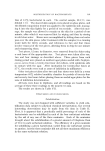
142 JOURNAL OF THE SOCIETY OF COSMETIC CHEMISTS (3) The total diffusion resistance for water vapor in vivo at dry conditions is 5-10 times higher than that of Szakall layer in vitro, also at dry conditions. (4) The same is true of methanol and ethanol vapor transfer. Here the diffusion resistance is about ten times higher in living skin than in Szakall layer in vitro. (5) Marzulli and Tregear (16) reported that stripping removed only part of the excised skin's resistance against radioactively labeled in- secticides. (6) Onken and Moyer (17) placed excised skin on a capsule with water on the inside and dry air outside. For 9øC and 40 øC they found R = 5.4 and 4.8 m. • hr. mm. Hg/gm , respectively. This value does not change much if the specimen is digested in 3% trypsin for twenty-four hours at 37øC. Stripping causes an uneven loss of stratum granulosum and a lowering of the diffusion resistance, not its disappearance. (7) Brody (3) differentiates on electron micrograph analysis an upper layer or stratum corneum disjunctum, an intermediate of three flattened cell layers and a basal layer. It is not known what barrier functions the intermediate and basal layers have. A change of diffusion resistance with environmental humiditiy exists also in animal skin. Excised skin of rat has R = 0.7 and R = 0.2 m. 2 hr. mm. Hg/gm. for 50 and 90% relative humidity, respectively. Separated guinea pig epidermis shows much higher diffusion resistance. We have R -- 33 and R = 10 for 50 and 90% relative humidity, re- spectively. * (Received June 25, 1964) J•CKNOWLEDGMENTS In different phases of this study the following agencies have assisted: USAF Arctic Command Office of Naval Research, Physiology Branch Army Chemical Center Fund for Biology and Medicine of this Uni- versity Boeing Employees Research Fund. REFERENCES (1) Christopher, E., and Kligman, A.M., cited by Flesch, P., t'roc. Sci. Sect. Toilet Goods Assoc., 40, 12 (1963). (2) King, G., Trans. Faraday Soc., 41,479 (1945). (3) Brody, I., J. Invest. Dermatol., 42, 27 (1964). * These data are evaluated from the originals given by Edward J. Singer in personal com- munication.
Purchased for the exclusive use of nofirst nolast (unknown)
From: SCC Media Library & Resource Center (library.scconline.org)