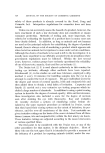
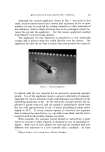
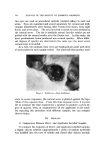
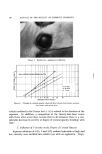
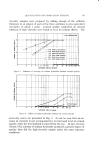
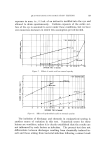
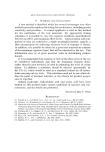
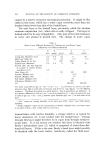
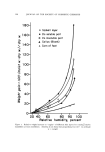
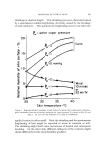
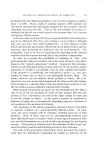
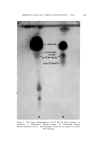
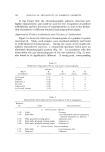
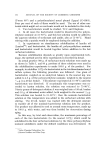
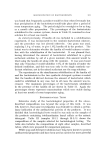
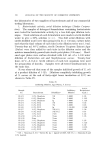
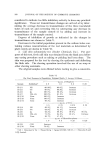
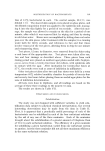
MOISTURE OF HUMAN SKIN 139 shrinkage or shortest length. This shrinking process is often interrupted by a spontaneous sudden lengthening, obviously caused by the breakage of some sublayers. This spontaneous lengthening occurs even when the water vapor pressure Skin temperature-øC Figure $. Expected relative humidity of skin surface for given skin temperature (abscissa), given ventilation (two sets of curves) and given air vapor pressure, P•0 based on Eq. (2) and Fig. 2. (cf. also (10) for reduction of Pw due to ventilation) applied tension is rather small. Both the shrinking and the spontaneous lengthening of hair might be expected to occur in corneum as well. The shrinking might itself cause an increase of tension and subsequent breaking. On the other side, different sublayers of the corneum might shrink differently in this steep humidity gradient.

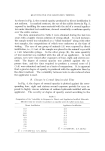
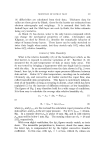
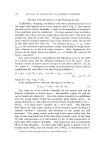
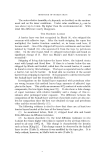
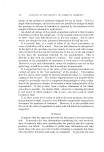
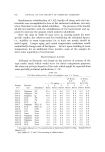
140 JOURNAL OF THE SOCIETY OF COSMETIC CHEMISTS THE RELATIVE HUMIDITY OF THE BARRIER LAYER If pliability, chapping, emolliency and other mechanical factors of the upper skin depend on its water content, and if (Fig. 1) this content depends on the relative humidity, a study of its magnitude is important. Two conditions must be considered. If a large amount of air or relative humidity, rhx, blows over an excised piece of horny layer, that layer will assume the same rhx in due time. If large amounts of this excised skin layer contact a limited amount of air of any initial rh value, the air will. in due time show the value rh•. The product rh. Pw.•sat = Pws where P•at is the saturation vapor pressure, a figure depending on temperature only, whereas p• is the real vapor pressure. Since temperature dif- ferences in the upper layers are minute, p•s•t is usually the same for all layers concerned. Any vapor transfer is controlled by the difference of Pw on two sides of a barrier layer and the diffusion resistance R of the layer. If we assume a series of barrier layers on top of each other called 01, 12, 23, etc., where 0, 1, 2 designate the border areas between the layers, then in equilibrium the vapor flow Q for three layers is found as' Q = (p•0 - p•1)//•01 = (Pwl -- p,,2)/R12 = (p,,2 -- p,,a)/R2a -- (p,,o- p•)/R (3) where R = R01 + R•2 + R•3. If the temperature is constant, this may be written as Q/p,,•.• = (rh0 - rhl)/R0•, etc. (4) The value rh3 is the relative humidity at the surface and can be directly evaluated as shown above. Intermediate values rh• and rh2 can be found only indirectly. rh0 is the relative humidity in equilibrium with the living matter below the essentially dead barrier layers. As shown elsewhere (5), this value is not that of body isotonic fluids or rh0 = 99.3%. It is much lower namely, rh0 = 85 to 90%. This indicates that below the skin exists a pump or active transfer agent creating a 4 osmolar solution.* Anatomy and function of this pump are still mysteries. The pump causes water and water vapor inflow into the skin of arm, hand and foot if the skin either touches water of less than 5% salt concentration or is surrounded by air at skin temperature of more than 90% relative humidity. This pump has also an important effect on skin pliability. It causes skin under grease or plastic cover to become moist (90%) but not stickily wet (100%), as mentioned above. * Number of moles per liter of water X van't Hoff constant = 4.
Purchased for the exclusive use of nofirst nolast (unknown)
From: SCC Media Library & Resource Center (library.scconline.org)