J. Soc. Cosmetic Chemists, 16, 133-143(1965) The Moisture of Human Skin Affected by Water Transfer* as KONRAD J. K. BUETTNER, Ph.D. Presented before the Third Congress of The I.F.S.C.C., June 21-26, 1964, New York City Synopsis--Mechanical features of and damages to the outer skin, such as pliability, stretch~ ability, stickiness while wet, and chapping seem to depend, at least partly, on the water con- tent on the stratum corneum, or, rather, the barrier layers. Statements on the behavior of callus cannot be immediately related to those referring to the barrier layers. The water content of the barriers depends on the local relative humidity. There seem to be at least two barriers. Their variable water vapor diffusion resistances, the external milieu and the active transfer processes below the barrier control the relative humidity of the barrier layers. 1. INTRODUCTION It is commonly accepted that skin wet •: from sweating or prolonged water application is clammy and very stretchable (1). Skin separated from the atmospheric environment for a long time by impermeable layers of oil, grease or plastics feels less clammy the reason for this will become apparent later. Very dry skin feels brittle, can be stretched very little, and breaks easily. Where are the barrier layers? In stripping the outer layers, stratum corneum disjunctum comes off easily in incoherent bits and pieces. It * Contribution #83, Department of Atmospheric Sciences, University of Washington, Seattle, Wash. } Dept. of Atmospheric Sciences and Div. of Dermatology, University of Washington, Seattle, Wash. { Anatomical and physiological behavior of the skin of palms and soles, of the inguinal area, of hairy areas and of the surroundings of body openings are so different from that of the rest of the body that they are excluded from the present discussion unless specifically stated. All following data refer to non-sweating skin. 133

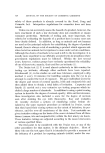
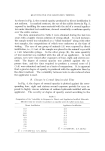
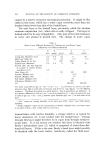
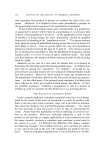
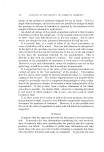
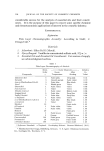
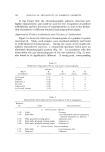
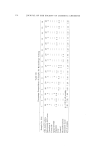
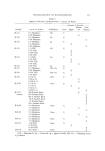
134 JOURNAL OF THE SOCIETY OF COSMETIC CHEMISTS cannot be a barrier except for mechanical protection. It might be like callus in this sense, which has a water vapor resistivity more than one hundred times lower than that of the Szakall layer. The next layer is the Szakall layer, previously called the stratum corneum conjunctum (scc), which also is easily stripped. This layer is defined solely for its easy strippability. Only part of the total resistance to water and alcohol is located here. The change of water vapor Table I Water Vapor Diffusion Resistant R, Thickness dx, and Water Vapor Diffusivity k of Different Materials R R k dry a moist a dx(u) dry • k moist • Living skin [Buettner (5,6)] Mall layer [Mall (4)] Callus [Blank (8, 12, 13)] Szakall layer [Buettner] Excised skin, also skin digested in trypsin or NaOH IOnken and Moyer (17)] Horn [King (2)] b Paraffin [Blokker (18)] Ebonite [Blokker (18)] Soft rubber [Blokker (18)] Cellophane [Blokker (18)] Air 2.5 0.6 (6) 8 4.1 1.6 (3) 2.3 0.7 ... 200 1000 0.3 0.3 3 30 3O 6.5 ß . . 3O 5.0 5O 100 ... 0.15 ... 4.5 ... 24. ß.. 600 . .. 280,000 ß . . 1400 280,000 The water vapor flow Q (gm. m. -2 hr.-•) is Q = _P• - Pw,,)/R where Pw• and P•2 are vapor pressures (mm. Hg) on both sides of the layer and R (m. 2 hr. mm. Hg gm.-i) is the diffusion resistance. Thickness dx is given in •u where known data in parentheses are estimates. If dx is known, diffusivity k (10 ø cm. 2 sec.-•) can be evaluated by Q = k dpw/dx where Q is now in units of gm. cm.-2 secß-• and p• denotes vapor densities (gm. cm.-a) on both sides of the layerß a "Dry" means an average humidity of tile layer near 50%, "moist" near 95% relative humidity. b King's original k values are for concentration or density of liquid water, not water vapor in the piece of horn data in this table are converted. transmittance with relative humidity, a change which is so typical for horny substances (2), is not evident with the Szakall layer. Passage through this layer might therefore be in vapor form through submicro- scopic holes. It is not known yet whether this layer is identical with Brody's intermediate layer (3), which is composed of about three flat- tened cell layers. If this is the case, Brody's basal layer might possibly be identical with the lower barrier, tentatively called the Mall layer.
Purchased for the exclusive use of nofirst nolast (unknown)
From: SCC Media Library & Resource Center (library.scconline.org)