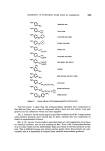
REACTIONS TO ARTIFICIAL COLOURING MATERIALS 217 eosin. A simple chromatographic analysis of a number of commercial samples will show that their composition varies from one to another. Furthermore, we have been able to confirm that repeated sodium salt recrystallization can considerably diminish, if not abolish, the dermatitic action of a sample of eosin. We now have quite a large number of patients who have had an eosin lipstick dermatitis, and who have continued to use for several years without further trouble a lipstick made with a similar concentration of such a highly purified eosin. But I must emphasize that these patients probably represent rather less than half of all our eosin- sensitive patients. So far, all attempts to identify the responsible allergen more precisely have failed. None•of our patients has reacted to resorcin or phthalic anhydride (from which fluorescein is made as a condensation product) or to unhalogenated fluorescein. There are presumably other unidentified phenolic by-products. The residue which we obtained from the repeated recrystallization was shown to be more strongly dermatitic than the original material. Paper chromatography using a solvent mixture of 50% ethanol and 3% ammonium hydroxide showed orange and light purple fluorescent materials which were not present in the refined sample. Apart from cases of lipstick dermatitis attributable to eosin sensitivity I have seen about 10 patients whose allergic reaction was traced to one of the other colour constituents. Six of them reacted to a single brand of a so-called hypo-allergenic lipstick which did not contain any eosin. At that time these lipsticks contained eosin salts of basic dyestuffs and the patients who were known to be sensitive to eosin evidently cross-reacted with these salts. I am of the opinion, therefore, that a hypo-allergenic lipstick should not contain any eosin derivatives at all. Rhodamine and its derivatives are another cause of allergic reactions, although they must be rare. One patient developed a dermatitis from lipstick and a face powder at the same time. It was traced to the colour D and C Red No. 36 (Permaton Red) which is 1-(o-cbloro-p-nitrophenylazo)- 2-naphthol. She also experienced a rash from nylon stockings and from the black lining material of a coat. She gave a positive patch test to the coat lining but we were unable to trace the dye. However, it was probably an azo dye, and one wonders if the two reactions could have been related, in spite of the fact that the Permaton Red does not contain a free/•-amino group. A second patient seen a few years later had a lipstick dermatitis and also reacted to the Permaton Red (D and C Red 36) in a regular lipstick but not to the eosin. She was also allergic to hydroquinone (she worked

218 JOURNAL OF THE SOCIETY OF COSMETIC CHEMISTS in a photographic laboratory) but I cannot see that the two sensitivities were chemically related. Another patient with dermatitis from a regular lipstick who was not sensitive to eosin, was found to be allergic to the barium lake of D and C Orange No. 17 (Permanent Orange) or 1-(2,4-dinitrophenylazo)-2-naphthol. This is another example of a reaction to a lake colour. The lakes are evidently not completely innocuous or biologically inactive, even though they may not "bleed", and are acceptable for use by the cosmetic chemist. One must remember, however, that in an allergic person only very small amounts of the chemical are required to produce a reaction. While on the subject of lipstick reactions I should like to mention that we have seen three patients with allergic sensitivity to carmine in a lip salve. Carmine is the aluminium lake of cochineal, obtained by precipi- tation with inorganic salts and albumin. The essential constituent is carminic acid. Carmine is used in a salve as a substitute for lipstick by some women. In cosmetic products other than lipsticks, I have seen a number of reactions to colour materials. Some of these are traceable to eosins and their derivatives, or to rhodomines and red azo dyes, but several have been found to be caused by yellow dyes. I have not always succeeded in identifying them further. But it may be of significance that in a recent investigation of our patients with allergic reactions to dyes in textiles and other articles of clothing, the most frequent sensitizing agent is Dispersol Fast Yellow G (Colour Index No. 11855). I have seen one patient with an allergic contact reaction to Amaranth (F.D and C Red No. 2) which is mainly the trisodium salt of 1-(4-sulpho-l-naphthylazo)-2-naphthol-3, 6-sulphonic acid. This material is used for dyeing textiles as well as in foodstuffs, and in the pharmaceutical industry apart from cosmetics and toiletries. Several drugs in the British National Formulary contain it. NAiL LACQUERS The last type of reaction from colouring agents which I wish to mention is not an allergic one at all. A few years ago dermatologists in Britain saw quite a large number of women who noticed that their fingernails developed an irremovable yellow-orange discolouration after using certain nail lacquers. It was at a time when lacquers of a tangerine or apricot colour were fashionable, but not all of the patients admitted that they had used these colours. Some of the pink and other non-yellow colours of nail lacquer at that time did, however, contain small quantities of yellow dyes.
Purchased for the exclusive use of nofirst nolast (unknown)
From: SCC Media Library & Resource Center (library.scconline.org)