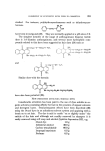
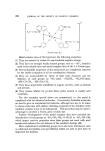
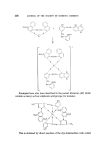
236 JOURNAL OF THE SOCIETY OF COSMETIC CHEMISTS Metal complex dyes of this type have the following properties: (1) They are anionic by virtue of a non-localized negative charge. (2) They have no strongly locally ionized groups, such as --SO-a, found in most water-soluble dyes and metal complex dyes of the 1:1 Neolan type. (3) The hydrophilic properties of the metal atom are completely removed by the stable occupation of all its coordination valencies. (4) They are water-soluble by virtue of their ionic character and the influence of such groups as-SO•-alkyl,-SO•NH•,-SO•NH-alkyl, -NH-CO-CH•, -NH-SO•-CH•. (5) They have appreciable solubilities in organic solvents, such as alcohols and ketones. (6) They possess affinity for protein fibres under neutral or weakly acid conditions. The two examples quoted above are symmetrical, i.e. the metal is complexed with two identical molecules. Occasionally dissimilar molecules are used to give an unsymmetrical molecule, although care has to be taken to choose molecules with similar chelating properties if the stability of the resultant complex is not to be endangered. This procedure may be used to advantage to produce a brown, grey or black dye. Further developments of the metal complex dyes have included the introduction of such groups as -SO•-CH•-CH•-O-SO•H or -SO•-CH-CH• which impart reactive properties since these groups can react with wool keratin and enhance the wet fastness of the resultant dyeings (42). More sophisticated solubilizing groups have also been introduced, such as sulphonyl-morpholine and pyrrolidonyl which are said to give dyes of improved wet fastness.

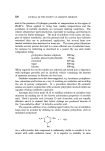
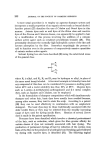
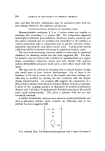
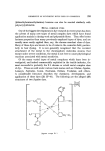
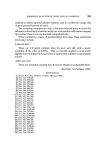
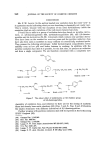
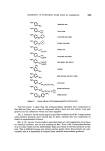
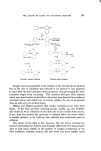
CHEMISTRY OF SYNTHETIC DYES USEI) IN COSMETICS 237 /H•-C•z CH•-C• N--SO•-- and /N--- CH•- CH z CH•-"• 0 New chelating systems have been developed (45) to produce 1:1 metal complex dyes suitable for dyeing nylon under acid conditions. One example given is the nickel complex of the following ,SO•--NH• • CH•N CH:N' SO•'NH• A recent tendency has been the introduction by several manufacturers of 2:1 metal complex dyes containing one of more sulphonic acid groups. In pale shades on wool these tend to exhibit interfibre selectivity resulting in skitteriness, but, they are excellent in heavy shades. One method of production (46) involves heating a solution of a 1:1 metal complex dye with a second molecule to give a 2:1 metal complex.
Purchased for the exclusive use of nofirst nolast (unknown)
From: SCC Media Library & Resource Center (library.scconline.org)