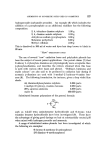
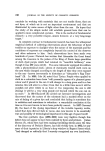
THE ACTION OF LIGHT ON COLOURING MATTERS 247 Certain colours had gone so much that the balance of my schemes had been completely upset" - these had been in the window for only one week! At this time, however, much faster dyes were being discovered and this heralded the era of technological research into determining how rapidly dyes fade, i.e. their light fastness, though such a method had been estab- lished as long ago as 1729 by Dufay in France to systematize the classi- fication of dyes and ingredients into "Grand," "Bon" and "Petit teint" (8). The discipline of technological research lies between fundamental re- search and the collection of empirical facts, and again Clibbens' description is well-worth quoting :- "The experimenter following this path controls as best he can all the relevant conditions known to him and puts up with variations in those that, through ignorance or inability, he cannot control. He may take the risk of being stigmatized as unscientific by the sophisticated doctors of science and as unpracticable by the prejudiced masters of practice. He certainly takes the more serious risk that, however sound his observations, the conclusions he draws from them may be quite wrong- invalidated by unsuspected or ignored factors in his experiments. In order to reduce this risk he must make many observations in which he attempts to repeat the conditions of his experiments and compares their results. With a sufficiently large number of observations he can hope that the effects of variations in the uncontrolled conditions will in the average compensate one another- will be removed in the statistical wash- so that he can distinguish fundamental significance. It is, however, unlikely that he could juggle simultaneously with many variables without occasionally dropping a brick. This is the risk that he takes in attempting to short- circuit the fundamental method taking the risk is the more justified the more complex are the fundamental aspects and the more urgent the technological aspects of the problem." Technological research on dye fading has been undeniably very success- ful and investigators in this field have managed to avoid dropping any bricks- at least, no heavy ones! FUNDAMENTAL PHOTOCHEMISTRY When a molecule absorbs visible or uv light, one of the electrons in the highest occupied orbital is displaced into a higher orbital with no change in its direction of spin. The spins of electrons usually occur in anti-parallel pairs so that the resultant spin angular momentum is zero giving a single energy level a molecule which has absorbed light is there-

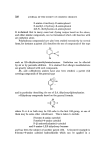
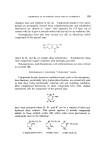
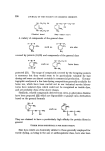
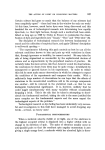
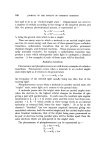
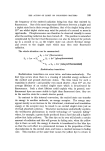
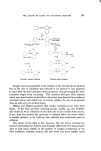
248 JOURNAL OF THE SOCIETY OF COSMETIC CHEMISTS fore said to be in an "excited singlet state." Displacement can occur to a number of orbitals according to the energy of the absorbed photon and this, the primary photochemical process, is represented as :- So +hv'-- So + hv" ) S• So being the ground state which is also a singlet. There are many ways in which a molecule in an excited singlet state can lose its excess energy and these are of three general types-radiative transitions, radiationless transitions that do not produce permanent chemical changes, and chemical reactions. These processes are not neces- sarily mutually exclusive for example, a radiationless transition may produce a state which subsequently emits light or undergoes a chemical reaction. A few examples of each of these types will be described. Radiative transitions Fluorescence and phosphorescence are well-known examples of radiative transitions. Fluorescence occurs when a molecule in an excited singlet state emits light as it returns to its ground state S1 So + hv the frequency of the emitted light usually being less than that of the exciting light. Phosphorescence occurs when a molecule in another excited state, the "triplet" state, emits light as it returns to the ground state. A molecule passes into the triplet state from an excited singlet state when the electron in the highest orbital changes its direction of spin giving a pair with par_allel spins. In such cases the resultant spin angular momentum is « + « ---- 1 in atomic units and this vector has three com- ponents + 1, 0, --1 which results in three energy levels in an internal molecular or external field, hence the term "triplet." In so far as the chemist's "biradical" has two separate unpaired electrons giving two unsatisfied valencies, both the excited singlet and the excited triplet states show biradical tendencies, that of the triplet being more pronounced as its pair of electrons having parallel spins will be further apart than the same electrons which are spin-paired in the singlet state. The phenomenon of phosphorescence can be represented as :. So + hv S• S• ----• T• T• • So + hv'
Purchased for the exclusive use of nofirst nolast (unknown)
From: SCC Media Library & Resource Center (library.scconline.org)