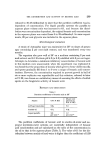
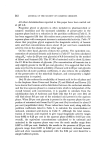
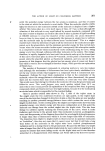
THE DISTRIBUTION AND ACTIVITY OF BENZOIC ACID 209 reduced to 10-15 millimoles/1 to show that the partition coefficient was in- dependent of concentration. For liquid paraffin systems the paraffin to aqueous phase volume ratio was increased to 6:1, and because the distri- bution was concentration dependent, the original benzoic acid concentration in the aqueous phase was varied from 5 to 25 millimoles/1. In some experi- ments, 20 per cent glycerin was included in the aqueous phase. Microbiological evaluation A strain of Aspergillus niger was maintained at 25 ø on slopes of potato agar containing 2 per cent malt extract, and was transferred every two months. The organism also grew well at 25 ø on a medium containing 2 per cent malt extract and 0.1 M citrate pH 4.2 (or 5.2) solidified with 2 per cent agar. Attempts to determine a minimum inhibitory concentration of benzoic acid in this medium were unsuccessful when the experiment was replicated it was found that the proportion of inocula which grew to form visible mycelia and spores gradually fell from 1 to 0 over a range of benzoic acid concen- trations. However, the concentration required to prevent growth in half of six or more replicates was reproducible and this criterion, referred to later as FC 50, was chosen as a satisfactory means of assessing the effects of added agents on the fungistatic activity of benzoic acid. RESULTS AND DISCUSSION Table I Partition coefficients of benzoic acid at 25 ø Phases 0.01 N HC1 20 per cent glycerin in 0.01 N HC1 isoPropyl myristate 9.87 7.0 Arachis oil 6.14 4,38 2.6 per cent -• Liquid paraffin 1.7 per cent -t The partition coefficients of benzoic acid in arachis oil-water and iso- propyl myristate-water systems are essentially independent of benzoic acid concentration and are calculated as the ratio of the concentration in the oil to that in the aqueous phase (Table I). The value of 6.1 for the dis- tribution between arachis oil and water is higher than the coefficient of 5.33

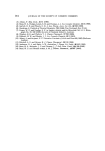
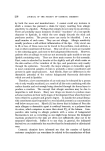
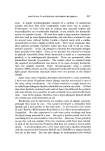
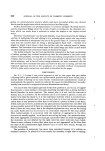
210 JOURNAL OF THE SOCIETY OF COSMETIC CHEMISTS reported by Garrett & Woods (5) the discrepancy is probably due to the variable nature of vegetable oils. When liquid paraffin is the non-aqueous phase, the ratio of the concen- trations in the two phases is not independent of concentration. However, the ratio of the square root of the concentration in paraffin to the con- centration in the aqueous phase is constant (Table II), suggesting that benzoic acid exists predominantly as dimers in the paraffin phase. Glasstone (6) found similar behaviour for the distribution of benzoic acid between benzene and water. Table II Partition coefficient of benzoic acid in liquid paraffin-water systems at 25 ø Initial Equilibrium Equilibrium . K = Co• aqueous concentration concentration Co Cw concentration aqueous phase* in paraffin* Cw (M/l) -t (mM/1)-t (%)-• as mM/1 (Cw) as mM/1 (Co) as mM/1 , , 25 6.17 3.14 0.51 9.08 0.287 2.6 20 5.31 2.45 0.46 9.32 0.295 2.67 15 4.53 1.75 0.39 9.23 0.292 2.64 10 3.50 1.08 0.31 9.4 0.296 2.68 *Ratio of oil: water ---- 6: 1 Average 9.3 0.29 2.6 When the solute dimerizes in one of the phases, the numerical value of the coefficient depends on the units in which the concentrations are ex- pressed and the value of 9.3 M-tl • (Table II) is equivalent to 0.29 mM-tl • or 2.6ø/o -t. The last method of expression, though unusual, is probably most convenient in pharmaceutical and cosmetic formulation. The presence of glycerin in the aqueous phase lowers the partition coefficients, and the values in the presence and absence of 20 per cent glycerin are listed in Table I. FUNGISTATIC ACTIVITY The effect on antimicrobial activity of benzoic acid concentration is shown in Table III which records the results of eight separate experiments in which each concentration was replicated six times. The estimated FC50 from each experiment is shown at the bottom of the table. Other FC50 values given in Tables IV and V are determined from six replicates with the exception of the value for 20 per cent glycerin in the absence of oil and surfactant which is based on 24 replicates.
Purchased for the exclusive use of nofirst nolast (unknown)
From: SCC Media Library & Resource Center (library.scconline.org)