THE ACTION OF LIGHT ON COLOURING MATTERS 257 ASSESSMENT OF COLOUR CHANGE In light and weather fastness testing one is only concerned with changes in colour which are not merely visible but of sufficient magnitude to be offensive if they occur during the expected life of the coloured article. For this reason the degrees of fading which must have occurred before assessment against the standards exposed simultaneously are quite marked. In the U.S.A., assessment used to be made at what was known as the "first break," i.e. the smallest change that a professional colourist could detect. This has since been modified to a change equal to a standard contrast shown on a Grey Scale (27) which is about 5 times as large. In the rest of the world, assessment is made at this stage and at one twice as great (also shown on the Grey Scale) to give two points on the rate of fading curve, the mean being taken as the light fastness. Many attempts have been made to use instrumental methods of measur- ing the amount of colour change. Unfortunately, however, whilst it is relatively easy to specify a colour numerically, it has proved extremely difficult to measure the difference between two colours- in this case the original and exposed specimens, and obtain numerical values which correlate well with visual observation. Of the many colour difference formulae which have been proposed over the years, the comparatively simple ones are so far out that they, for example, show that Standard 5 fades more rapidly than Standard 4 (30). The formulae which do give good correlation are so complex that their use, even if a computer is available, requires far too much time and effort. Visual assessment will undoubtedly be the only method used for many years to come. PHOTODEGRADATION It has already been mentioned that dyes on protein substrates, e.g. wool under the influence of light, are reduced by the histidine side chains. The wool is consequently oxidized and one might imagine that degradation of the fibre would occur. In actual fact the degradation is not detectable, probably because the amount of colouring matter present is rarely above 2% of the weight of fibre. Photodegradation of cellulose (cotton, rayon, linen) dyed with certain colours does, however, occur to such an extent that on washing holes will appear, corresponding exactly to the parts coloured with certain dyes. This phenomenon is usually known as "tendering" and caused a great deal of trouble when it was first observed in 1928. Strangely enough, it is the class of dye of highest all-round fastness - vat dyes - which provides

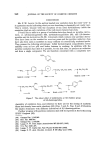
258 JOURNAL OF THE SOCIETY OF COSMETIC CHEMISTS the relatively few tendering dyes, mainly yellows and oranges. This phenomenon is their only weakness and as it has not been possible to replace them entirely they are still widely used and, providing they are not used for curtains and furnishing fabrics, they are excellent. No standard method of determining the tendering properties of dyes has been evolved. The photochemical reactions involved in tendering have naturally been the subiect of fundamental research using simpler systems. Bolland and Cooper (31) irradiated simple anthraquinone compounds in alcohol- the former are related to vat dyes, and the latter is chemically similar to cellulose- and showed that there is a cyclic reaction on irradiation the excited anthraquinone compound abstracts hydrogen from the alcohol forming a semi-quinone radical or radical ion and in subsequent reactions involving oxygen the alcohol is oxidized to acetaldehyde, acetic acid and hydrogen peroxide. Cooper later found that quite minor differences in the anthraquinone compounds had marked effects on their photo- sensitizing ability the sodium salt of anthraquinone • sulphonic acid is a sensitizer, the ¾ isomer is not. In view of such observations it is not surprising that marked differences exist in the tendering properties of related vat dyes. SUMMARY AND CONCLUSIONS Fundamental studies in the field of photochemistry are at last providing explanations of the complex mechanisms which are involved when light is absorbed by colouring matters. Two molecularly excited states are formed, singlet and triplet, both of which have been shown to undergo chemical reactions with other compounds in the system. The most common end product is the oxidized form of the colour matter the oxidizing agent so far positively identified is not oxygen but water, the oxygen preventing subsequent reduction by removing the hydrogen atoms formed. Reduction is also believed to occur on substrates which contain reducing groups but surprisingly no one has apparently attempted to prove this conclusively by identifying the products of fading. The reactions which an excited dye molecule can undergo, however, are numerous so that deductions as to the behaviour of colouring matters in non-textile systems is decidedly hazardous, and no apparent anomaly should ev r cause more than momentary surprise. Technological research in the field of dyed textiles has been successful in providing an understanding of the effect of all the variables in fading, and this has yielded the extremely important standard testing methods
Purchased for the exclusive use of nofirst nolast (unknown)
From: SCC Media Library & Resource Center (library.scconline.org)