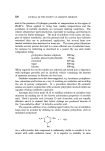
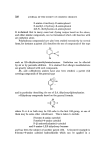
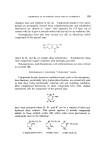
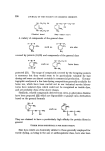
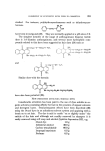
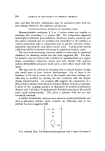
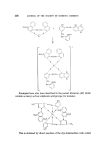
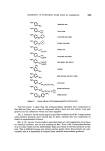
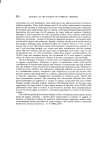
CHEMISTRY OF SYNTHETIC DYES USED IN COSMETICS 243 yellowish red blue violet brownish red-violet H3 C,,,"•,N7*'.•. N H 2 H2N•i' • %/'•"' N•H 2. CH 2. CH 2. O CH 3 H2N'",,[i • ,,-CH 3 I•N•'N•:H2.CH 2. CH2. N,,,,CH 3 H2N"',ii • •T"NH2 Figure 8 bluish red-violet bluish red brownish red-violet pale green, low colour orange pale orange, very low colour red brown bluish red-brown redlsh brown Colour effects of 2,5-diaminopyridine derivatives. Tn•. L•.CTOR•.R: I agree that the aminopyridines represent new compounds in this field and they are a class of compound which I have not met before. I am also grateful for the references which you have supplied. DR. J. CORB•.T•: In his recent paper on pyridine oxidation dyes Mr. Lange quoted some reaction products and I should like to know whether this was conjectural or based on experimental evidence. MR. F.-W. Lx•GE: I have made it clear that these are only suggestions as we have no chemical evidence, but we are working on this. Even with p-phenylenediamine it is not clear which are the intermediate steps and which is the final product on the hair. This is difficult because one always reaches points where the products are very unstable and it is impossible to analyse these unstable intermediate products.

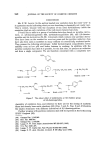
244 JOURNAL OF THE SOCIETY OF COSMETIC CHEMISTS MR. [D. F. ANSTEAD: Your paper has taught me a lot about a line of dyestuffs of which I am fairly ignorant, but I would comment on one point. You mention a number of new ranges of textile dyes which may well contain individual dyes of value in the dyeing of hair, and in the colouring of cosmetics. We are all fairly familiar with hair dyeing, and the dyes used therein, and the possibilities of problems arising therefrom, but getting to cosmetics, have you any experience of the dermatological or toxicological properties of all these dyes? T•- L•-CTURER: I have no specific know]edge whatsoever of the effect of dyes in cosmetics from the point of view of producing allergic reactions. The only knowledge I have is derived from those few instances where dyes are known to produce reactions from dyed substrates in the textile field. DR. J. CORB•.TT: I would like to confirm the results on chromatography reported, particularly that the nitro dyes contained in shampoo bases could only be separated effectively by paper chromatography using basic solvents, whereas considerable streaking occurred if an acidic solvent is used. The important point emerges that electrophoresis seems to be the only satisfactory method for separating perfectly the two most common nitro dyes, nitro-0-phenylenediamine and nitro-p-phenylene- diamine. We could not find a solvent that would separate these two compounds chromatographically sufficiently to identify one in the presence of the other, parti- cularly as one of them is relatively very pale compared with the other. Do you have any ideas on the pro-oxidation effect of dihydroascorbic acid? T•. L•.C•UR•-R: Taking your last point first, I am afraid I must join you in seeing neither rhyme nor reason I was merely reporting the findings as described in the patent, and I was assuming that there must have been some point which I did not appreciate, as I also could not understand the 'pro-oxidative' effect discussed. I agree with you about the chromatographic separation of nitro-0-phenylenediamine and nitro-p-phenylenediamine. We never found a perfect method on either paper or thin layer to separate them completely, whereas this is possible with electrophoresis.
Purchased for the exclusive use of nofirst nolast (unknown)
From: SCC Media Library & Resource Center (library.scconline.org)