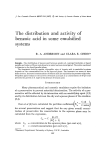
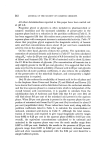
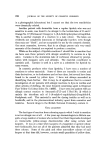
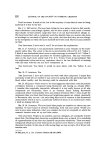
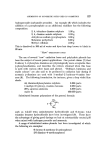
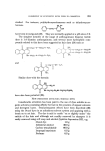
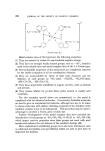
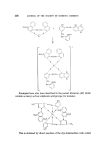
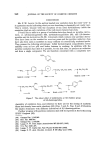
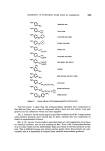
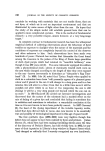
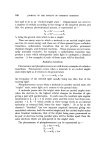
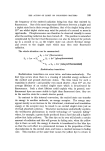
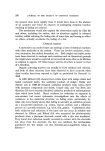
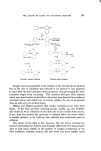
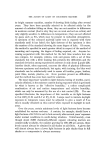
THE ACTION OF LIGHT ON COLOURING MATTERS 251 -N:N•OH /• J J /--• Excited dye- (k,•/X--'N--N'• OH free rodicol Reduction at e ectrode k, / Oxidorion .in +e+H+ / '---• X•solution H2 0 H OH Free radical Free rodical HzO 1 +H OH OH +e+H + •'NJ--!•OH Coluurless hydrazo campound Colourless azoxy compound +2H Oxygen was not postulated as the oxidant of the excited dye in solution but as the rate of oxidation was reduced in its absence it was assumed to react with the free hydrogen atoms produced, thus preventing the back reduction stages from occurring. This reaction will give H02 radicals which may react further to give H20a which has been detected in irradiated vat-dyed cotton and which can, of course, oxidize the dye in its ground state as well as in its excited states. Hillson and Rideal postulate that similar reactions occur with dyed fibres. If the fibre provides reducing groups readily, e.g. the histidine side chains in wool, reduction of the molecule in the excited state occurs if not, then the excited dye molecule is oxidized either by water, which is usually present, or by hydroxy free radicals from substrates such as cellulose. The nature of the fibre is not, however, the sole factor covering the reaction mechanism for Schwen and Schmidt (16) found two diazacyanine dyes to fade more rapidly in the absence of oxygen irrespective of the fibre {cullulose, cellulose acetate, silk and wool) and more rapidly moist

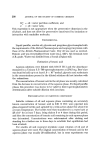
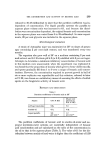
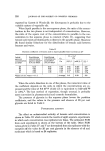
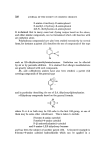
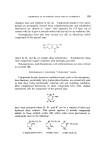
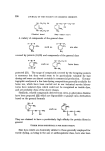
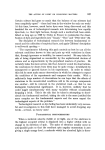
252 JOURNAL OF THE SOCIETY OF COSMETIC CHEMISTS than dry. From these results they were forced to the conclusion that water must have provided the reducing agent (H+) possibly by a mechanism similar to that postulated for photosynthesis in the presence of chlorophyll by Van Niel (17). These experiments clearly show the importance of water both in oxidation and reduction fading, and of atmospheric oxygen in the former. This provides an explanation of the observation first made by Chevreul in 1837, and repeatedly since, that coloured substances fade very slowly, if at all, in vacuo residual traces of absorbed oxygen and moisture which are very hard to remove without the danger of decomposing the colouring matter or substrate may explain any fading which does occur in vacuo. These observations led to the formation in 1893 of a company to seal paintings, etc., in glass cases in vacuo, one example, a painting by Turner, still in existence in the Victoria and Albert Museum. If it is true that dyes on cellulose are oxidized and those on wool are reduced, the above experiments explain why the fading rates of dyes on cellulose are generally more affected by moisture than those on wool. Spectral regions causing photochemical change The basic law relating photochemical activity and the wavelength of the incident radiation is that of Grotthus-Draper which today appears to be merely a statement of the obvious- only radiation which is absorbed can produce photochemical effects. This does not mean that all absorbed radiation will necessarily do so a green colouring matter must absorb red and violet light and will inevitably absorb some uv as well the author (18) investigated 117 dyes covering most chemical classes applied to many different substrates and found that, in general, the absorbed uv radiation will cause fading as will the violet light absorbed red light will also be active if the colouring matter is fugitive but not if it is moderately fast. Bedford (19), using a more precise method on only three dyeings, obtained results showing good qualitative agreement with the author's. These observations show that the use of uv screens is only of limited benefit they do the most good where they are needed least. Even the orange screens used in many shop windows are not really an adequate safeguard, the yellow, orange and red light transmitted by them may account for 60-70% of the total fading of fugitive colours in daylight (18). THE FADING OF COLOURING MATTERS The best-known effect of light on colouring matters is fading in which the colour is progressively destroyed, usually to a colourless compound.
Purchased for the exclusive use of nofirst nolast (unknown)
From: SCC Media Library & Resource Center (library.scconline.org)