THE ACTION OF LIGHT ON COLOURING MATTERS 259 which, with little modification, have proved suitable for diverse other fields such as leather, paper, paints, plastics, dyed aluminium, etc., and if the action of light on colouring matters is an important factor in cosmetics then I am sure the experience of investigators in the textile field will be of considerable value. (Received: 25th November 7965) REFERENCES (1) Porter, G. Proc. Roy. Soc. London Ser. A. g00 284 (1950). (2) Bischoff, J. N. quoted by I-Iuebner, J. Soc. Dyers Colourists 29 344 (1913). (3) Beatty, J. M. Saturday Review, 5 (5 August 1961). (4) Cole, W. Phil. Trans. Roy. Soc. London 1õ (i) 1278 (1685). (5) Bancroft, E. "Experimental Researches concerning the Philosophy of Permanent Colours," Cadell & Davies, London (1813). (6) Quoted by Pinte, J. and Millet, J. Teintex 14 21 (1949). (7) Fifty Years of Sundour (Morton Sundour Fabrics Ltd.) (1929). (8) Hellot, J. "'•I rt de la Teinture des Etoffes de la Lathe, en grand et petit Teint," Paris (1772). (9) Giles, C. H. and Rahman, S. M. K. J. Soc. Dyers Colourists ?õ 681 (1960). (10) Hibbert, E. J. Soc. Dyers Colourists 48 292 (1927). {11) Hailer, R. and Ziersch, G. Melliand Texttiber. 10 951 (1929) Z. Angew. Cher•., 411 209 (1930). Couper, M. Text. Res. J. 2! 720 (1951). Van Beek, H. C. A. and Heertjes, P.M. J. Chem. Soc. 80 83 (1962). Giles, C. H. et al. J. Soc. Dyers Colourists 70 487 (1954). Hillson, P. J. and Rideal, E. K. Proc. Roy. Soc. London Set. A. 21õ 458 (1953), Schwen, G. and Schmidt, G. J. Soc. Dyers Colourists 75 101 (1959). Rabinowitch, Photosynthesis and Related Processes, Interscience, New York. (12) (13) (14) (15) (16) (17) (18) (19) (20) (21) (22) (23) (24) (25) (26) (27) McLaren, K. J. Soc. Dyers Colourists 72 McLaren, K. J. Soc. Dyers Colourists 72 Gebhard, K. J. Soc. Dyers Colourists 2õ Am. DyestuffReptr. 46 861 (1957). McLaren, K. y. Soc. Dyers Colourists 70 British Standard 1006 (1961). McLaren, K. J. Soc. Dyers Colourists 75 McLaren, K. J. Soc. Dyers Colourists 79 McLaren, K. J. Soc. Dyers Colourists 80 86 (1956). 527 (1956). 276, 304 (1909). 553 (1954). 597 (1959). 618 (1963). 250 (1964). Standard Methods for the Determination of the Colour Fastness of Textiles 3rd Edition (1962). The Society of Dyers & Colourists, Bradford. (28) See discussion in Giles, C. H. Text. Res. J. 111 141 (1961). (29) Bridge, N. K. and Porter, G. Proc. Roy. Soc. London A 208 244, 259, 275 (1958). (30) Godlove, I. H. Am. Dyestuff Reptr. 89 215 (1950). {31) Bolland, J. L. and Cooper, H. R. Proc. Roy. Soc. London Ser. A. 225 405 (1954). Introduction by the lecturer Earlier in this symposium you have heard that the object of the action of a colour- ing matter is to absorb light so that the light reflected from the substance to which the colouring matter has been applied appears coloured. This absorption in the visible part of the spectrum is essentiM for a product to be coloured, but light is a form of energy, which must be released from the colouring matter because its presence results

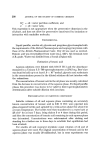
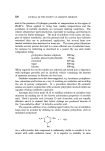
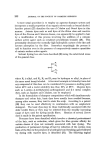
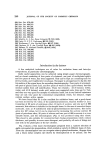
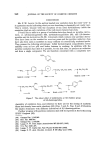
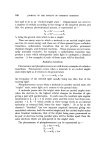
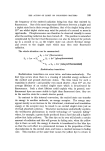
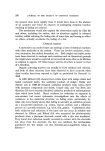
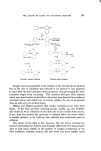
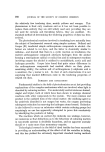
60 JOURNAL OF THE SOCIETY OF COSMETIC CHEMISTS in an unstable state: this energy usually results in fading, particularly of dyes on textiles. In the cosmetic field many of the pigments used are inorganic, e.g. ferric oxide which absorbs visible light, probably by exactly the same fundamental mecha- nism as the organic colouring matters, but ferric oxide is never faded by light it is completely stable. When I was a student, the basic mechanisms of photochemistry were almost completely unknown: one or two reaction products of faded dyes on textiles had been identified, and a hundred and fifty years ago Chevreul deduced that oxidation or reduction had occurred, but it is only in the last 20 years or so that any real progress has been made. The initial mechanism is the absorption of a photon of visible light, or uv light which is, if anything, more important in the case of fading. This is best understood by means of an energy diagram (Fig. 1), where a simple scheme for a diatomic molecule is presented. Most colouring matters are polyatomic but the same basic principle applies though the actual potential energy curves will probably prove to be quite impossible to work out. , i • SINGLET mON J /BOUN 1 I - •EC I / STATE I! o 0 INTEB-ATOHIC DISTANCE---• Figure I The basis of this diagram is that the molecule in its normal state, which is called the "ground state", oscillates about a certain optimum interatomic distance. At this
Purchased for the exclusive use of nofirst nolast (unknown)
From: SCC Media Library & Resource Center (library.scconline.org)