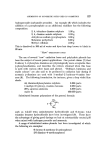
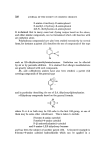
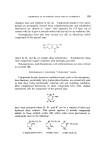
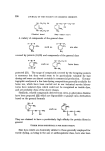
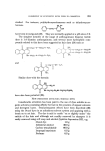
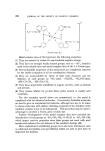
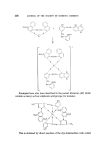
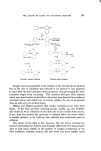
THE ACTION OF LIGHT ON COLOURING MATTERS 261 point the potential energy between the two atoms is minimum, and this of course is the state at which the molecule is most stable. When the molecule absorbs visible light, the electron in the outermost orbital of the molecule is displaced into a higher orbital. This takes place in a very short space of time, 10-• 5sec, so that although the vibration of this molecule is very rapid indeed by normal standards, compared with the time it takes to displace an electron (the tinhe it takes a photon of light travelling at 186,000 miles/sec to cross the diameter of the molecule), the atoms themselves have no tinhe to move apart, so consequently the increase in energy line is vertical, and the molecule ends up in what is known as an "excited state". This is a singlet excited state when the directions of spin of all the electrons in the molecules are spin- paired, as in the ground state, but the minimum potential energy for this excited state occurs when the atoms are rather further apart: consequently this absorption results in a compressed molecule which immediately starts oscillating along its curve, losing energy every tinhe through collisions with other molecules in the system. The energy, therefore, is rapidly degraded into heat until the molecule ends up at the lowest part of the curve: this takes place in about 10-8 seconds. At this point a fluorescent com- pound emits the absorbed photon as fluorescent radiation, and you can see by the geometry of this diagram that the photon has less energy when it comes out than it had when it went in: the wavelength is therefore longer, which provides an explanation of Stokes Law. The number of fluorescent compounds in colouring matters is very few indeed, and although the mechanism of fluorescence has been quite firmly established it is not by any means certain what happens to a compound which is coloured but non- fluorescent. Perhaps the most likely explanation is that in the complexity of the molecule, where the energy/distance relationships are three dimensional, the ground state and the excited state may cross somewhere, or come into very close contact. This would mean that during its vibration the molecule will cross the ground state and follow its curve. This could Lhappen very much quicker indeed than 10-8 sec and if this is true it may provide an explanation of the empirical fact that, in genera], compounds which are fluorescent have low light fastness, because it is the molecule in an excited state which is responsible for the eventual fading. There is another excited state shown in .Fig. 1, that of the triplet state: in the singlet state the two outermost electrons are spin paired, in the triplet state one of the electrons has changed its direction of spin so that the spins are now parallel, resulting in another potential energy/distance curve which crosses the curve of the singlet excited state. At the crossing point, the singlet and triplet states have the same potential energy, zero kinetic energy and the same configuration so at this point the molecule can change from the excited singlet into the triplet state. This also loses energy by collision rapidly reaching the lowest point of the curve, where it emits radiation and returns to the ground state: this mechanism is known as phosphores- cence and the geometry of the diagram shows that the wavelength of phosphorescence is longer than that of fluorescence which is in turn longer than that of excitation. The transition from triplet to singlet states is what is known in quantum mechanics as "forbidden": this does not mean that it cannot occur but that it will take a long time before all the molecules in the triplet state have emitted phosphorescent radiation and in so doing return to the ground state. Because the life-time of a triplet state is longer than that of the excited singlet state by many orders of magnitude, it is natural to assume that most fading occurs via the triplet state and it was therefore somewhat of a disappointment when Bridge and Porter (29) in the first ever investi-

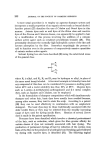
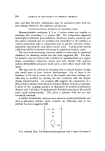
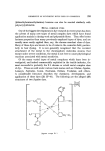
262 JOURNAL OF THE SOCIETY OF COSMETIC CHEMISTS gation of a photochemical reaction which could have proceeded either way, showed that it was the singlet state which was involved and not the triplet. Neither fluorescence nor phosphorescence is common amongst colouring matters, and the important things about the action of light on textiles are the chemical reac- tions which can result from a molecule in either the singlet or the triplet excited states. The term "excited state" can be taken literally. I can demonstrate this by taking a solution of methylene blue and adding to it a reducing agent which acts very slowly when the molecules of methylene blue are in the ground state. If I convert the mole- cules into the excited state by firing a photographer's flash bulb - whether it is singlet or triplet is not known-then the reaction with the reducing agent is instan- taneous. The formation of an excited state is the initial stage and these excited states can then undergo a host of reactions which are listed in the paper. The textile industry has not been particularly interested in the basic mechanisms of fading: perhaps they realised instinctively that the elucidation of the basic mech- anisms would probably not help them to overcome fading, at least there is very little evidence that it is likely to succeed now that some ground work has been done. The textile industry, and in fact all colour using industries, are more concerned with the rate at which these reactions take place and not how they are occurring, and here the empirical approach has led to the acceptance of a standard method of assessment which is quite easily carried out, and which is described in the paper. DISCUSSION DR. F. J. J. CLARKe-: I WaS a little surprised to find in your paper that pale shades of dyeing with a given dyestuff on a given textile produce much more fading than a heavier shade of dyeing on the same textile. Commonsense considerations would al- most indicate the opposite. Could you indicate the reason for this difference? Secondly, exactly how accurate is reciprocity between illumination and time? THE LECTURER: The logical approach to the first question is, as you say, to suggest that because a weak dyeing is obviously absorbing less light than a strong dyeing it should therefore be more resistant. ,The reason why it is not, and the converse is strictly true, is as follows: All the molecule can do is to absorb a photon: it does not matter how deep the shade is, it is the individual molecule which is involved here, it either absorbs a photon and is in the excited state or it does not absorb a photon unless there is any protective effect then it will absorb a photon if there is one there. If this molecule, however, is destroyed by photochemical reactions then the effect will be more readily perceived if there are comparatively few unfaded molecules remaining than if there are very many: this is the simplest explanation why you see the fading on a pale shade and you do not see it on a full shade exposed for the same period. More fundamentally, it is involved with the build up of aggregates in the fibre dyes are not usually applied - or at least do not end up by being - in a molecular form, they form aggregates, and here you may get a protective effect as inside the aggregate the molecules are not affected by the light until the outer molecules have faded. There is some evidence to show that when dyes are not aggregated on the fibre then the slope of the concentration light fastness curve is much more nearly, though not entirely, horizontal. The question of reciprocity has never been examined because it is entirely an academic question. In practice it is not merely the intensity of light that is varying:
Purchased for the exclusive use of nofirst nolast (unknown)
From: SCC Media Library & Resource Center (library.scconline.org)