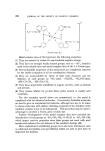
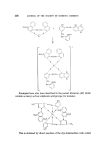
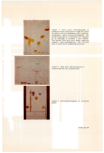
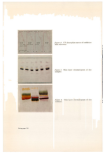
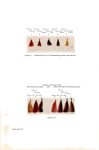
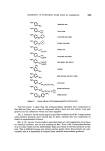
240 JOURNAL OF THE SOCIETY OF COSMETIC CHEMISTS {29) (3o) (31) (32) (33) (34) (as) (36) (37) (38) (39} (40) (41) (42) (43) (44) (45) (46) (47) Brit. Pat. 979,405. Brit. Pat. 986,712. Brit. Pat. 951,021. Brit. Pat. 906,526. Brit. Pat. 953,170. Brit. Pat. 942,499. Brit. Pat. 965,620. Brit. Pat. 993,181. Schetty, G. J. Soc. Dyers Colourists 71 705 (1955). Casty, R. S.V.F. Fachorgan, 80 189 (1953). Weidmann, C. Am. DyestuffReptr. 48 167 (1954). Clapham, H. F. Am. Dyestuff Reptr. 48 200 (1954). Pfitzner, H. Meliand Textilber, 85 649 (1954). Brit. Pat. 787,986. Brit. Pat. 825,606. Brit. Pat. 826,207. Brit. Pat. 868,284. Brit. Pat. 903,662. Brit. Pat. 925,997. Introduction by the lecturer A few analytical techniques are of value for oxidation bases and hair-dye compositions, in particular chromatography. Quite useful separations can be achieved using simple paper chromatography, and an eluent consisting of four parts of n-butanol, one part of methylated spirits and five parts of water, has been suggested. This can be kept as a standing tank for several weeks, and it splits into two phases. The paper is arranged just to dip into the top surface of the upper layer for ascending chromatography. Four parts of n-butanol, one part of glacial acetic acid, and five par•s of water is also a good eluent, but this mixture suffers from self esterification. These t•vo eluents- 4:1:5 butanol, meths, water, and 4:1:5 butanol, acetic acid, water were suggested some time ago by Turi, and they are very good for samples of oxidation bases, but in my limited experience they are not very good for commercial compositions which, for instance, might contain surface active agents. We have found that tic is also excellent for oxidation bases, and a good eluent has been devised by Dr. Close, of the analytical laboratory, Clayton Aniline Co. Ltd. Consisting of 30 parts of petroleum ether, 10 parts of acetone, and one part of 880 ammonia, this mixture is suitable for the simpler bases. In the case of somewhat larger molecules, such as N-substituted nitro-p-phenylenediamine derivatives, this eluent gives low RF values, but it can be improved by increasing the acetone content. 30 parts of petroleum ether, 20 parts of acetone and one part of 880 ammonia is a more suitable eluent, and the chromatogram (Fig. 1) was produced using that eluent. This eluent is also suitable for commercial hair dyeing preparations which contain thickener, and possibly in some cases detergent, and probably all sorts of hhings not met with in the philosophy of the dye chemist. Fig. 2 shows a thin layer chromatogram prepared from a random selection of eight commercial dye preparations, which contain a variety of different types of dyes. From the chromatogram one can recognise nitro-p-phenylenediamine, disperse dyes and a black metal complex dye shown by electrophoresis to be anionic. The two

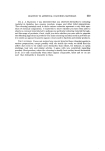
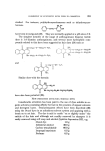
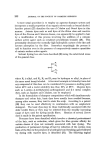
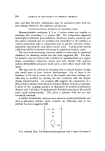
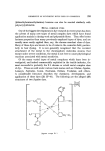
Figure I Thin layer chromatogram of oxidation bases. From left to right the spots are nitro-p-phenylenediamine, nitro-o-phenyl- enediamine, nitro-m-phenylenediamine, the streak being due to overloading the baseline in an attempt to produce a nice exhibit. The fourth, fifth and sixth spots represent isomeric nitro-aminophenols, the seventh spot is methylnitro-p-phenylenediamine. Figure 2 Thin layer chromatogram of commercial hair dye preparations. Figure bases. Electrophoretogram of oxidation Facing page 240
Purchased for the exclusive use of nofirst nolast (unknown)
From: SCC Media Library & Resource Center (library.scconline.org)