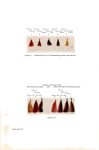
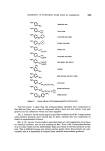
THE ACTION OF LIGHT ON COLOURING MATTERS 255 to bright summer sunshine, number 8 showing little fading after several years. They have been specially selected to be affected solely by the amount of radiation falling on them they are not sensitive to differences in moisture content (that is why they are on wool and not on cotton) and only slightly sensitive to differences in temperature they are not affected by gases such as SOs which may be present in industrial atmospheres. A specimen of the coloured material under test is exposed with these standards until it has faded the light fastness of the specimen is then the number of the standard showing the same degree of fade. Of course, the method is specified in much greater detail in respect of the method of mounting and exposing, the degree of fading required, etc. Anyone be- coming acquainted with this method for the first time wonders how one can compare, for example, yellows, reds and greens with a set of blue standards but with a little training this presents few difficulties and the standard deviation among experienced assessors is only about « grade (24). Another doubt, often expressed, concerns the effect of physical differences between specimens and standards, but again, with training, the blue wool standards can be satisfactorily used to assess all textiles, paper, leather, paint films, metals, plastics, etc. Even powders present no difficulties, and the method has even been used for solutions. The most important variable in light fastness testing of textiles, parti- cularly cellulosic, is the moisture content during exposure which is governed by what is known as the "effective humidity," a rather complicated combination of air and surface temperatures and relative humidity, which can only be measured by the use of a test control (25). The one specified illustrates the importance of this variable as its light fastness is 3 at 100% E.H. and 6-7 at 0% E.H. Lamps used to imitate daylight exposure in temperate zones must be adjusted to give a result of 5 as this is usually obtained on this control when exposed to daylight in such areas. Over the years, certain minimum levels of light fastness have become established for various end-uses. A curtain, for example, should have a light fastness of 6-7 if it is not to fade severely after several years' exposure under normal conditions in south-facing windows. Unfortunately, even though about 3,000 chemically-different organic colouring matters are commercially available, the number growing by 100-150 per annum, these levels cannot always be obtained in all shades on all fibres. A given dye will almost always have a lower light fastness in pale shades than in full shades so a compromise is always necessary.

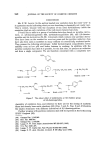
256 JOURNAL OF THE SOCIETY OF COSMETIC CHEMISTS SPACING OF STANDARDS The spacing of the standards is such that each one will take twice as long to fade under standard conditions as the one below it up to Standard 6. For reasons concerned with the availability of suitable dyes, Standard 7 is about 4 times as fast as Standard 6 but Standard 8 is twice as fast as Standard 7 (26). In America a different set of standards has become established where the limitations of available dyes has been overcome by blending fibres dyed with a fast and a fugitive dye, respectively, in different proportions. This elegant solution has two fundamental defects which have prevented its adoption in other parts of the world. The faded standards appear mottled and they do not fade progressively towards white but stop when the fugitive component has faded. These defects do not worry the Americans who place a premium on regularity of spacing as an inevitable consequence of the Standard Fade-Ometer Hour concept, the method being based on doubling the time of exposure. This has never been the practice in other parts of the world where the irregularity in spacing causes little inconvenience, though considerable discussion. FASTNESS TO •fEATHERING It has already been mentioned that an increase in moisture content often causes an increase in fading rate. The extreme case of this occurs with fabrics exposed in the open, e.g. awnings and tent cloths. In such cases fastness to weathering is determined using the light fastness standards purely as an actinometer by protecting them by glass whilst the specimens are unprotected either in open air or in a xenon lamp with water spraying device (27). PHOTOCHROMISM Closely allied to true fading and often confused with it is the phenomenon known preferably as photochromism but usually as phototropism. This appears as a change in shade caused by relatively short exposure to light: the original colour returning in the dark. The rate of return varies widely - from a few seconds to several hours. Though its effects are by definition, not permanent marked photochromism, especially if accompanied by a slow return, it is a defect as serious as poor light fastness. The mechanism has been shown in one case to be due to the change from the cis form to the trans form of an azo dye (28).
Purchased for the exclusive use of nofirst nolast (unknown)
From: SCC Media Library & Resource Center (library.scconline.org)