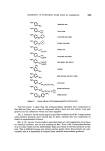
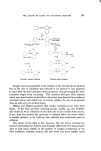
THE ACTION OF LIGHT ON COLOURING MATTERS 263 you can never eliminate the effect of heating, because as Fig. I shows, the energy absorbed which does not result in photochemical change, fluorescence or phosphor- escence, must appear as heat, irradiating it therefore with actinic light must raise its temperature even if ir radiation were excluded. Similarly, under practical condi- tions, irradiation will also reduce the moisture content, which is a very important factor in governing the rate of fading. To the best of my knowledge, even from the academic point of view, this question has never been investigated but it is, as far as I can see, of no practical consequence. MR. J. D. Crib. ShIRE: In the discussion of one of the papers at this symposium you mentioned that there is no relationship between fluorescence and any possible medical effect. I wonder if you would like to suggest whether there might be any correlation between the effect, which I believe is called phototendering of textiles, and any medical sensitization effect on the human body. TI•. LF•CTUR•.R: This is much more likely. As far as fluorescence is concerned nobody can predict by looking at the molecular structure of a colouring matter whether it is going to be fluorescent or not: there is, therefore, no fundamental reason for thinking there might be a medical effect common to all fluorescent compounds which I mentioned this morning. The excited state, however, is very reactive, it is what the chemist calls a diradical: it can result in electron transfer it can result in hydrogen abstraction it can result in free radical formation. All of these reactions could possibly do harm to the human body. I was very interested in the observation that a patient who has been injected with fluorescein and exposed to light may suffer unpleasant consequences. In that case it is not the fluorescence that is doing the harm because fluorescence is merely the loss of energy with the production of harmless light (it is bound to be harmless because it is of longer wavelength than that causing the ex- citation): but the excited state, whether it is a singlet or a triplet, could quite conceiv- ably have damaging effect on tissue and, because of its much longer life-time, the trip- let state is the most likely culprit. As fluorescein is phosphorescent as well as fluores- cent it must exist in the triplet state. MR. A. FosT•-R: Is there any record of the interaction of colours and substrate and what kind of influence does a substrate have on fading action? Tn•. L•-c•uR•.R: It has the most important action of all. Although a chemist in the colour-producing industry will loosely talk about the light fastness of a dyestuff or pigment, he is not really talking about anything of the kind, because the rate of fading of a dye or pigment is governed in the first place by the nature of the substrate. A change of substrate can increase the rate of fading of a given colouring matter by a factor of several hundred: it can sometimes result in a very much slower rate of fading or a very much more rapid rate of fading, as by the following examples. Vat dyes are among the fastest to light when they are applied to cotton. When they are applied to nylon they are extremely fugitive. The first dyes that were ever inven- ted were basic dyes (Perkin's mauve was a basic dye) and the dyes used widely today for boot polishes and typewriter carbons and things like that are also basic dyes: these dyes are in general, extremely fugitive, which resulted in the so called "aniline dyes" getting a bad name. Basic dyes on synthetic fibres have very good light fastness, and they are providing the most important class of dyes for one of the newest syn- thetic fibres, the polyacrylic fibre.

264 JOURNAL OF THE SOCIETY OF COSMETIC CHEMISTS MR. R. L. DAVIES: IS there any information which suggests that the cuticular layer of mammalian hairs offers any light protection to the cortex and medulla beneath? THF. LECTURER: It would depend entirely on what its absorption or scattering properties are. If it is absorbing in the uv, it could exert a protective effect if it is reducing the intensity of light immediately underneath it by scattering or by absorp- tion again it could have a beneficial effect, but I have no idea what the absorption characteristics of these layers are. MR. D. F. ANSTEAD: I wish to underline your remarks on substrata. A very useful indication is obtained with something we do not perhaps use in cosmetics, but which is used very widely in pharmaceuticals, namely tablets: you can coat tablets with water-soluble colours and they will fade rapidly if you can coat them with the same dyes in the form of an aluminium lake they are much more lightfast. To refer directly to the cosmetic industry, I would instance soap, which is, after all, a sub- stratum. You have soap as such, with its alkaline nature, but we also have perfume and other additives which the soap manufacturers put into their base. All these things do influence the fastness of soluble or insoluble colour used. Can you make any observations on additives which may come into the textile application of colours? THE LECTURER: I can only reinforce what you have just said. I conclude mypaper by saying that "the behaviour of colouring matters in non-textile systems is decidedly hazardous, and no apparent anomaly should ever cause more than momentary sur- prise". This is my experience of about 20 years' involvement in this subject, and when anybody tells me that they have put this or that substance into a dye/substrate system and have found a marked reduction in light fastness, I am not the slightest bit surprised. As the fundamental reactions are so comparatively unknown, some substances, even in small amounts, can have a most adverse effect some of these reactions are cyclic and are therefore catalytic so that you only need a small amount: the tendering of textiles is a catalytic effect. On wool where we know chemical degradation of the fibre accompanies - in fact causes - the fading of the dye, the loss in tensile strength is quite negligible, because such a small amount is involved. On cotton one can get a catalytic effect occurring where a small amount of colouring matter can catalyse the degradation of many more times its own weight of substrate, and here one can get the fibre literally falling to pieces. I do not think it is possible to generalize at all in the textile field: as soon as anybody brings out a new method of chemical treatment, the first thing he suspects is that it will have some effect on the light fastness and these effects are rarely beneficial. The first thing the dyemaker does is to find out what effect these treatments have on the light fastness of his dyes, and publishes this information. The light fastness of a dye is expressed usually in about a dozen figures which involve the depth of shade, the substrate to which the dye can be used (there are practically no dyes which are used on one substrate only), and then the effect of after-treatments which are widely used on this particular fibre the range of light fastnesses under these conditions can quite often span half the range: the same must be true in cosmetics, in pharmacy, and wherever there are apparently inert systems under the influence of light-either directly or indirectly one can get photodegradation.
Purchased for the exclusive use of nofirst nolast (unknown)
From: SCC Media Library & Resource Center (library.scconline.org)