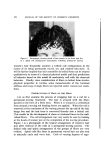
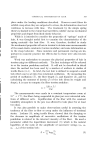
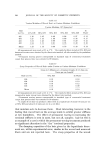
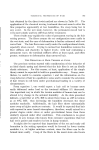
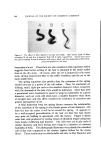
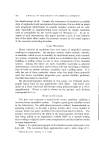
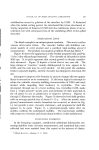
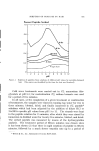
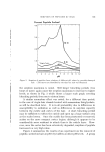
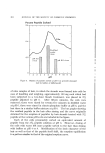
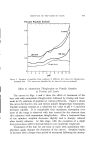
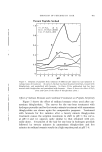
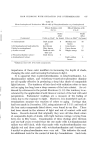
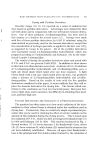
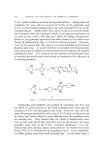
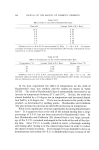
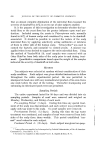
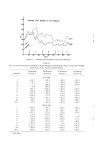
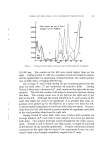
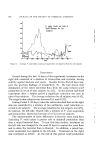
JOURNAL OF Till, SOCIETY OF COSMETIC CHEMISTS ß A B C Figure 6. The effect of fiber diameter on hair coil length. Itair tresses made of fibers averaging 70, 55 and 42/z in diameter from left to right, respectively. Tresses were set in pin curls averaging 16 mm in diameter with water, dried, and thcn suspended at 65% R.H., and photographed at one hour. formation of a set. These facts are also consistent with experience which suggests that better setting of the hair is obtained in the moist rather than in the dry state. Of course, after the set is imparted in the moist state, drying restores the fiber to the stiffer condition and the set to the more stable form. The spring equations also predict that the extension of the spring should increase as a power of the coil radius. Thus, for maximum set holding, small, tight pin curls or the smallest diameter rollers consistent with the demands of the hair style would be indicated. Since hair with a permanent wave treatment is easier to wrap in conformity to a given diameter, such set curls will often have a smaller diameter than those of straight hair, and this effect would favor resistance to extension and greater permanence of set. A final deduction from the spring theory concerns the relationship of the extension of the spring to the fourth power of hair diameter--the finer the hair the easier it will be to extend the spring. It appears to be a well-accepted generalization of the hair art that fine hair shows very poor set holding in agreement x•:ith the theory. Figure 6 shows some hair coils produced by setting tresses of identical length using hair from heads of differing hair fineness. The coils were set in pin curls of similar diameter and after drying were hung in a chamber at constant humidity of 65%. The photograph illustrates very plainly the extended coil of fine hair compared to the shorter, tighter helices for the coarse fibers. These results may be attributable not only to fiber diameter and

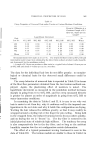
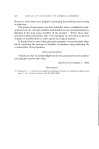
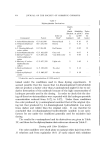
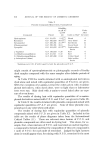
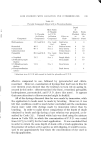
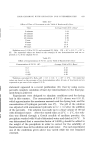
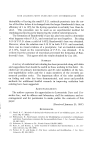
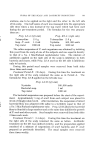
TORSIONAL I'ROl'ERTIES OF HAIR ,587 Table V The Effects of Fiber Diameter on Torsional Properties of Hair Fibers by Direct Twist Method Hair Lot S403 Hair Lot PF _ Fine Coarse Fine Coarse Cross section, cm 2 X 10 -6 31 Torsion modulus, dyne/cm '2 X 10 tø At 65% RH 0.96 Immersed in water 0.22 Creep at a couple of 3.1 dyne-cin in 5 minutes, turns/cm At 65% RH 0.025 Immersed in water 0.11 48 1 O1 0 25 00l 0 06 24 56 ß , . 26 O. 24 0 12 ß , . 0.05 to possible effects of torsional stiffness but to creep as a function of diameter. Some relevant data are shown in Table V. In the previous single fiber results the test fibers were sorted out so that hairs of similar diameter were used for measurement. In the present case fibers from the same head but differing in cross section were employed. The data show no real differences in modulus between coarse and fine fibers of the same lots. It should be recalled, however, that the modulus describes the property of a unit volume of substance a fine hair presents less material to resist stress and is therefore more easily deformable than a coarse fiber of the same modulus. The tendency for creep also seems to be influenced by fiber fineness. The precision of the results at 65% RH is not very high so that it is uncertain whether fine fibers really creep more under these conditions. Under moist conditions, however, the creep rate for fine fibers is clearly greater than for coarse, as shown in Table V. The lower intrinsic stiff- ness and the tendency for greater creep would be consistent with the poorer retention of set of fine hair. This appears to be the situation in practice with fine adult or children's hair. I)ISCUSSION AND CONCLUSION The presentation above has emphasized the existence and behavior of helical coils. From this one is led to attempt analysis of setting and styling behavior in terms of classical theory of mechanical springs. While the theory holds for ideal materials and circumstances the depar- ture from ideality does not appear to rule out the qualitative relations that the theory suggests. One of the implications of the spring theory is that torsional forces are important in the behavior of hair coils. Measurement of the tor-
Purchased for the exclusive use of nofirst nolast (unknown)
From: SCC Media Library & Resource Center (library.scconline.org)