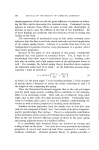
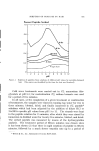
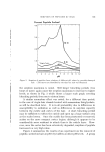
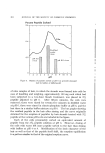
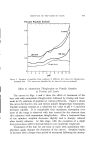
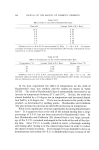
588 JOURNAL OF THE SOCIETY OF COSMETIC CHEMISTS sional properties of hair reveals the great influence of moisture in soften- ing the fiber and in increasing the torsional creep. Permanent waving appears to enhance these effects of water on hair and, surprisingly, to increase in many cases the stiffness of the hair at low humidities. All of these findings are consistent with the behavior of hair in setting and styling on the head. The observation of mechanical creep in hair under torsional stress indicates that the fiber is not truly elastic and rules out strict application of the simple spring theory. Indeed, it is certain that loss of the set configuration in practice involves creep phenomena to a greater extent than elastic properties. Because of the point of view adopted in this paper, considerable emphasis has been placed on torsional forces. Yet, it must be ac- knowledged that other types of mechanical forces, e.g., bending, come into play in reality and could explain some of the phenomena about as well. For example, the helical spring theory described above requires the deflection under load to be small. As the deflection becomes large, equation 1 must be altered to: (cos •' a sin •' a• /x = K'Pr% •, GI• q- EI ,I (4) in which a is the pitch angle, E is the bending modulus, I is the moment of inertia about a diameter or about the center (subscript p) and L is the length of wire composing the spring. Thus, the theoretical treatment suggests that as the coil gets longer and the pitch angle greater, bending forces contribute to the deforma- bility to an increasing extent. Hair coils are of relatively large pitch angle, and, as they relax, the angle increases further. Presumably also, creep in bending takes place so that for complete understanding the viscous as well as elastic properties in bending need elucidation. Another obvious departure from the simple view is that hair tress coils are not composed of single "wire" but consist of an array of approxi- mately parallel single fiber springs. There is a substantial contribution to the mechanics of the system of frictional forces between the individual fibers in the coil between different groups of fibers in the same spring and among adjacent tresses of a fin/shed coiffure. It is concluded that torsional forces are involved in waving and setting of hair on the head. New data have been presented on torsional properties of waved and unwaved hair fibers exposed to a variety of moisture conditions. Classical physical theory of springs provides a

TORSIONAL PROPERTIES OF HAIR 589 useful viewpoint for considering hair behavior since helical coil tresses are often found in both waving and setting. Predictions from the theory are in general agreement with the result of experience, although deviations from ideal elastic properties and from simple systems make quantitative comparisons impossible. AC}CNOWLE•)GMENT A number of ideas and techniques for dealing with the torsional properties of hair arose from discussion with Dr. Lyman Fourt. (Received October 24, 1966) REFERENCES (1) Poynting, J. H., Thomson, J. J., and Todd, G. U., A University Textbook of Physics, 14th Ed., Charles Guffen & Company, London, 1947. (2) Champion, F. C., and Davy, N., Properties of Matter, 3rd Ed., Blackie and Son, Ltd., London, 1959. (3) Meredith, R., Rigidity, moisture and fibre structure, .1. Textile Inst. Trans., 48, T163- T174 (June 1957) The torsional rigidity of textile fibers, Ibid., 45, T489-T503 (July 1954). (4) Pierce, F. T., The rigidity of cotton hairs, Ibid., 14, T1-T17 (1923) The plasticity of cotton and other materials, Ibid., 14, T390-T413 (1923). (5) Guthrie, J. C., Morton, D. H., and Oliver, P. H., An Investigation into bending and torsional rigidities of some fibres, Ibid., 45, T912-T929 (1954). (6) Lochner, J.P. A., Measurement of modulus and damping capacity in torsion and in bending for wool and other textile fibres, Ibid., 40, T220-T231 (1949). (7) Morton, W. E., and Permanyer, F., The measurement of torsional relaxation in textile fibres, Ibid., 38, T54-T59 (1947) Torque-twist relationships in single and multiple rayon filaments, Ibid., 40, T371-T380 (1949).
Purchased for the exclusive use of nofirst nolast (unknown)
From: SCC Media Library & Resource Center (library.scconline.org)